How to Play Carcassonne Maps: Deutschland
Hans im Glück, 999 Games · Board game · 2019What do you want to do now
Ask anything about Carcassonne Maps: Deutschland: rules, setup, components, complexity, price, or whether it fits your group.
Step by step
Game Objective
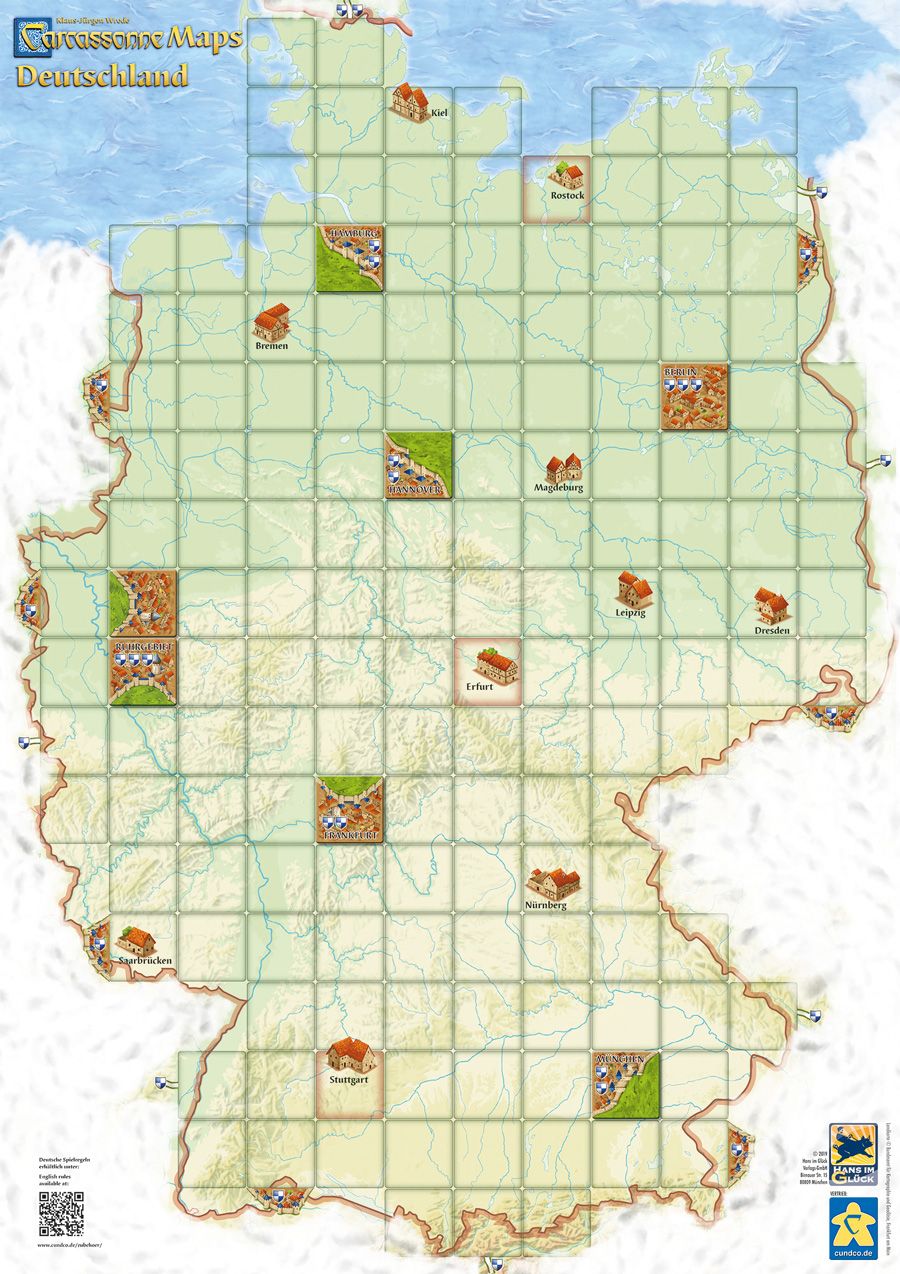
In Carcassonne Maps: Deutschland (Germany), players have the opportunity to experience Carcassonne in a new way, recreating different countries with their landscape tiles. The objective is to connect and complete cities, roads, fields, and monasteries on the pre-printed map of Germany, using the basic Carcassonne rules with some map-specific additions. Players score points by completing these features, and at the end of the game, the player with the most points wins.
Preparation (Setup)
- Separate the Carcassonne Map of Germany.
- Gather the landscape tiles. It is recommended to use tiles from the base game and the first and second expansions, ignoring the additional rules and meeples from those expansions (e.g., no goods, builders, pigs, etc. from the second expansion).
- Each player should have 9 meeples, instead of the usual 7 (+1 meeple on the scoring track).
- Identify the starting fields on the map. They are marked with a reddish border and contain a "Kleinstadt" (small city). It is recommended to play with at least 2 starting fields.
- Take the starting landscape tile (with the dark back) and 1 to 2 additional tiles selected randomly. Place them on 2 to 3 of the starting fields. Players can begin placing their tiles adjacent to these starting tiles.
- If you are playing only with the basic rules and without the Map-Chips expansion rules, ignore any additional elements printed on the map (such as wine bottles on the France map, colored stripes on the Iberia map, islands on the Benelux map, etc.). The general game rules remain the same, with some new rules added.
Game Flow
The game progresses with players taking their actions on their turns. The basic Carcassonne turn structure is maintained, with some additional map-specific rules. On each turn, a player must:
- Place a landscape tile: The player draws a landscape tile and places it on a pre-printed placement field on the map. The tile must be placed adjacent to an existing tile, following the usual rules for connecting features (cities with cities, roads with roads, fields with fields).
- Place a Meeple: After placing the tile, the player may choose to place one of their meeples on the newly placed tile, following the usual Carcassonne rules.
- Trigger a Score: If the tile placement completes a feature (city, road, monastery, or field), scoring is triggered. Meeples are removed and points are scored.
Actions and How to Play
Placing Landscape Tiles
- You can only place a tile on a pre-printed placement field.
- The tile must be placed (as usual) adjacent to an existing tile.
Large Cities (Großstädte)
- In fields with large city tiles already printed (e.g., Berlin, London, Paris, Amsterdam, or Barcelona), you cannot place tiles.
- As soon as you connect a tile to a large city tile, it is considered "connected." From that moment on, any player can place tiles on any open side of that large city tile.
Small Cities (Kleinstädte)
- Fields with small cities (fields with houses, such as Bremen, Bordeaux, Oxford, Strasbourg, Utrecht, Salamanca) count as normal fields. You can place a tile on them according to the normal rules.
- On some maps, they may have specific rules. Variants for them are found in the Variants section.
Border Fields with Adjacent City or Road
- Where roads and cities are printed on the edge of the map, you must place a compatible tile.
- Once a city or road on the border is connected with a compatible tile, in future turns, players can also place tiles on the adjacent fields.
Border Fields without Connection
- The edge of the map is considered "neutral." This means you can place any side of the tile (city, field, or road) adjacent to it, if there is no pre-printed road or city.
Ferry Connections (Fährverbindungen)
- If you have connected one side of a ferry connection with a road, any player can continue that connection with a road on the other side.
Placing a Meeple
- After placing the tile, you can place a meeple on it according to the usual rules.
- A coat of arms (Wappen) is worth 2 additional points in scoring, regardless of whether it is on a road or city.
End of Game and Scoring
End Game Trigger
Refer to the manual for details on this section.
Scoring
Scoring is triggered when a feature is completed. The scoring rules are as follows:
- Large Cities: If you complete a large city, you score according to the usual rules. The pre-printed large city tiles count as normal parts of the city. The printed coats of arms give additional points to the city owner.
- Example: Berlin is completed. As the owner, you receive 20 points (6 tiles + 4 coats of arms, which are worth 2 points each).
- Border Fields with Adjacent Road or City:
- Roads that exit the board are completed there. If a pre-printed road or city is part of a score, you count it as a normal tile. The owner receives additional points for the coats of arms.
- Example: Your road is completed (ends in Denmark). You receive 8 points (4 points for 4 roads and 4 points for the two coats of arms).
- Example: Your city (half) is completed by the border. You receive 2 points.
- Roads that exit the board are completed there. If a pre-printed road or city is part of a score, you count it as a normal tile. The owner receives additional points for the coats of arms.
- Border Fields without Connection: A city, road, or field that is on the border (next to clouds or the sea) is considered completed there. You score it according to the normal rules.
- Ferry Connections: A ferry connection is worth 1 point for the road plus the coats of arms that are on that connection. These points are only counted when the road with the ferry connection is completed.
- Example: The road with the ferry is completed. You receive 7 points (3 points for 3 roads and 4 points for 2 coats of arms).
- Monastery in Border Fields: A monastery on the edge of the map does not need 8 adjacent tiles to be scored. Only the adjacent placement fields (including diagonal ones) need to be filled with tiles. In such a monastery scoring, only these tiles bring points (pre-printed large city tiles also count).
- Example: You score your monastery on the border. It brings 6 points (1 point for the monastery and 1 point for each adjacent tile).
Final Scoring (Schlusswertung)
- As in the base game, city tiles and coats of arms in uncompleted cities count only 1 point.
- On open roads that end in neighboring countries, coats of arms also count only 1 point.
- Example: The open road earns you 4 points (3 points for the road and 1 point for the coat of arms).
Tips for Winning
- Take Advantage of Large Cities: The pre-printed large cities can be a significant source of points, especially with the coats of arms. Try to connect your features to them to benefit from their high scoring.
- Strategy with Borders: Borders offer flexibility. In border fields without connection, you can place any side of the tile, which can be useful for completing your features or blocking opponents. Use the borders to complete roads and cities more easily, as they are considered complete when they reach the edge.
- Consider Small City Variants: If you are using the variants for small cities, adapt your strategy.
- If covering a small city gives you an extra turn, prioritize these placements to maximize your actions.
- If covering a small city costs 2 minus points, avoid them unless strictly necessary or the benefit of the placement outweighs the point loss.
- If visible small cities adjacent to a road give 2 extra points, try to build roads near them to increase your score.
Rules manual
Official PDF file
Frequently Asked Questions
Quick answers about the rules
What is the objective of Carcassonne Maps: Deutschland?
How do you set up Carcassonne Maps: Deutschland?
How do you play Carcassonne Maps: Deutschland?
How does Carcassonne Maps: Deutschland end, and how do you score?
What are some tips for winning Carcassonne Maps: Deutschland?
Expansion for
Published additional content