How to Play Carcassonne: The Plague
W. Nostheide Verlag GmbH · Board game · 2010What do you want to do now
Ask anything about Carcassonne: The Plague: rules, setup, components, complexity, price, or whether it fits your group.
Step by step
Game Objective
In this variant of Carcassonne, the Plague spreads across the land, increasing the importance of connections between terrain tiles. The objective is to accumulate points, preventing your Followers from being removed by the Plague and, if possible, directing the outbreak towards your opponents to gain points for the infections you avoided. The Plague starts from six Outbreak tiles, and once an Outbreak enters play, each player must spread it on their turn. Followers on infected tiles are removed without scoring. Players can also try to escape the Plague by moving their Followers within the same road, field, or city. As the game progresses, players can ward off Outbreaks, preventing the Plague from spreading in certain areas.
Preparation (Setup)
- Place the starting tile face up.
- Count 17 of the 71 base game terrain tiles and shuffle them. These tiles must be drawn first.
- Add the 6 new Plague tiles to the rest of the tiles and shuffle them as well.
- Place the Flea tokens next to the playing area.
Components
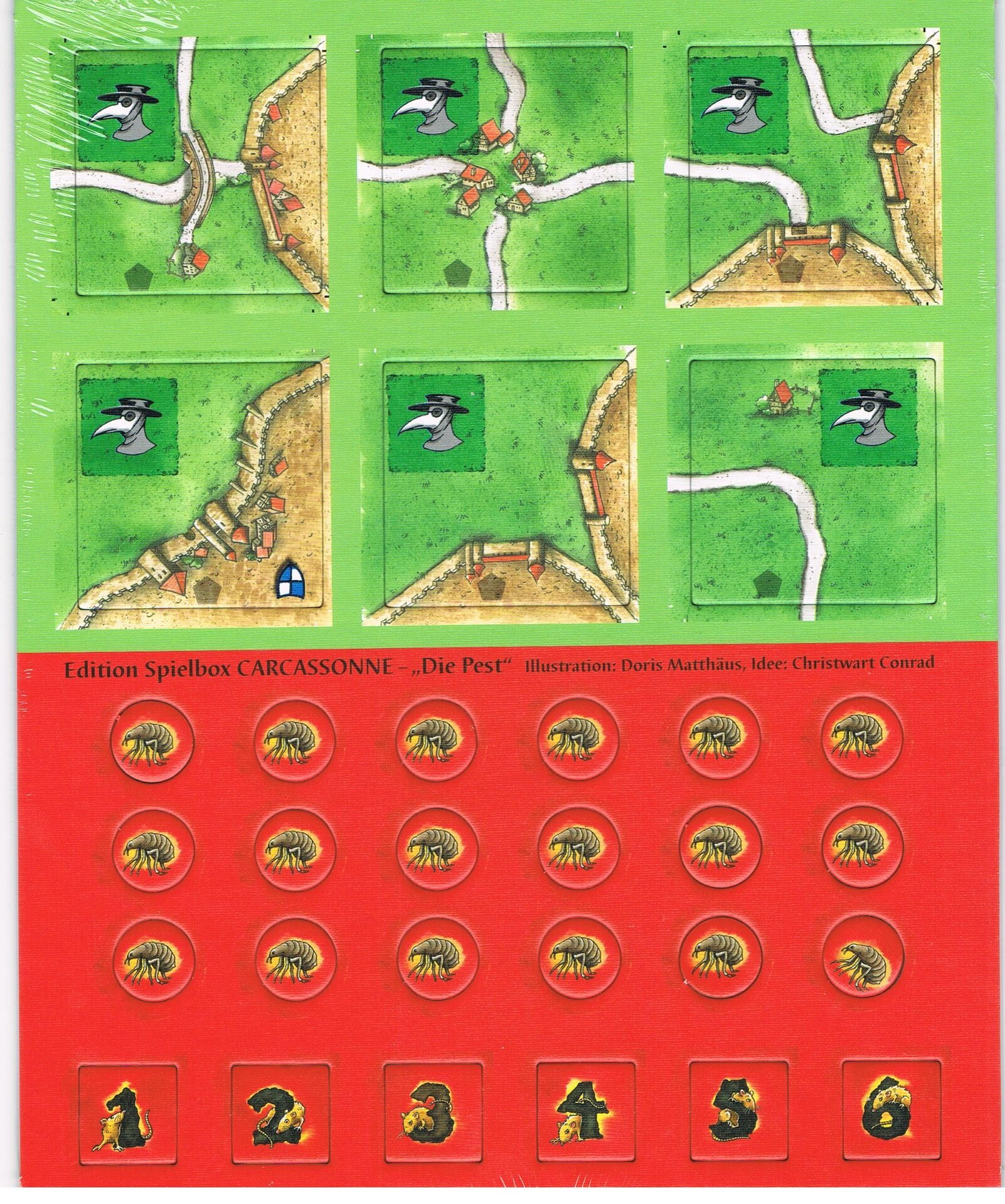
- 6 terrain tiles with a Plague symbol, where the Plague can emerge ("Plague tiles").
- 6 square Outbreaks:
- Front (number with rat): "Active Outbreak", numbered 1 to 6.
- Back (field): "Plague avoided".
- 18 round Flea tokens (Fleas), which show where the Plague is active:
- Bright red side: active.
- Pale red side: latent/inactive.
Definitions
- A Plague tile with an active Outbreak and all adjacent bright red Fleas constitute an active Plague region. An active Outbreak without adjacent Fleas also counts as an active Plague region.
- Adjacent pale red Fleas constitute a latent Plague region.
- A Plague tile with a passive Outbreak (field) is safe from the Plague. It can never be part of a Plague area.
Game Flow
Refer to the manual for details on this section.
Actions and How to Play
The First Outbreak Appears
As soon as a player draws the first Plague tile and places it according to the usual rules, an active Plague region is created, and the Plague begins to spread from it. Outbreak 1 is placed on the Plague symbol on the tile, front side up. Players who place Outbreaks cannot place a Follower that turn. Outbreaks never divide fields.
Spreading the Plague
Once the first Outbreak has appeared, the Plague spreads on each subsequent turn (if possible). Starting with the player to the left of the person who placed the first Plague tile, the active player must draw a Flea from the supply and place it, active side up, on a terrain tile that is orthogonally (not diagonally) adjacent to the Outbreak and does not yet contain a Flea. As the game progresses, players can also place Fleas on tiles that are adjacent to other active Fleas. If a Flea is placed on a tile containing one or more Followers, they are returned to their owner without scoring. The active player decides at what point in their turn to spread the Plague. Flea tokens can never be placed on Outbreaks.
The Plague Rises Again
When another Plague tile is drawn and placed, the Outbreak with the lowest available number is placed on it. The Plague will now also spread from here. A player who places a Plague tile does not place a Flea on the same tile (after all, they had the privilege of choosing where the Outbreak would occur). From this point on, each active player can choose which of the active Plague regions to expand.
Escape
After the Plague has broken out, each player can (at a time of their choice during their turn) also help one (never more) of their Followers to flee. The Follower is moved any number of tiles, but must remain within the same city, field, or road. A fleeing Thief cannot cross a crossroads or a branching intersection. A fleeing Farmer can flee by passing under a bridge, but cannot cross any roads and, of course, cannot move to a different field. Monks in Monasteries can never escape. Players cannot flee to or through a tile containing a Flea (whether active or inactive) or an active Outbreak (number with rat). Players can move to tiles that already contain a Follower. Obviously, players can never cross an area that does not yet contain a tile.
Eliminating an Outbreak
Once no Fleas remain in the supply at the start of a player's turn, the Outbreak with the lowest visible number is eliminated – that is, it is flipped to show the Field. (Exception: Once the first Plague tile has appeared, there must always be at least one active region, so at least one Outbreak must always be active). From now on, this area is an "inactive" Plague region. All adjacent Fleas are flipped to their latent side. From now on, players draw Fleas from an inactive Plague region instead of the supply.
Eliminating More Outbreaks
Once no inactive Fleas remain to be moved at the start of a player's turn, another Outbreak is eliminated (always the one with the lowest visible number).
Flea Movement and Inactivation
A player can also choose to move a Flea that will divide the remaining Fleas into separate swarms. An active Flea with no connection to an active Outbreak is immediately flipped to its passive side: Fleas with no connection to an active Outbreak are always inactive.
Contiguous Plague Regions
It is entirely possible for two or more Plague regions to merge. When multiple Outbreaks are connected to the same region, all but the one with the highest number are flipped. Any inactive Fleas that are connected to an area with an active Outbreak are flipped back to their active side. Thus, Fleas that have become inactive can also be flipped back to active. Separation can also lead to inactive areas within a region, so Fleas must be flipped to their latent side. Outbreaks that have been eliminated can never become active again. Tiles with Outbreaks flipped to the field side remain protected from the Plague until the end of the game. Fleas can never be placed on Outbreaks. Once the Plague has been eliminated from a tile with a former Outbreak, players are always protected from infection in that space.
Special Case of Flea Movement
If all 18 Fleas are part of a Plague region, a player draws one of them and places it on another tile that must, of course, border an active Plague region. Even in this situation, movement is mandatory: The player must move a Flea to another tile.
Inactivation of Old Plague Region
If, later, another Outbreak appears in a disconnected area, the old Plague region becomes inactive. The Outbreak is flipped to show the field, and all 18 active Fleas from the old Plague region are flipped to their latent side.
End of Game and Scoring
Infected areas do not affect scoring, as long as Followers are not affected.
Refer to the manual for details on this section.
Tips for Winning
- Try to direct the Plague outbreak towards your opponents to gain points for the infections you avoided.
- Use the escape ability to move your Followers out of infected tiles, keeping them safe and allowing them to score at the end of the game.
- Connect Plague regions to manipulate which Outbreaks remain active and which are eliminated, aiming to protect your own areas and expose those of your opponents.
Rules manual
Official PDF file
Frequently Asked Questions
Quick answers about the rules
What is the objective of Carcassonne: The Plague?
How do you set up Carcassonne: The Plague?
How do you play Carcassonne: The Plague?
How does Carcassonne: The Plague end, and how do you score?
What are some tips for winning Carcassonne: The Plague?
Expansion for
Published additional content