
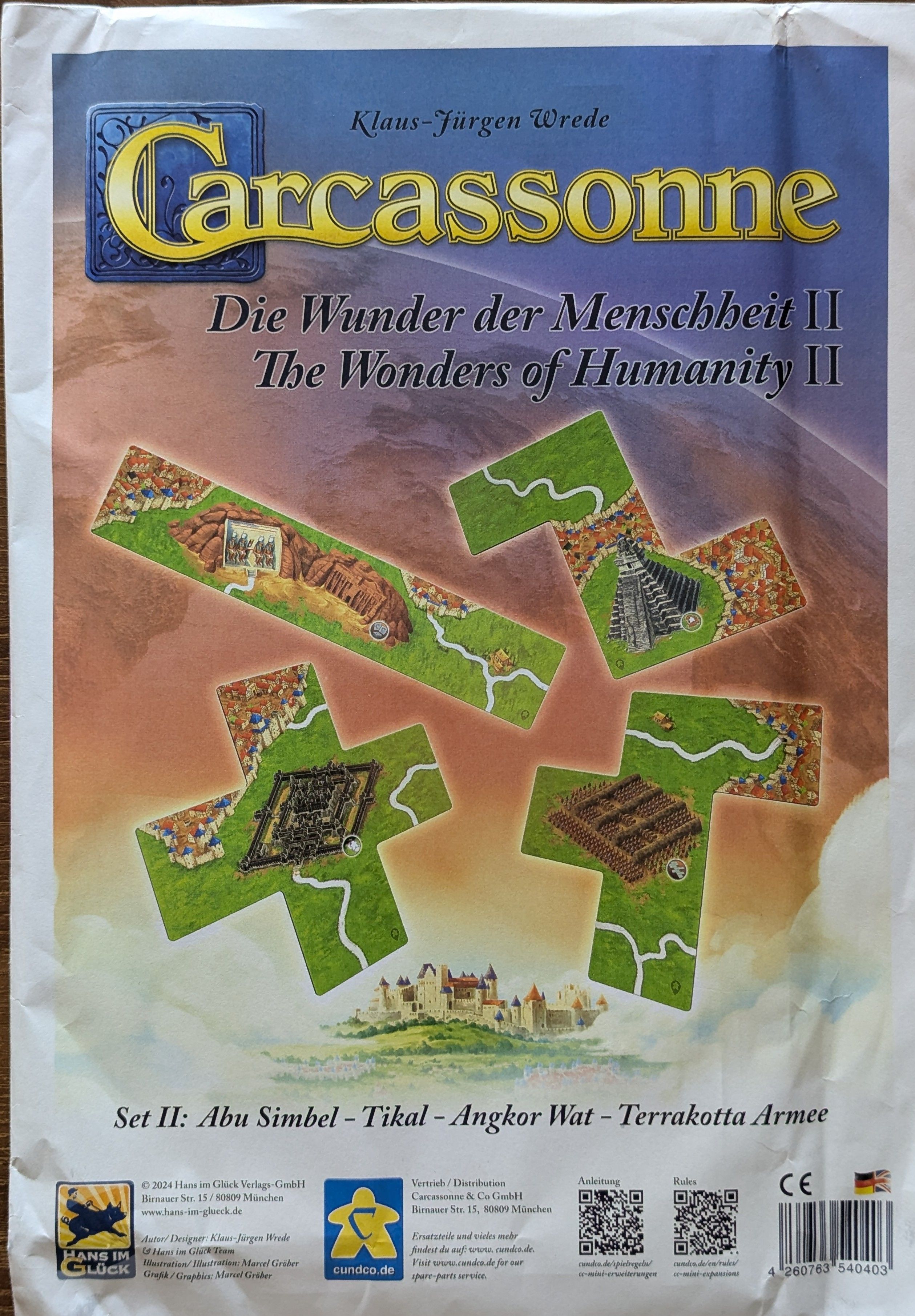
Carcassonne: The Wonders of Humanity Set II
Hans im Glück, 999 Games · Board game · 2024
2–4
—
—
rating
Ludopedia
7.9
rating
BGG
—
rating
Ludopedia
7.9
rating
BGG
Our Verdict
RECOMMENDED
If you love Carcassonne and crave extra challenge, this expansion brings new wonders and a fresh scoring twist.
Highlights
- Wonders add strategic depth
- Scoring twist keeps game fresh
- Integrates seamlessly with base game
- Variety of new components
Keep in mind
- Complex scoring requires care
- Game length may increase
Rules manual not indexed yet
Upload the PDF rulebook to ask questions about this game with AI.
About the game
What you do in a play session
Carcassonne: The Wonders of Humanity Set II is the second installment in the line of expansions that bring the Wonders of Humanity to the classic tile‑placement game. Released in 2024, it adds four new wonders – Abu Simbel, Tikal, Angkor Wat, and the Terracotta Army – each with its own scoring rule. The core mechanics stay true to the original: players continue placing terrain tiles, positioning meeples, and building cities, roads, and fields, but now there’s an extra step at the end of the game. First, the wonders are evaluated: each one awards points according to its design, and unlike the first expansion, each wonder tile counts as five normal tiles. This means roads and cities can span more than one tile, requiring extra care when tallying points. After this initial calculation, the standard scoring proceeds, with points for completed cities, roads, fields, and hidden meeples.
The expansion works as a direct add‑on to the base game, without requiring any complex new rules. It increases strategic variety, as the presence of wonders changes tile‑placement dynamics and resource competition. Game length tends to rise, especially when players experiment with different wonder combinations. For fans of Carcassonne’s blend of simplicity and depth, Set II offers an extra layer of challenge while preserving the game’s core essence. If you enjoy expanding your Carcassonne repertoire, this expansion is a solid choice, though it does demand a bit more attention to scoring.
The expansion works as a direct add‑on to the base game, without requiring any complex new rules. It increases strategic variety, as the presence of wonders changes tile‑placement dynamics and resource competition. Game length tends to rise, especially when players experiment with different wonder combinations. For fans of Carcassonne’s blend of simplicity and depth, Set II offers an extra layer of challenge while preserving the game’s core essence. If you enjoy expanding your Carcassonne repertoire, this expansion is a solid choice, though it does demand a bit more attention to scoring.
Expansion for
Published additional content

Gallery
Box and component photos
Tap any photo to open fullscreen. Photos submitted by the community or publisher.
Best player count
BGG community vote
2
OK
3
OK
4
OK
Soundtrack
Ambience suggested by Melodice
Loading playlist...
Where to Buy
Prices monitored daily
Finding best prices...
Prices unavailable at this time.
Price history — last 6 months (lowest new offer)
Alert enabled!
Join the BoardGamesBot deals group
Get the best board game deals every day — without message spam.
Join the WhatsApp groupGame details
Mechanics, categories, families and credits
Categories
Families
Publisher
Hans im Glück, 999 Games
Designer
Klaus-Jürgen Wrede
Artist
Marcel Gröber
Community
Data from BoardGameGeek
Frequently Asked Questions
Quick answers before you buy
What is the approximate game duration?
It varies with wonder combinations but typically ranges from 30 to 45 minutes.
How many players can play?
2 to 4 players.
What is the game’s complexity?
Medium; the core mechanics stay the same, but wonder scoring requires extra attention.
What components are included?
Terrain tiles, wonder pieces (each equivalent to five normal tiles), meeples, and scoring markers.
Who is this expansion for?
Fans of Carcassonne who want more variety and strategic challenge.
Do I need the base game to play?
Yes, the expansion integrates with the base game and cannot be played alone.
How does wonder scoring work?
First, each wonder is scored according to its rules, treating each tile as five normal tiles; then the standard scoring proceeds.
