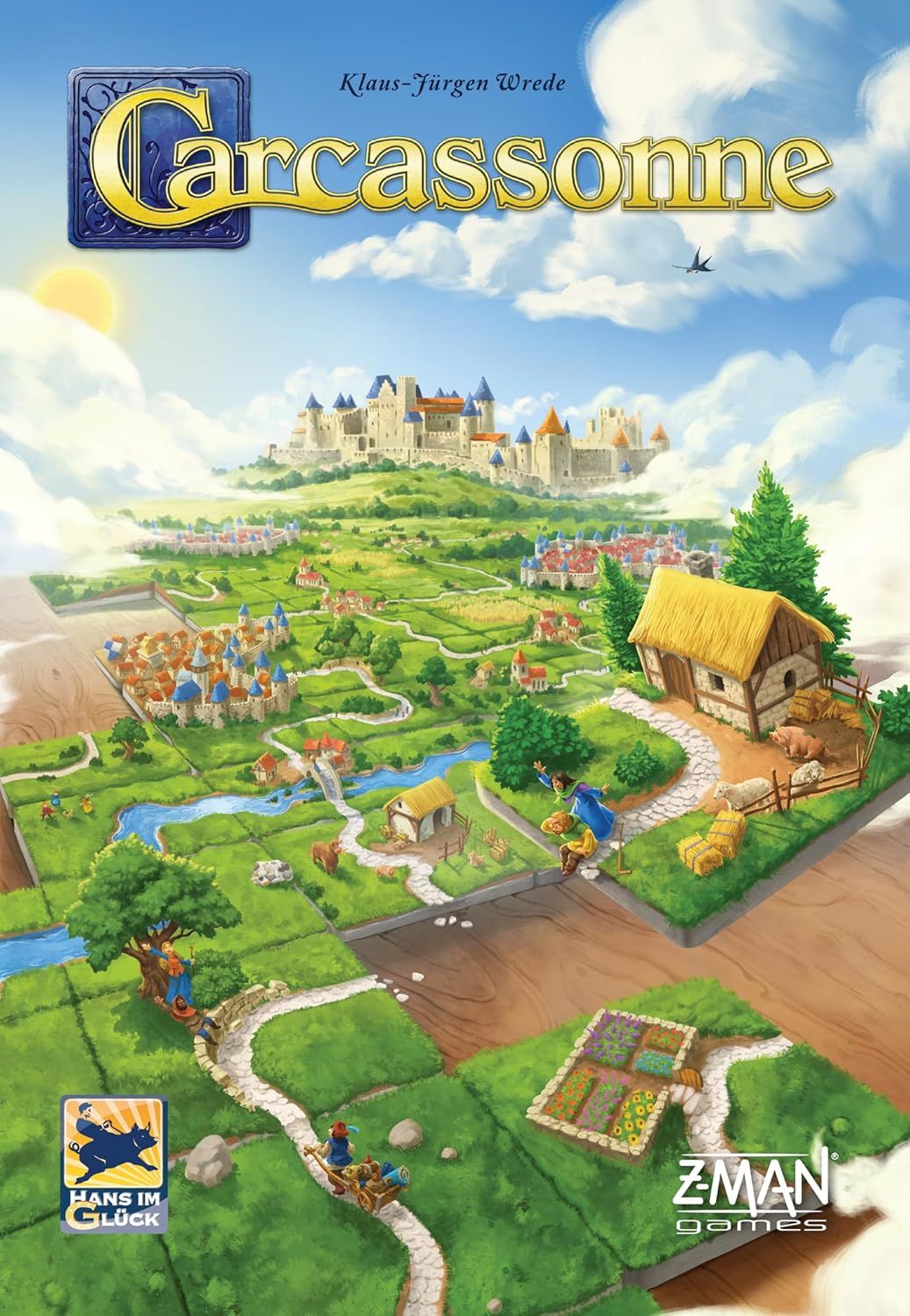
How to Play Carcassonne: The Wonders of Humanity
999 Games, Hans im Glück · Board game · 2023What do you want to do now
Ask anything about Carcassonne: The Wonders of Humanity: rules, setup, components, complexity, price, or whether it fits your group.
Video: How to Play
Start here, then follow the written guide
Step by step
Game Objective
In "Carcassonne: The Wonders of Humanity," players are building the landscape around Carcassonne, as in the base game, but now with the addition of Wonders of Humanity. Each Wonder offers individual advantages that can only be used once per game. The goal is to acquire the desired Wonder quickly to benefit from it as much as possible and thus accumulate more points than the other players.
Preparation (Setup)
This mini-expansion was developed for the Carcassonne base game, and its rules still apply. It is recommended to play with at least 90 tiles and an additional meeple (e.g., base game + 1st expansion).
- Each player takes all 9 meeples of one color.
- Place 2 meeples of each color next to space 10 of the scoring track. (One of these two meeples is only used to mark your Wonder. You can use the large meeple from the 1st expansion or any other token of that color).
- Place a scoring meeple as usual on space 0 of the scoring track. You start the game with 6 meeples in your supply.
- Choose 1 Wonder tile per player. You can combine Wonders from different sets. Place them face up next to the scoring track. Discard the remaining tiles; you will not need them for this game. (Alternatively, you can prepare as many Wonders as you like to have a larger selection and choose the right Wonder later in the game).
Components:
- 4 Wonder tiles with the Wonders of Humanity (Set I): Angkor Wat, Terracotta Army, Tikal, Abu Simbel.
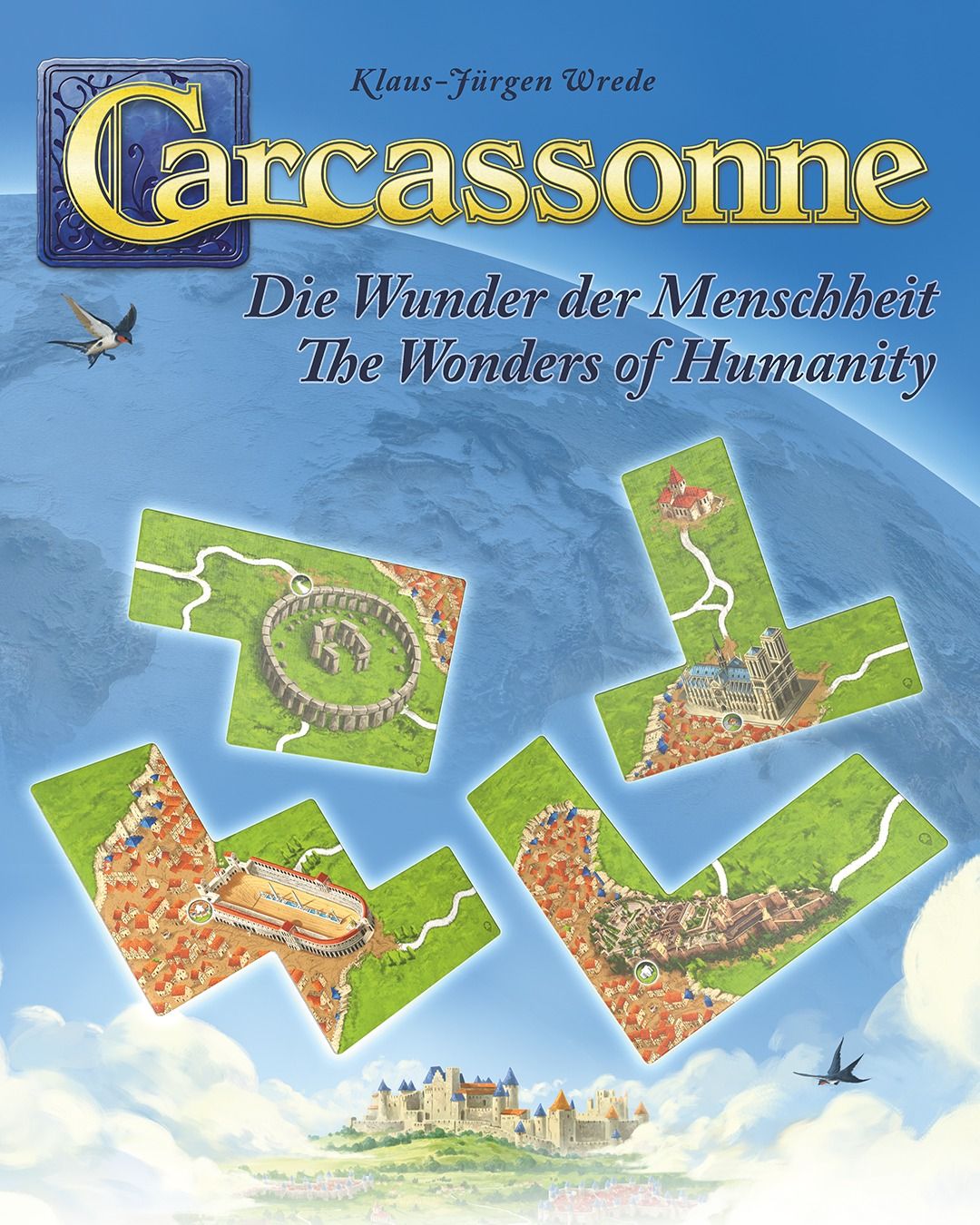
- 4 Wonder tiles with the Wonders of Humanity (Set II): Circus Maximus, Alhambra, Stonehenge, Notre Dame.
Note: All Wonder tiles count as 5 connected normal tiles.
Game Flow
The game proceeds according to the Carcassonne base game rules. The main addition is how to acquire and use the Wonders:
Acquiring a Wonder Tile
There is one Wonder for each player, so you can acquire a Wonder tile only once. When your scoring meeple reaches or exceeds the space with the meeple pairs (the first time that space is 10), you perform the following steps, one after the other:
- Choose one of the Wonder tiles and place it in front of you. You do not place it on the game board yet.
- Take your two meeples that are next to the scoring track and place them in your supply.
Special case: If multiple players reach the space with the meeple pairs in the same turn, the person whose turn it is chooses which of them will take a Wonder tile. After that, the meeple pairs are moved 5 spaces forward as usual. If there are still scoring meeples from other players (who have not yet taken a Wonder) on or behind the meeple pair space, the person whose turn it is decides again who will take the next Wonder, and so on.
Actions and How to Play
The basic Carcassonne actions remain the same. The additional actions related to the Wonders are:
1. Placing a Wonder Tile
If there is a Wonder tile in front of you, you do not draw a tile, but instead, place your Wonder according to the usual placement rules. Once you have placed it, you must mark your Wonder with one of the 2 meeples you previously unlocked, by placing it in the center of the Wonder (not on a city, road, or field). The marker meeple remains there until the end of the game. For better distinction from other meeples, you can place the marker meeple upside down.
Note: In very rare cases where you cannot place the Wonder correctly, you draw a tile which must be immediately placed so that you can then place your Wonder tile next to it. If this is also not possible, the normal tile is removed from the game, and you draw another tile and place it, until you can place your Wonder tile. You do not place a meeple on the additionally drawn tile.
2. Placing Meeple on a Wonder Tile
After you have placed and marked your Wonder, you can immediately place up to 2 meeples on different unoccupied areas (city, road, monastery, or field) of this Wonder. You can also place only one or no meeple. If you place 2 meeples, they can also be placed on the same square of the tile.
3. Scoring with your Wonder
Move all remaining meeples next to the scoring track 5 spaces forward (i.e., the first time next to field 15, then 20, and then 25). Attention: You should never move the meeple pairs beyond space 25, even if there are more than 4 players. The meeples remain on field 25 until they are reached by all other scoring meeples.
Each Wonder has its own function that can earn points. Some Wonders give points during the game, while others give points at the end of the game.
Scoring during the game:
- Notre Dame: During the game (not on the turn you place Notre Dame), if you place a meeple on one of the 8 tiles surrounding a monastery, you immediately score 3 points. It is irrelevant whether there is a monk in this monastery or not. Even if several monasteries are adjacent to the tile, you will receive "only" 3 points.
- Stonehenge: If you complete one or more occupied roads during your turn (not when playing the Stonehenge tile itself), you immediately score 3 points for each road you complete (even if you do not have a meeple on the road). After that, you score the road as usual.
- Abu Simbel: When it is your turn, you can choose between 2 tiles. The first time, you draw 2 tiles. You choose one and place it as usual. Place the other face down in front of you for a later turn. When it is your turn again, you draw another tile and choose between 2 tiles again, and so on. If there are no more tiles for you to draw at the end of the game, place the one in front of you. If your unchosen tile is the last one of the game, it goes to the next player for the last turn.
Scoring at the end of the game:
- Circus Maximus: At the end of the game, depending on the number of players, you will receive points for each meeple of another color in still open cities: 2 players: 4 points; 3-4 players: 3 points; 5+ players: 2 points.
- Tikal: If a city is scored that has at least 3 tiles and you have at least one meeple in it, you receive 2 points for each of your own meeples in a city on the game board. The following applies: You do not need to have the majority in the scored city. The meeple in the scored city also scores 2 points.
- Alhambra: At the end of the game, you score 5 points for each of your farmers, regardless of how many points that farmer scores. If you play with at least 120 tiles, you gain 6 points. It is not relevant if it is your own farmer, the field itself scores the points.
- Angkor Wat: For each road (open or closed) that is at least 5 tiles long, you receive 5 points at the end of the game. It does not matter if the roads have already been scored or are still open, if there are meeples on them or not.
- Terracotta Army: You receive 2 points for every at least 7 tiles that are in a row or column on the board at the end of the game. The following applies: You can score identical tiles for the column and for the row. Each column and row is scored only once.
End of Game and Scoring
The game ends when the last tile is placed, as in the base game. At the end of the game, scoring is done as follows:
- First, score the Wonders that score at the end of the game (Circus Maximus, Tikal, Alhambra, Angkor Wat, Terracotta Army).
- After that, continue with the normal base game final scoring.
Important: Each Wonder tile counts as 5 individual normal tiles. Consequently, roads and cities can consist of more than one tile. You must take this into account during scoring.
Wonder-Specific Scoring Criteria at End of Game:
- Circus Maximus: Points for each meeple of another color in still open cities (4 points for 2 players, 3 points for 3-4 players, 2 points for 5+ players).
- Tikal: 2 points for each of your own meeples in a city on the game board, if a city with at least 3 tiles is scored and you have at least one meeple in it.
- Alhambra: 5 points for each of your farmers (6 points if playing with at least 120 tiles).
- Angkor Wat: 5 points for each road (open or closed) at least 5 tiles long.
- Terracotta Army: 2 points for each row or column with at least 7 adjacent tiles without gaps.
The player with the most points at the end of the game is the winner.
Tips for Winning
- Choose your Wonder wisely and quickly: Wonders offer unique advantages. Acquiring the Wonder that best aligns with your strategy or the current game situation can be crucial. For example, if you plan to build many monasteries, Notre Dame might be a good choice.
- Plan your Wonder placement: Remember that your Wonder tile counts as 5 connected normal tiles. Use this to your advantage to connect or complete large features, or to block opponents.
- Maximize your Wonder's benefits: Once you have a Wonder, try to use it as much as possible. For example, with Abu Simbel, managing your extra tiles to always have a good option is key. With Stonehenge, look for opportunities to complete roads, even opponents', to gain extra points.
Rules manual
Official PDF file
Frequently Asked Questions
Quick answers about the rules
What is the objective of Carcassonne: The Wonders of Humanity?
How do you set up Carcassonne: The Wonders of Humanity?
How do you play Carcassonne: The Wonders of Humanity?
How does Carcassonne: The Wonders of Humanity end, and how do you score?
What are some tips for winning Carcassonne: The Wonders of Humanity?
Expansion for
Published additional content