How to Play Codenames: Pictures
Czech Games Edition (CGE), Boardgame Space, Brain Games · Board game · 2016What do you want to do now
Ask anything about Codenames: Pictures: rules, setup, components, complexity, price, or whether it fits your group.
Video: How to Play
Start here, then follow the written guide
Step by step
How to Play Codenames: Pictures
Welcome, secret agents, to the thrilling world of Codenames: Pictures! Get ready to put your deductive skills and creative thinking to the test in this exciting game of hidden identities and clever clues. As an editor at BoardGameBot, I'm here to guide you through the ins and outs of becoming a master spymaster or a sharp-witted operative. Let's dive in!
Objective of the Game
In Codenames: Pictures, two rival spy organizations are trying to make contact with their secret agents. Your goal is to be the first team to identify all of your team's agents among a grid of seemingly random pictures. Only your spymaster knows who is hiding where, and they'll be giving one-word clues to guide you. But be careful! Guessing an innocent bystander will end your turn, guessing an opposing agent helps the other team, and guessing the dreaded assassin means immediate defeat! Work together, think creatively, and outsmart your opponents to claim victory!
Preparation (Setup)
Getting ready for a game of Codenames: Pictures is quick and easy. Follow these steps to set up your mission:
- Split into 2 Teams: Organize players into two teams of roughly the same size, with at least two players on each team.
- Choose Spymasters and Operatives: Each team selects one player to be their spymaster. The remaining players are operatives. The orange and purple spymasters should sit on the same side of the table, opposite their own operatives.
- Lay Out 20 Random Pictures: Mix up the picture cards, choose 20 at random, and lay them out in a 5x4 grid. Ensure all cards are oriented the same way. Choose the orientation that best fits your group.
- Spymasters Draw a Random Key Card: Spymasters secretly choose one key card randomly from the deck. This card reveals the secret identities of the 20 pictures. Slide it into the stand between the spymasters, oriented the same as the 5x4 grid of pictures. Only the spymasters see the key card!
- Spymasters Take the Tiles: The orange spymaster takes the 7 orange agent tiles, and the purple spymaster takes the 7 purple agent tiles. Place the 4 bystander tiles and 1 assassin tile in between the spymasters.
- Give the Double Agent to the Starting Team: The triangles on the top and bottom of the key card indicate which team starts. The starting team has one additional picture to guess. Flip the double agent tile to their color and add it to their agent tiles.
The Turn of Play
Teams take turns, starting with the team indicated by the key card. Turns continue until one team wins. Here's how a turn unfolds:
- The Spymaster Gives One Clue:
- If you are the spymaster, your turn begins by trying to find a clue for one or more pictures in your team’s color. More is better!
- Your clue must be 1 word and 1 number. For example, "evolution: 2" could be a good clue for two related pictures.
- The word must be related to the pictures you want to give a clue for.
- The number tells your operatives how many pictures your clue relates to.
- Spymaster Etiquette: Spymasters must keep a straight face and give away no more information than the one word and one number. Do not preface your clue with additional comments or react to your operatives' discussions.
- The Operatives May Make Multiple Guesses:
- The operatives should take a moment to discuss the clue.
- Then, one of the operatives must make a guess by touching one of the cards.
- The spymaster covers the picture with a tile matching the color shown on the key card.
- If you guess a picture in your own color: You may guess again. (You get another guess, not another clue.)
- The "Plus One" Rule: As long as operatives keep guessing pictures of their own color, they are allowed to guess one more card than the number specified by the clue. So for "glass: 3", operatives can make up to 4 guesses. This extra guess can be used to guess a picture missed from a previous turn's clue.
- Operative Etiquette: Operatives should focus on the table when making guesses and avoid eye contact with the spymaster to prevent nonverbal cues.
- When Your Turn Ends: Your turn can end in one of three ways:
- You Choose to End Your Turn: If your turn does not end with a wrong guess, you can end it voluntarily. For example, if you were given "glass: 3" and found 2 good pictures, but guessing a third seems too risky, you can end your turn after 2 (or even 1) correct guesses. You are required to make at least 1 guess.
- A Wrong Guess Ends Your Turn:
- If you guess an innocent bystander, your turn ends.
- If you guess the other team’s picture, your turn ends, and you have helped the other team!
- If you guess the assassin, you immediately lose the game!
- You Use the "Plus One" Rule: If you've made all your allowed guesses (including the "plus one" if applicable) and correctly identified all intended pictures, your turn ends.
- Other Team's Turn: When your turn ends, it is the other team's turn.
Expert Rules (Optional)
- Unlimited Clue: Instead of a number, you can say your clue is "unlimited" (e.g., "tiny: unlimited"). This allows your operatives to make as many guesses as they want, as long as they keep guessing right.
- Zero Clue: A clue like "reptiles: 0" also allows unlimited guesses (ignoring the "plus one" rule). This means "Don't guess the picture (or pictures) related to reptiles." This can be a clever way to guide your team towards other cards by eliminating certain options.
End of Game and Scoring
The game continues with teams taking turns until one team wins. Here's how to achieve victory:
- Win by Guessing All Your Agents: When your team has no pictures left to guess (meaning you've covered all your agents with your team's color tiles), your team wins! This often happens by guessing your last picture on your turn.
- Win by Opponent's Mistake: You can also win if the other team accidentally guesses your last picture on their turn.
- Win by Assassin: You immediately win if the other team guesses the assassin.
Tips for Winning
To become a top-tier spymaster or an elite operative, keep these tips in mind:
- Spymasters: Balance Risk and Reward with Clues: While giving a clue for one picture can be simple, try to find creative clues that link multiple pictures of your color. However, don't overdo it! A clue that is too abstract or ambiguous can lead your operatives astray and potentially cost you the game by hitting an innocent bystander, an opponent's agent, or worse, the assassin. Aim for 2-3 pictures per clue for a good balance.
- Operatives: Discuss and Analyze Thoroughly: Don't rush your guesses! Take your time to discuss the spymaster's clue with your teammates. Consider all possible interpretations of the word and how it might relate to the pictures on the grid. Remember, you can guess pictures from previous clues, so keep those in mind as well.
- Spymasters: Embrace Wordplay (Carefully): In Codenames: Pictures, all wordplay is allowed! You can use "knight" to lead your teammates to a picture with a moon and a picture with a person in armor. This can be a powerful tool for connecting disparate images, but ensure your operatives are on the same wavelength. If there's any doubt about a clue being a single word, ask the opposing spymaster for clarification.
You now know the rules! Go forth and play Codenames: Pictures!
More videos
More rules explanations from the community
In English
-
 Codenames: Pictures - How to Play (Skip the Rulebook)
-
 Quick look at Codenames & Codenames Pictures
-
 CODENAMES Pictures: Official How to Play Video
-
 CODENAMES PICTURES Quick Overview
-
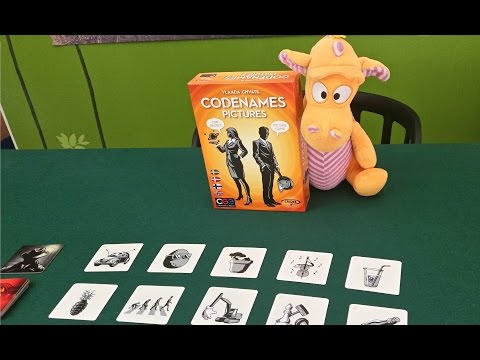 Codenames Pictures - Gameplay Runthrough
-
 How To Play CodeNames Pictures
-
 How To Play in Under 3 Minutes
-
 Spiel doch mal...! FIRST LOOK - Prototyp - CODENAMES PICTURES (EN)
Rules manual
Official PDF file
Frequently Asked Questions
Quick answers about the rules
What is the objective of Codenames: Pictures?
How do you set up Codenames: Pictures?
How do you play Codenames: Pictures?
How does Codenames: Pictures end, and how do you score?
What are some tips for winning Codenames: Pictures?
Expansions
Published additional content


Other Games You'll Like
Based on mechanics and theme