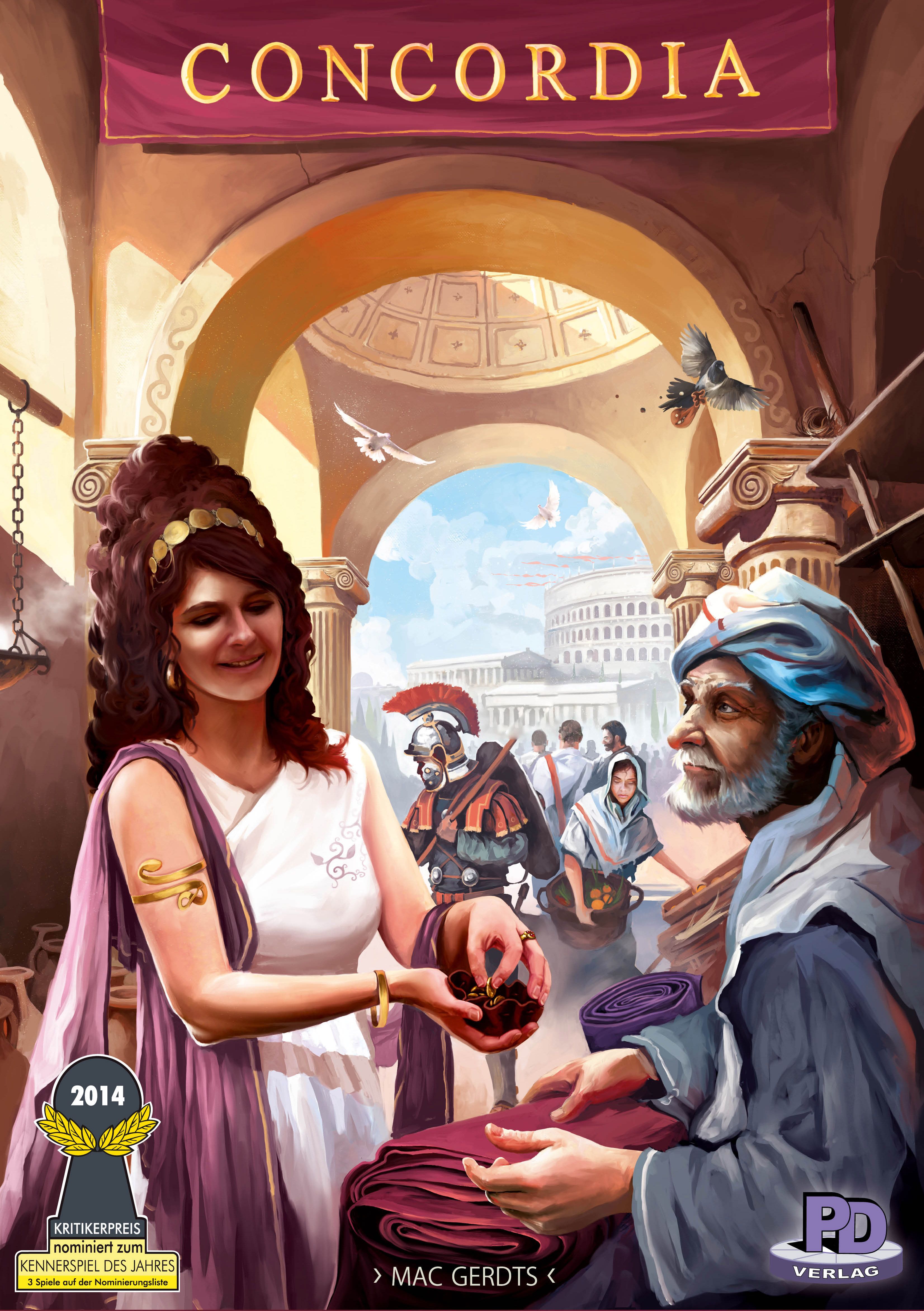
How to Play Concordia
PD-Verlag, 999 Games, Cranio Creations · Board game · 2013What do you want to do now
Ask anything about Concordia: rules, setup, components, complexity, price, or whether it fits your group.
Video: How to Play
Start here, then follow the written guide
Step by step
Objective of the Game
Welcome to Concordia, a game where you'll expand your Roman empire, establish trade routes, and build houses across the Mediterranean! Your ultimate goal isn't just about conquering land, but about strategically accumulating Victory Points (VP). These points are tallied at the end of the game based on various achievements, each tied to an ancient Roman god. The player with the most VP at the end of the game earns the prestigious title of victor!
Preparation (Setup)
Let's get your Roman adventure started! Here's how to set up your game:
- Choose your map: Use the Imperium board for 3-5 players or the Italia board for 2-4 players.
- Place the 5 storehouses, 30 city tokens, and 24 bonus markers on their designated spots on the board.
- Place the Coins (1, 2, 5, and 10 sestertii) and 80 wooden units of goods (brick, food, tool, wine, cloth) in a general supply area, accessible to all players. These are considered unlimited.
- Each player chooses a color (red, green, yellow, blue, or black) and receives:
- 3 sea colonists
- 3 land colonists
- 1 scoring marker
- 15 houses
- 7 starting cards
- 1 player aid
- Each player places 4 of their colonists into their storehouse, occupying 4 storage spaces. The remaining colonists are kept off-board.
- Shuffle the 30 cards for sale (decks I-V). Remove any cards not needed based on the player count (details in the quick intro, but not provided here).
- Place the remaining cards for sale in their designated display area on the board.
- Randomly determine the start player.
- The player to the right of the start player receives the Praefectus Magnus card.
The Turn of Play
Players take turns in clockwise order. Your hand consists of your un-played personality cards. On your turn, you'll:
- Play 1 card from your hand.
- Execute the related actions of that card.
All played cards form a personal discard pile, with only the last card played visible. Let's look at the actions you can take with different cards:
Personality Cards & Their Actions
- Tribune
- Recover cards: Take back all your previously played cards into your hand. If you take back more than 3 cards (including the Tribune itself), you receive 1 sestertius from the bank for each card past the 3rd.
- Purchase 1 new colonist (optional): Pay 1 food and 1 tool to the bank. Place either a new land colonist or sea colonist from your storehouse into "Roma". This also frees up a storage space in your storehouse.
- Architect
- Move colonists: The number of colonists you have on the board determines your total movement steps. You can freely allocate these steps among your colonists.
- Land colonists move along brown lines.
- Sea colonists move along blue lines.
- A colonist's first step is out of its starting city onto an adjacent line. Subsequent steps move through a city and onto the next adjacent line.
- You cannot end a colonist's movement on a line already occupied by another colonist, but you can move through occupied lines.
- Build houses (after all movements): You may build houses in cities adjacent to any of your colonists. You cannot build more than one of your own houses in a single city, and never in "Roma".
- Goods cost: 1 food in a brick city, or 1 brick plus the good of that city type in every other city.
- Coins cost: 1 sestertius in a brick city, 2 in a food city, 3 in a tool city, 4 in a wine city, and 5 in a cloth city.
- If you build a house in a city that already has other houses, the coin cost is multiplied by the total number of houses that will be in that city after your build. The goods cost remains the same.
- Move colonists: The number of colonists you have on the board determines your total movement steps. You can freely allocate these steps among your colonists.
- Prefect
Choose one of two alternatives:
- Produce goods in a province: Choose an active province whose bonus marker still shows the goods symbol. Flip that bonus marker to its coin side. You receive 1 unit of the good depicted on the bonus marker from the bank. Additionally, all houses in that province (regardless of owner) produce one unit of the good produced in their respective cities. If you own the Praefectus Magnus and choose this option, you receive a double bonus (2 units instead of 1) from the bonus marker, then pass the Praefectus Magnus to the player on your right.
- Collect cash bonus: For every visible coin on the bonus markers, you receive 1 sestertius from the bank. Afterwards, all bonus markers are flipped back to their good's symbol side. The Praefectus Magnus is not activated and remains with you if you choose this option.
- Colonist
Choose one of two alternatives:
- Place new colonists: Pay 1 food and 1 tool for each new colonist you wish to place. New colonists can be placed in "Roma" or any other city where you own a house.
- Receive sestertii: Get 5 sestertii plus 1 sestertius for each of your colonists currently on the game board.
- Mercator
- Receive sestertii: Get 3 sestertii from the bank (or 5 sestertii if it's a purchased Mercator card).
- Trade goods: You may trade up to two types of goods with the bank. You can sell two types, buy two types, or sell one and buy another. The number of units is limited by free space in your storehouse. Trade is done at fixed prices shown on the roof of the storehouses. You cannot discard goods to make room for others.
- Diplomat
Use an opponent's top face-up personality card in their discard pile. You execute the action as if you had played that card yourself. You cannot copy actions from players who recently used a Diplomat card or took back their cards with a Tribune.
- Senator
Purchase up to two personality cards from the display on the game board and add them to your hand. The price of a card is the sum of:
- The goods depicted in the red field of the card.
- Plus the goods depicted beneath the card's position on the game board (a question mark means you can choose any good).
After your purchase(s), all remaining cards in the display slide to the left if their left position is empty. The display is then replenished to 7 cards from the stack.
- Consul
Purchase one personality card from the display on the game board and add it to your hand. The price consists only of the goods depicted in the red field of the card; goods beneath the card's position are ignored. Similar to the Senator, remaining cards slide left, and the display is replenished.
- Specialists (Mason, Farmer, Smith, Vintner, Weaver)
All your houses of the related city type produce one unit of their respective good.
Game End and Scoring
The game ends immediately when one of two conditions is met:
- A player purchases the last card from the display on the board.
- A player builds their 15th house.
The player who triggers the end condition is awarded the Concordia card (worth 7 VP). All other players then get one final turn. After everyone has had their final turn, all players tally their final Victory Points.
Final Scoring
Victory points are awarded based on the ancient gods associated with your personality cards. Gather all your cards, including those in your discard pile, and arrange them by god. The back of your player aid summarizes the gods and their scoring order. Here's how points are calculated:
- VESTA: Add the value of all goods in your storehouse (at their usual price) to your cash. You receive 1 VP per full 10 sestertii (fractions are ignored).
- JUPITER: For each house you own in a non-brick city, you receive 1 VP. Multiply this by the number of Jupiter cards you own (max. 15 VP per card).
- SATURNUS: For each province where you have at least one house, you receive 1 VP. Multiply this by the number of Saturnus cards you own (Imperium max. 12 VP per card, Italia max. 11 VP per card).
- MERCURIUS: For each type of goods that your houses produce, you receive 2 VP. Multiply this by the number of Mercurius cards you own (max. 10 VP per card).
- MARS: For each of your colonists on the game board, you receive 2 VP. Multiply this by the number of Mars cards you own (max. 12 VP per card).
- MINERVA: For each house you own in a city of the related type (e.g., food cities for a Farmer card), you receive a certain number of VP as depicted on the specialist's card. Multiply this by the number of Minerva cards you own.
The player with the most Victory Points wins! In case of a tie, the player owning the Praefectus Magnus wins. If neither tied player owns it, the tie is broken by the player who would receive it next in the course of the game.
Intermediate Scoring (Optional)
If playing for the first time, it's recommended to do an intermediate scoring. The first time a player plays their Tribune card to take back cards, they immediately perform a personal intermediate scoring, tallying their VP on the track. After all players have done this once, compare scores: 1st place gets 2 sestertii, 2nd place gets 1 sestertius. Then, all scoring markers return to zero. This is not recommended for experienced players.
Tips for Winning
- Diversify your production: While focusing on one type of good might seem appealing, remember that Mercurius rewards you for producing different types of goods. Building houses in various city types can be a strong VP engine.
- Don't neglect your colonists: Your colonists are crucial for movement and building. The Mars god rewards you for having more colonists on the board, and the Colonist card can also give you a nice cash injection based on their numbers.
- Master the card market: The Senator and Consul cards are your gateway to powerful new actions and more VP at the end of the game. Pay attention to the costs and the shifting card display to grab the cards that best fit your strategy!
More videos
More rules explanations from the community
In English
-
 How to play Concordia
-
 Get Ready for Game Night! How to Play Concordia
-
 How to Play Concordia
-
 How to Setup and Play Concordia
-
 CONCORDIA STRATEGY GUIDE / How To Win At Concordia / 10 BEST STRATEGY TIPS
-
 Concordia Solo Variant Tutorial
-
 Concordia - Playthrough With Friends!
-
 How to Play Concordia - Chairman of the Board
-
 Concordia - How to Play
-
 Concordia Digital Playthrough! Best Board Game now has a digital version
-
 Concordia Solo Playthrough
Rules manual
Official PDF file
Frequently Asked Questions
Quick answers about the rules