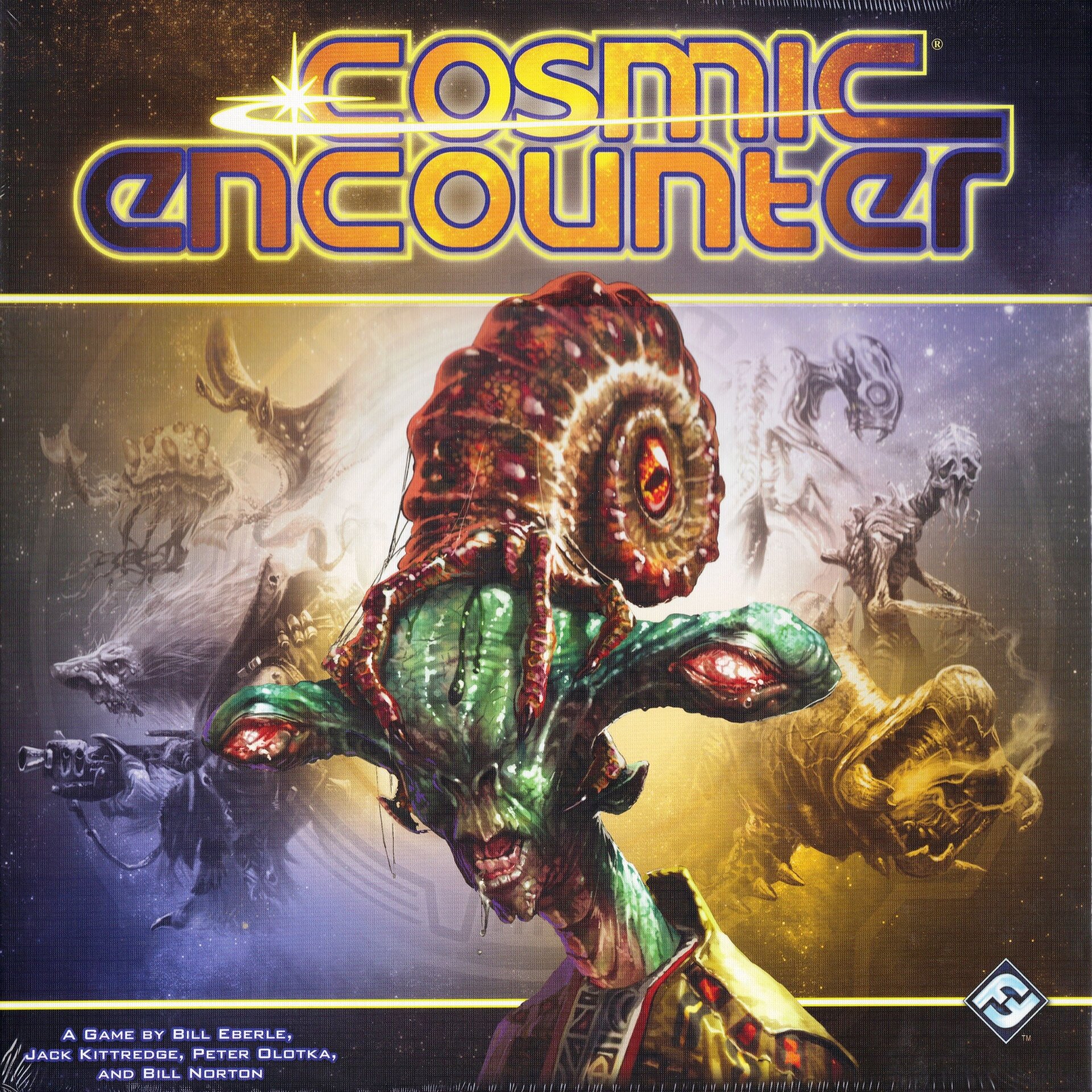
How to Play Cosmic Encounter: Cosmic Dominion
Fantasy Flight Games, Heidelberger Spieleverlag, Hobby World · Board game · 2014What do you want to do now
Ask anything about Cosmic Encounter: Cosmic Dominion: rules, setup, components, complexity, price, or whether it fits your group.
Video: How to Play
Start here, then follow the written guide
Step by step
Game Objective
The objective of the game is to conquer the universe, or at least a significant portion of it, by establishing colonies on planets. Players seek to expand their cosmic empire through encounters and negotiations with other alien races.
Setup
To incorporate the Cosmic Dominion expansion into the base game Cosmic Encounter, follow these additional steps before normal game setup:
- Alien Tokens: Add the new alien tokens to the pile of available alien tokens.
- Flare Cards: Shuffle the new flare cards into the existing deck of flare cards.
- Reward Cards: Return the reward cards to the game box, unless you are using the Reward Deck variant.
If you are using the Reward Deck variant, follow this additional step during Step 5 of normal game setup:
- Reward Deck: Shuffle the reward deck and place it near the warp. If you have reward cards from both Cosmic Dominion and Cosmic Incursion, shuffle them together to form a single 64-card reward deck, or use either deck separately.
To use Special Ships:
- During game setup, each player places their colored ship marker on one of their normal ships, face up, to create a special ship.
- All players must agree on what the special ships represent, using one of the listed variants (such as Flagship or Salvage Vessel).
- If playing with three or four players, each player may create a second special ship using a ship marker of an unused color. Players must agree whether everyone will have two special ships of the same type, or of two different types (also agreeing which is represented by the unused color).
New Components:
- Danger Token: Use the danger token to track when a danger warning is in effect. Flip the yellow side up at the start of each encounter and the red side up whenever a destiny card with a danger warning is drawn.
- Ship Markers: The ship markers fit on top of normal ships to create "special ships". Each marker has a front and back, and some variants instruct the player when to flip it.
Gameplay Flow
The game follows standard rules and victory conditions, with the following exceptions for the Reward Deck variant:
- When a player receives cards as defender rewards, they may draw some or all of the cards from the reward deck.
- Discarded reward cards go to a special reward deck discard pile. Not all game effects that target the regular discard pile, or cards in it, will apply to the reward deck discard pile. If an effect targets a card just before, during, or just after it is discarded (such as the Clone, the Fido, or the Vulch), then that effect works on cards going to either discard pile. However, something that happens later and is not specifically responding to the discard process (such as Delta Scanners or Space Junk) does not affect the reward deck discard pile; it's too late!
- When the reward deck runs out, shuffle its discard pile to form a new reward deck. If the reward deck discard pile is also empty, no further reward cards may be drawn until at least one reward card is discarded. The reward deck never causes a cosmic quake.
- When randomly selecting cards from a hand with both cosmic and reward cards, a player may choose which card backs they are targeting. In other words, "randomly" means "without seeing the faces of the cards."
New Rule: Cosmic Quakes
- If a player must draw a card from the cosmic deck and both the cosmic deck and the discard pile are empty, then a cosmic quake occurs! All players discard their hands and shuffle the discard pile to form a new deck. Then, deal eight cards to each player.
Actions and How to Play
Special Ships:
- Using the game effects of your special ship requires having control of that ship (not in the warp, not captured, etc.).
- If a variant offers a special action, the ship's owner may activate this one-time use effect by flipping the ship marker face down. The owner may then "recharge" the special action for reuse by flipping the marker face up again whenever the special ship is recovered from the warp, or if the owner does not have a second encounter on their turn.
- If a special ship is captured or removed from the game, when its owner recovers a different ship from the warp during their own regroup phase, that player may place their ship marker on it, face up, to create a replacement special ship.
Special Ship Variants:
- Flagship Variant: When a main player or ally has their flagship in an encounter, after the encounter cards are revealed, they may add an extra +3 to their side's total.
- Hyperspace drive special action: A player's flagship may interrupt the game to move to one of their colonies, to one of their technology cards being researched, or to an encounter they are involved in (ignoring hyperspace gate limits).
- Salvage Vessel Variant: When a main player or ally has their salvage vessel in an encounter, after winning the encounter, they may receive two rewards, or draw two technology cards from the technology deck (if in use) and choose one to keep. This is in addition to any other benefits received for winning.
- Tractor beam special action: A player's salvage vessel may interrupt the game to retrieve a card from the discard pile.
- Double Ship Variant: Normally, a player cannot send both of their special ships to an encounter, although game effects like the Amoeba's power or a flagship's hyperspace drive special action may allow this.
Intimidate Cards:
- These are new non-encounter cards that often transform into encounter cards.
- During any encounter, each player in the game may play an intimidate card face down on the table, at any time before the planning phase, announcing that it is an intimidate card.
- When a main player plays an intimidate card, it will automatically become their encounter card when cards are selected in the planning phase. (This main player will not be subject to restrictions on card selection by game effects and does not need to draw a new hand or end their turn due to lack of encounter cards.)
- When a non-main player plays an intimidate card, they are announcing it for potential use by main players who may invite them to be an ally. After encounter cards are selected, but before they are revealed, each main player may choose an intimidate card played by one of their allies to replace their encounter card. This choice is made "blind"; the ally may make statements (true or false) about the card, but cannot show it.
- When a player reveals an intimidate card as their encounter card, it becomes an attack card if the opposing player reveals an attack card. If the opposing player reveals anything else, the intimidate becomes a negotiate card. An intimidate card modifies itself before other game effects occur.
- Intimidate cards on the table are not part of a player's hand. Those that are not used, as well as encounter cards that are replaced by intimidate cards, are not revealed. Instead, they return to their owners' hands as soon as it is clear they are not being used.
Kicker Cards:
- These are played face down during the planning phase before encounter cards are selected (limit of one kicker per main player), with the player announcing they are playing a kicker.
- They are revealed when encounter cards are revealed. Kickers are not affected by game effects that target a player's encounter card.
- A kicker's effect depends on the types of encounter cards revealed during the encounter.
- Attack: If a player reveals an attack card, its value is multiplied by their kicker. For example, a player with 12 ships on their side who revealed an attack 10 and a kicker x2 has a total of 32 ((2×10)+12). This takes effect after any self-modifying cards (such as morphs or intimidates) change their card types, but before other game effects.
- Negotiate (vs. Attack): If a player reveals a negotiate card and collects compensation, it is multiplied by the value of their kicker. For example, a player who would normally receive 3 cards as compensation would receive 6 cards as compensation if they had revealed a kicker x2.
- Negotiate (vs. Negotiate): After a failed deal, the number of ships lost to the warp by the opposing player is multiplied by the kicker's value. For example, if a player revealed a kicker x2 before a failed deal, that player would lose the usual 3 ships to the warp, but their opponent would lose 6 ships to the warp!
- The new kickers in Cosmic Dominion have additional effects depending on their unique game text, but each kicker uses the multiplication rules listed above, unless the card states otherwise.
Other Reward Cards:
- The reward deck also includes two reinforcement cards, several new artifact cards, and another morph. The morph card works the same way as morph cards in previous expansions: if both players in an encounter reveal a morph card at the same time, both sides lose.
Variable Attack Cards:
- Each attack card in Cosmic Dominion has two different values. The larger number printed in black is the normal, standard value. However, during an encounter where a danger warning is in effect (i.e., a destiny card was drawn that had a danger warning on it), when a variable attack card is revealed, its value is immediately transposed to become the smaller number printed in white. A variable attack card modifies itself before other game effects occur, and the modification is only for that encounter.
Unique Negotiate Cards:
- The negotiate cards introduced in the reward deck still count as negotiate cards, but have unique game effects described on each card.
Retreat Cards:
- This is a new type of encounter card that represents completely avoiding conflict.
- When a retreat and an attack card are revealed by opposing players, the retreating player automatically loses the encounter, but the ships on their side live to fight another day.
- When a retreat and anything else are revealed by opposing players, the retreat transforms into a regular negotiate card, and both players attempt to make a deal. A retreat card modifies itself before other game effects occur.
Rift Cards:
- The rift cards in Cosmic Dominion have two effects. First, a player may play a rift to receive a benefit of ships, cards, or a colony as indicated on the card.
- Additionally, if a rift card is taken from a player's hand and kept, either as compensation or as a result of another game effect, the rift detonates, causing the stealing player to lose ships, cards, or a colony as indicated on the card. After detonating, a rift is discarded.
Joker (Alien Power):
- You have the power of the Wild Cards. The attack 08 cards are initially "wild." At the start of your turn, you may name any other attack card to become the new wild card.
- After encounter cards are revealed, for each one that matches the current wild card, use this power. Place a face-up joker token from this token on the wild card to transform it into the card indicated by that token.
- After the outcome is determined, return the used joker token(s) to this token, face down. When you remove the last face-up joker token from this token, immediately flip the ones used here face up for reuse.
Love (Alien Power):
- Super (If you are Love): Instead of discarding a card to use your power, you may show the card to the other players and then return it to your hand.
- Wild (If you are not Love): As a main player, before encounter cards are selected, you may ask your opponent to discard a card randomly from their hand. If they do, you may take the card; if they do not, you receive a reward.
End of Game and Scoring
Refer to the rulebook for details on this section.
Tips for Winning
Rules manual
Official PDF file
Frequently Asked Questions
Quick answers about the rules
What is the objective of Cosmic Encounter: Cosmic Dominion?
How do you set up Cosmic Encounter: Cosmic Dominion?
How do you play Cosmic Encounter: Cosmic Dominion?
How does Cosmic Encounter: Cosmic Dominion end, and how do you score?
Expansion for
Published additional content