How to Play Cribbage
(Public Domain), (Self-Published), (Unknown) · Board game · 1630What do you want to do now
Ask anything about Cribbage: rules, setup, components, complexity, price, or whether it fits your group.
Video: How to Play
Start here, then follow the written guide
Step by step
Objective of the Game
Welcome to the classic card game of Cribbage! Your goal in this engaging game is to be the first player to reach 121 points or more. You'll be scoring points through clever card combinations during different phases of the game, including dealing, playing cards, and showing your hand. It's a race to the finish where every point counts, and a little strategy goes a long way!
Preparation (Setup)
Getting ready for a game of Cribbage is quick and easy. Here's how to set up your game:
- Players: Cribbage can be played with 2, 3, or 4 players.
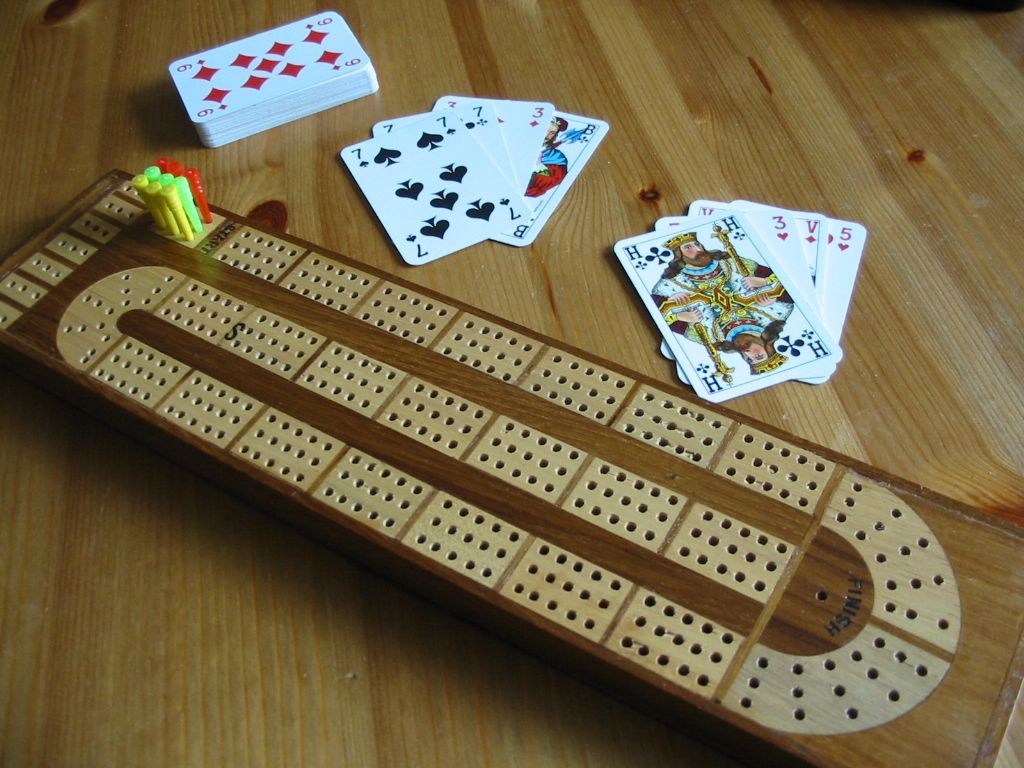
- Components: You'll need a standard 52-card deck and a Cribbage board for keeping score.
- Determine the First Dealer:
- Each player cuts the deck, and the player with the lowest card wins the deal. (Aces count as 1, which is low).
- After the first hand, the deal rotates clockwise among players.
- Dealing the Cards:
- 2 Players: The dealer shuffles, the opponent cuts, and the dealer deals six cards to each player.
- 3 Players: The dealer shuffles, the clockwise opponent cuts, and the dealer deals five cards to each player, then places one additional card directly into the crib.
- 4 Players: The dealer shuffles, an opponent cuts, and the dealer deals five cards to each player.
- Forming the Crib:
- 2 Players: Both players discard two cards face down to form "the crib." The crib is an extra hand scored for the dealer. The dealer wants to put high-scoring cards in it, while the opponent tries to "confound" this by discarding low-scoring or unhelpful cards. This is where a lot of the game's skill comes in!
- 3 Players: All three players discard one card face down into the crib. (Remember, the dealer already put one in).
- 4 Players: All four players discard one card face down into the crib.
- The Cut (Starter Card):
- The dealer asks the opponent to their left to cut the cards a second time.
- The top portion of cards is placed under the bottom portion.
- The new top-most card is turned face upwards. This is the "starter card".
- "His Heels": If the starter card is a Jack, the dealer immediately pegs 2 points and says "Two for his heels."
The Turn of Play
Now that the cards are dealt and the starter card is revealed, it's time for the "Pegging" phase!
- Starting the Play: The opponent to the dealer's left begins by laying one of their four cards face up, clearly stating its numerical value.
- Card Values: Royal cards (King, Queen, Jack) count as 10. Aces count as 1. All other cards are worth their pip value.
- Continuing the Play: Players take turns laying one card face up in front of them, announcing the running total of all cards played so far.
- The running total must not go above 31.
- Scoring During Play (Pegging): Points are immediately pegged on the Cribbage board for the following combinations:
- Fifteen for Two: If your card brings the total to exactly 15, you score 2 points.
- Pair for Two: If you play a card of the same rank as the previous card, you score 2 points. (Numerical value doesn't matter here, so a Jack and a Queen, both 10, don't pair).
- Pair Royal for Six (Three of a Kind): If you play a third card of the same rank, you score 6 points.
- Double Pair Royal for Twelve (Four of a Kind): If you play a fourth card of the same rank, you score 12 points.
- Run: If your card creates a sequence of three or more cards (e.g., 4-5-6), you score points equal to the number of cards in the run.
- Cards don't need to be in sequential order of play, but they must form an uninterrupted sequence.
- Aces are always low (A-2-3 is a run, Q-K-A is not).
- Double, Triple, and Quadruple Runs do not count during pegging.
- Go: If a player cannot play a card without exceeding 31, they say "Go." Any remaining players must continue playing if they can, without exceeding 31. The player who laid the last card before the "Go" scores 1 point ("One for Go").
- Thirty-one for Two: If a player manages to bring the total to exactly 31, they score 2 points instead of 1 for a "Go." (You cannot score both "31 for two" and "one for Go" for the same play).
- Last Card: After all players have said "Go" and no more cards can be played, the player who laid the very last card scores 1 point ("One for last card"), unless that card brought the total to 31, in which case they score 2 points. (Again, you cannot score both "31 for two" and "one for last card" for the same play, unless 15s, runs, or pairs were also involved with placing the last card).
- New Play: Once no more cards can be played, the cards are turned over, and the player to the left of the player who laid the last card starts a new play with their remaining cards. This continues until all cards are exhausted.
- Renege: If you say "Go" but could have played a card without exceeding 31, that's a Renege. If an opponent claims a Renege, any points pegged after the renege are cancelled, and the opponent scores 2 points for each reneged card. You can correct a renege before an opponent plays or announces their count.
End of Game and Scoring
After the Pegging phase, it's time for "The Show" and "The Crib" scoring. This is where the big points often come in!
The Show
Each player now scores their hand, plus the starter card. The player to the dealer's left shows their hand first, and scoring continues clockwise to the dealer. It's crucial to score by category to avoid missing points!
- Fifteens: Any combination of cards that adds up to 15 scores 2 points.
- Pairs:
- A Pair (two cards of the same rank) scores 2 points.
- A Pair Royal (three of a kind) scores 6 points.
- A Double Pair Royal (four of a kind) scores 12 points.
- Runs: A sequence of three, four, or five cards scores 1 point per card in the run (e.g., 3-card run = 3 points, 4-card run = 4 points, 5-card run = 5 points).
- Double Runs: If you have a run with a pair (e.g., 2-2-3-4), you score for each distinct run. A Double 3-card run scores 6 points, a Double 4-card run scores 8 points.
- Triple Runs: (e.g., 2-2-2-3-4) scores 9 points.
- Quadruple Runs: (e.g., 2-2-3-3-4) scores 12 points.
- Flush:
- A 4-Card Flush (all four cards in your hand are the same suit) scores 4 points. (This only counts if all cards are from your hand).
- A 5-Card Flush (all four cards in your hand PLUS the starter card are the same suit) scores 5 points. (Flushes do not count during the pegging phase).
- His Nob: If you have a Jack in your hand (or crib) that is the same suit as the starter card, you score 1 point. This is always scored last, often with the satisfying phrase, "And one for his nob!"
Fun Fact: The highest possible score in "The Show" is 29 points!
Another Fun Fact: If a player has no points in their hand, they often claim they have "nineteen" (which equals 0 points).
The Crib
Finally, the dealer counts the score of the cards in the crib plus the starter card. Scoring for the crib is exactly the same as "The Show," with one exception: a crib can only score a flush if all five cards are of the same suit (5 points). A 4-card flush in the crib does not count.
End of Game
The game ends immediately as soon as one player scores 121 or more points (it doesn't have to be exact). However, there are a couple of special conditions:
- Skunk: If a player scores 121 or more points before an opponent scores 91 points, the winner scores 2 games instead of 1.
- Double Skunk: If a player scores 61 or more points before an opponent scores 31 points, the game ends, and the winner scores 2 games instead of 1.
Optional Rules & Penalties
- Muggins (Optional): If you play with Muggins, you can claim points that your opponent(s) fail to score in their hand, crib, or during play, or if they forget to peg them on the board. The first player to spot the error and exclaim "Muggins!" gets to claim those points.
- Penalties:
- 2 points for sneaking a peek at cards (e.g., bottom card when dealing, or the crib prematurely).
- 2 points for moving an opponent's peg.
- 2 points for placing the starter card in your hand or crib, or returning it to the pack prematurely.
- 15 points for incorrectly claiming the game (e.g., pegging more than your actual score and claiming victory). The opponent scores points equal to the over-claimed amount, and the offender pegs back 15 points.
Tips for Winning
Cribbage is a game of skill and a bit of luck. Here are a few tips to get you started on the path to victory:
- Master the Crib Discard: This is arguably the most skillful part of the game. As the dealer, try to discard cards that are likely to form 15s, pairs, or runs with the starter card. As the non-dealer, aim to discard cards that are unlikely to help the dealer, often breaking up potential runs or pairs.
- Prioritize Pegging Points: Don't underestimate the points you can score during the "Pegging" phase. Always be on the lookout for opportunities to make 15s, pairs, or runs, especially when you can bring the total to exactly 31. These small points add up quickly!
- Know Your Card Values: Quickly identifying combinations that make 15, or sequences for runs, is key. Remember that face cards are 10, and Aces are 1. Practice recognizing these patterns to speed up your scoring and identify potential plays.
More videos
More rules explanations from the community
In English
-
 How to play Cribbage (Cultural Relay Project)
-
 How to play Cribbage
-
 How to play Cribbage
-
 How To Play Cribbage (3 players)
-
 LED Cribbage board demo
-
 This may be my longest video yet! CRIBBAGE, the classic card game, finally joins the channel.
-
 A walk-through explanation of Cribbage game-play
-
 Solitaire Cribbage - Rules and Playthrough!
-
 How to play Cribbage
-
 Improving Cribbage with Henry Douglass (Part 3 of 3)
-
 A Beginner's Guide to 3 & 4 Handed CRIBBAGE
Rules manual
Official PDF file
Frequently Asked Questions
Quick answers about the rules
What is the objective of Cribbage?
How do you set up Cribbage?
How do you play Cribbage?
How does Cribbage end, and how do you score?
What are some tips for winning Cribbage?
Other Games You'll Like
Based on mechanics and theme