
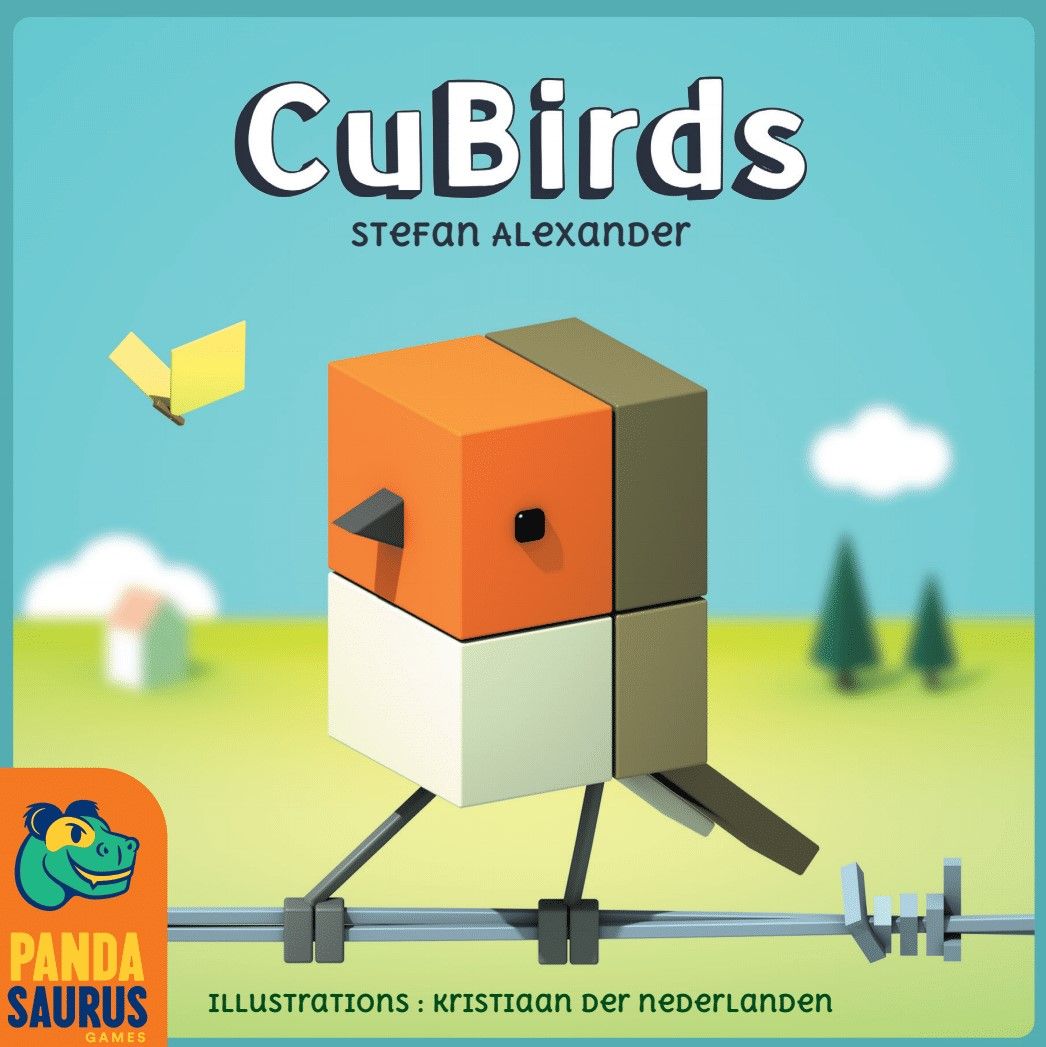
CuBirds — How to Play
Catch Up Games, Board Game Circus, Evrikus · Board game · 2018Video: How to Play
Start here, then follow the written guide
Step by step
Complete Guide to CuBirds
Hello, future tabletop ornithologists! Welcome to CuBirds, a game where we help a flock of little birds find their way back home. It's a simple game, but with a tactical touch that will have you thinking about how to organize these flocks. Shall we begin?
Game Objective
In CuBirds, the theme is that dozens of birds land on the fences of our field, but when it's time to leave, they get mixed up and can't organize into flocks. Our mission is to help them find their way back to the nest. The game ends and a player wins when they manage to gather in their collection:
- Any 7 different species of birds.
- Or 2 species of at least 3 birds each.
Setup
Let's get everything ready for the fun to begin:
- Take the 110 bird cards, which are distributed among 8 species. The number of copies of each bird is in the bottom left corner of the card.
- Choose a player to be the starting player.
- The starting player shuffles all 110 bird cards and deals them into 4 rows with three face-up cards in the center of the table.
- Important: Each row must contain 3 birds of different species. If a row has the same bird repeated, discard the extra birds and place new cards until each row has 3 different species.
- The remaining cards form the draw pile, which is placed face down near the center of the table and accessible to everyone.
- The starting player deals 8 bird cards face down from the draw pile to each player. This is their starting hand.
- Next, the starting player deals one face-up bird card to each player. This card is placed in front of the player and is the first bird in their collection.
- Leave free space near the draw pile to form a discard pile.
Game Flow
The game is played over several successive rounds. Here's how it progresses:
- Round Start: Each player begins with 8 cards in hand.
- Player Turn: Starting with the starting player and proceeding clockwise, each player fully completes their turn.
- Round End: The round continues until one of the players no longer has cards in their hand.
- Game End: Players take turns until the end of the round or until a player manages to win the game.
Actions and How to Play
On your turn, you have two main actions:
1. PLACE BIRDS (Mandatory)
This is the main action of your turn. You must perform it:
- Choose one or more birds from your hand to play. You must play all birds of the same species that you have in your hand.
- Place these birds, side by side, to the left or right of one of the 4 bird rows in the center of the table. You can choose any row, regardless of the species already present.
- Special Action: If you place a bird in a row that already contains birds of the same species, you must take all the cards that are between those birds in the row. These cards are added to your hand.
- After taking the cards, rearrange the row by joining the remaining birds to form a continuous line.
- Row Restoration: If, and only if, there is only one species of birds remaining in the row immediately after you take the cards, you must add cards from the draw pile to that row, one by one, until there are two different species. The birds added from the draw pile can be placed to the left or right of the row. Stop adding cards as soon as there are two different species in the row.
2. COMPLETE A FLOCK (Optional)
After performing the place birds action, you may, if you wish, attempt to complete a flock.
- What is a Flock? A flock is a series of birds of the same species. All birds of the same species have the same flock number, which can be small or large, indicated on the card.
- How to Complete: To complete a flock, you must reveal all the birds of the same species that you have in your hands.
- Rewards:
- If the number of revealed cards is greater than or equal to the declared number for a small flock, you add one of these revealed cards to your collection.
- If the number of revealed cards is greater than or equal to the declared number for a large flock, you add two of these revealed cards to your collection.
- The remaining cards from the revealed flock are placed on the discard pile.
- Restrictions:
- You cannot reveal cards if you do not have enough to complete a flock.
- On your turn, you can only complete a single flock.
- You are never forced to complete a flock.
- Once a bird has been added to your collection, it can never be placed back into your hand or the draw pile.
- Special Situation: If you place one or more birds without enclosing any other cards between birds of the same species, you do not take any cards from the center of the table. In this case, you have the option to take the first 2 cards from the draw pile and add them to your hand.
End of Game and Scoring
The game ends in two ways:
- Round End: As soon as a player has no more cards in their hand, the current round ends. Other players place any remaining cards in their hands onto the discard pile. The cards in the rows in the center of the table remain. The player who ended the round becomes the new starting player and deals 8 cards from the draw pile to each player. If the draw pile becomes empty, shuffle the discard pile to form a new draw pile.
- Immediate Game End: The game stops immediately and the round is ended if a player has 7 different species or 2 species of at least 3 birds in their collection at the end of their turn.
- End Due to Lack of Cards: The game ends immediately if it is impossible for the starting player to deal 8 cards to each player, even after reorganizing the discard pile.
Victory Conditions:
- The first player to manage to gather in their collection: Any 7 different species OR 2 species of at least 3 birds each, wins the game immediately.
- If the game ends due to a lack of cards in the draw pile, the player with the most bird cards in their collection wins the game. In case of a tie, the tied players share the victory.
Tips for Winning
To help you become a master of CuBirds, here are some tips:
- Keep an eye on the species that you and your opponents are collecting. Trying to complete a large flock can be risky if you don't have the right cards.
- Managing your hand is crucial. Sometimes it's better to hold onto some cards to create a better opportunity to pick up other cards from the center of the table in the future.
- Observe the bird rows in the center of the table. If a row is about to have only one species remaining, you can plan your move to force the addition of new cards, potentially benefiting you or hindering others.
More videos
More rules explanations from the community

Rules manual
Official PDF file
