
Descent: Journeys in the Dark — How to Play
Fantasy Flight Games, Delta Vision Publishing, Edge Entertainment · Board game · 2005What do you want to do now
Ask anything about Descent: Journeys in the Dark: rules, setup, components, complexity, price, or whether it fits your group.
Video: How to Play
Start here, then follow the written guide
Step by step
Objective of the Game
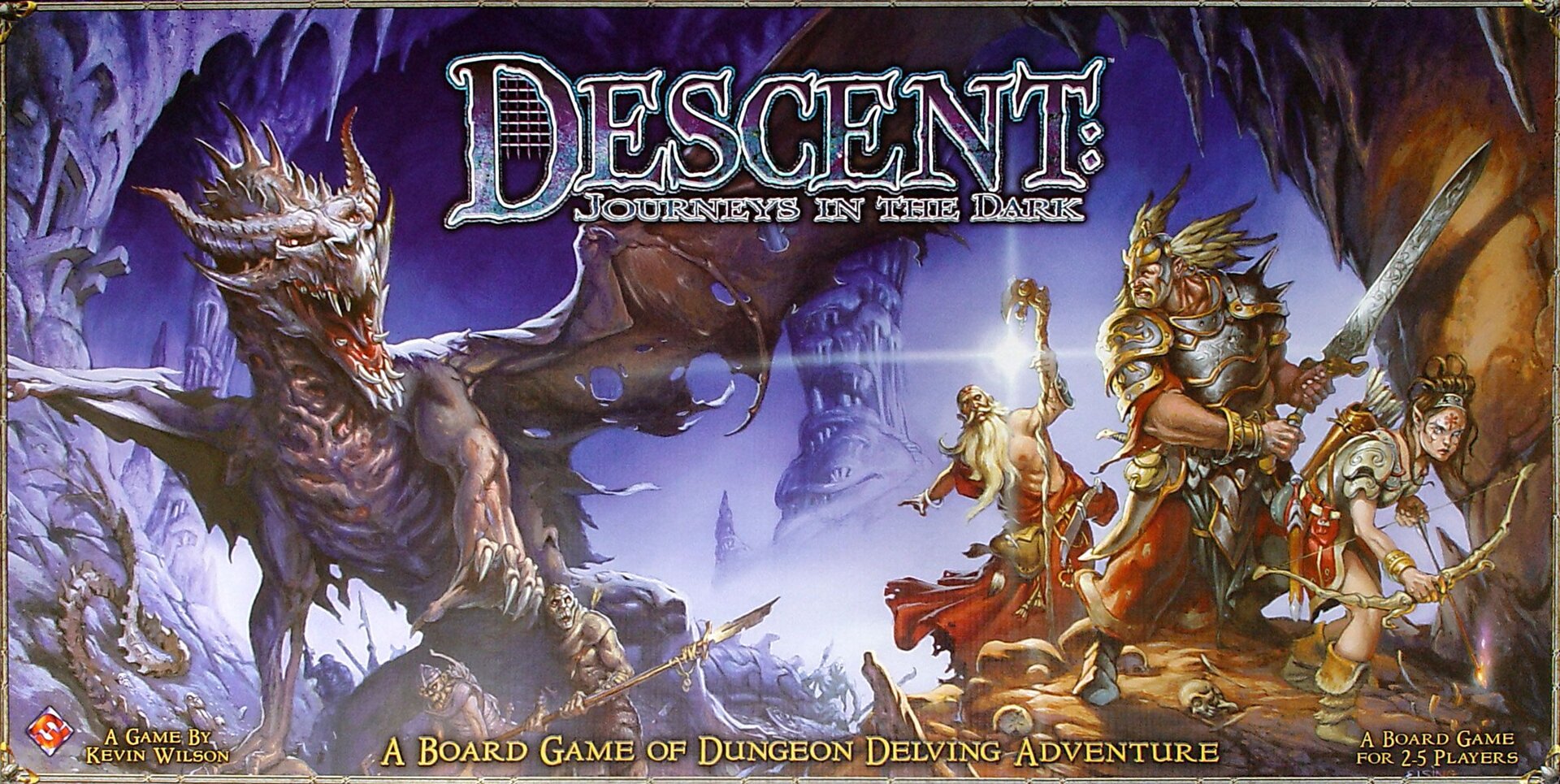
Welcome, brave adventurers, to the dark and perilous world of Descent: Journeys in the Dark! Get ready to delve into forgotten corridors, battle monstrous foes, and uncover ancient secrets. In this epic dungeon crawler, up to four players take on the roles of valiant heroes, while one cunning player commands the forces of evil as the Overlord.
As heroes, your ultimate goal is to work together, explore treacherous dungeons, gather powerful equipment and treasure, and ultimately complete the specific quest goal outlined at the beginning of each game. You'll gain conquest tokens by activating glyphs, opening chests, and completing other tasks, representing your progress. But beware! If your group ever runs out of conquest tokens, the game immediately ends, and the Overlord claims victory.
The Overlord, on the other hand, seeks to thwart the heroes at every turn. You'll deploy deadly monsters and treacherous traps, aiming to slay the heroes before they can complete their quest. If you manage to deplete the heroes' conquest tokens, you win!
Preparation (Setup)
Before you plunge into the darkness, let's get your adventure set up. Follow these steps to prepare your game:
Choose Overlord Player
First things first, decide who will be the Overlord. This player controls all the monsters and traps. It's often recommended that the most experienced player takes this role, but feel free to choose at random!
Heroes Setup
- Choose Heroes: The first hero shuffles the cardboard hero sheets and deals one randomly to each hero player, starting with themselves and going clockwise. If everyone agrees, you can also just pick your heroes!
- Set-Up Hero Markers: Each hero player takes the indicated number of wound and fatigue tokens from their hero sheet. You'll also get 300 coins to start, a set of order tokens (1 aim, 1 dodge, 1 guard, 1 rest, 1 prolonged action), and one hero turn token. Place these near your hero sheet.
- Deal Starting Skill Cards: Separate the three skill decks (subterfuge, fighting, and wizardry) and shuffle each. Draw the number and type of skill cards indicated on your hero sheet. You can trade in one (and only one) skill card for a new one from the same deck. These cards are placed face up and are never discarded or exhausted!
- Deal Starting Feat Cards: Similarly, separate and shuffle the three feat decks. Draw the quantity and selection of Feat cards indicated by your hero sheet.
- Purchase Starting Equipment: Now for some shopping! Look through the town shop deck and spend your coins on items. Each item's cost is at the bottom of its card. You can also buy any potions for 50 coins each. Heroes cannot sell items or trade during setup. The shop's stock is limited, so if there's a dispute over an item, the first player to the left of the Overlord who wants it gets it.
- Collect Conquest Tokens and Place Hero Figures: The heroes receive a number of conquest tokens as specified by the chosen quest. These are shared! Starting with the first hero, place your figure on or adjacent to an activated glyph, one figure per space.
Overlord Setup
- Choose a Quest: Select a quest! Each quest tells you how to set up the game, any special rules, and the win conditions for both sides.
- Randomize the Chest Markers and lay out Monster Reference Cards: Separate the chest markers by type and randomize them face down. Then, select the appropriate monster reference cards for the number of players and lay them face up for everyone to see.
- Create the Game Board: Assemble the map pieces as shown on the quest map. Place any monster figures, doors, or markers indicated in the starting area. If a chest is indicated, draw a random chest marker from the appropriate pile, look at its back, and place it face up.
- Draw Starting Overlord Cards: The Overlord starts with three Overlord cards and zero threat tokens.
And with that, the stage is set! Play begins with the heroes' first turn.
The Turn of Play
Descent: Journeys in the Dark is played over a series of rounds. Each round, every player gets a turn, starting with the heroes and ending with the Overlord.
Hero Turn Order
At the start of each round, all heroes place their hero turn tokens green side up. The hero players collectively decide who goes first. Once a hero takes their turn, they flip their token to the red "X" side. Once all heroes have taken a turn, it's the Overlord's turn. If you can't decide, the first hero makes the call!
Hero Player’s Turn
Your turn as a hero is a three-step dance:
- Step 1: Refresh Cards: Flip any exhausted cards back to their upright position.
- Step 2: Equip Items: You can freely swap items between your equipped slots and your hero's pack. Remember, you're limited to two items with "hand" icons, one armor, and three potions equipped at a time, plus two other type cards. Your pack holds up to three unequipped items.
- Step 3: Take an Action: This is where the real fun begins! Choose one of these four actions:
- Run: Move up to twice your speed, but you can't attack.
- Battle: Make up to two attacks, but you get zero movement points from this action (unless you spend fatigue for extra movement). Resolve each attack completely before the next.
- Advance: Move up to your speed AND make one attack. You can attack before, after, or even in the middle of your movement!
- Ready: This action gives you two different "half actions," and one of them MUST be an order. You can take them in any order. The half actions are:
- Move: Move up to your speed. You can interrupt this movement with your other half action.
- Attack: Make one attack.
- Order: Place one of your five order tokens (aim, dodge, guard, rest, or prolonged action) face up next to your hero.
- Concentrate: If you already have a prolonged action order token, you can take this half action to make an additional prolonged action roll. You can spend fatigue to add up to five power dice to this roll.
Important: Resolve any "at the beginning of a player's turn" events before declaring your action.
Hero Orders Explained:
- Aim: Declare an aimed attack to re-roll any number of dice (even misses!) after your initial attack roll. You must keep the second result. This order is removed if you take wounds, move, change equipped items, or use it for an aimed attack.
- Dodge: When attacked, force your attacker to re-roll any number of their attack dice, once per attack. You must accept the second result. This order lasts until the start of your next turn.
- Guard: Make one interrupt attack at any point during the Overlord's turn! The Overlord's turn immediately halts for you to resolve your attack. This order is removed if you take wounds, use it for an interrupt attack, or at the start of your next turn.
- Rest: At the start of your next turn, restore your fatigue to its maximum value. This order is removed if you take wounds or at the beginning of your next turn.
- Prolonged Action: These are quest-specific actions. You roll power dice equal to a specified trait (Melee, Ranged, or Magic), spending fatigue to add more dice (up to five). For every power enhancement rolled, you gain a progress marker. Reach the specified Difficulty to succeed! This order is removed at the end of your turn, but you keep progress tokens. Some can be disrupted by moving or taking wounds, while "continuous" ones require you to keep working on them each turn.
Overlord Player’s Turn
The Overlord's turn also has three steps:
- Step 1: Collect Threat and Draw Cards: Collect one threat token for every hero in the game. Then, draw two cards from the Overlord deck. You can discard cards from your hand to gain extra threat tokens (you must discard down to eight cards or less after drawing). If you draw the last card from the deck, the heroes immediately lose three conquest tokens, and you shuffle the discards to create a new deck.
- Step 2: Spawn Monsters: You can play one spawn card per turn, paying its threat cost. Place the indicated monsters on the board, following placement rules (no figures, obstacles, unrevealed areas, or hero line of sight). If you can't place all monsters, you can't place those. If all figures of a type are already on the board, you can remove one to place it elsewhere.
- Step 3: Activate Monsters: Activate each monster on the board once. When activated, a monster may move up to its speed and make one attack. It can attack before, after, or during its movement.
Once the Overlord has activated all monsters, the round ends, and a new round begins with the heroes!
End of Game and Scoring
The game of Descent: Journeys in the Dark concludes in one of two ways:
- Hero Victory: If the heroes successfully complete the quest goal as described in the chosen quest before running out of conquest tokens, they win the game!
- Overlord Victory: If the heroes ever run out of conquest tokens, the game immediately ends, and the Overlord wins! Heroes lose conquest tokens when one of them is killed or when the Overlord shuffles their deck.
There is no traditional "scoring" beyond these win conditions. It's all about completing the quest or stopping the heroes!
Tips for Winning
Alright, future dungeon masters and hero legends, here are a few pointers to get you started:
- Heroes: Manage Your Fatigue Wisely! Your fatigue tokens are a precious resource. You can spend them to gain extra movement points (even during a Battle action!) or to add extra power dice to your attacks. Knowing when to push your limits and when to use a Rest order to recover is key to surviving tough encounters. Don't let yourself run out at a critical moment!
- Overlord: Exploit Line of Sight for Spawning! When spawning new monsters, remember that other monster figures do not block a hero's line of sight for placement purposes. This means you can potentially place new threats in unexpected locations, even if they appear "behind" existing monsters, as long as no hero has direct line of sight to the specific space you're targeting. Use this to surprise and flank the heroes!
- Heroes: Coordinate Your Orders! Your order tokens are powerful tools. A well-timed Guard order can interrupt a crucial monster attack, potentially saving a hero. An Aim order can turn a missed attack into a hit. Discuss with your fellow heroes who should use which order and when, as only one hero can have an order active at a time. Teamwork makes the dream work, especially in the dark!
More videos
More rules explanations from the community


Rules manual
Official PDF file
