8.0
rating
Ludopedia
7.0
rating
BGG
Our Verdict
RECOMMENDED
Diamonds Club blends economics, technology, and park-building into a gem‑based contest that will keep you hooked for hours.
Highlights
- Engaging combination of mechanics
- Deep economic decisions
- Scalable, strategic pacing
- Collection and tech appreciation
Keep in mind
- Game length can be long
- Requires careful placement details
- Moderate complexity can be challenging
Rules manual not indexed yet
Upload the PDF rulebook to ask questions about this game with AI.
About the game
What you do in a play session
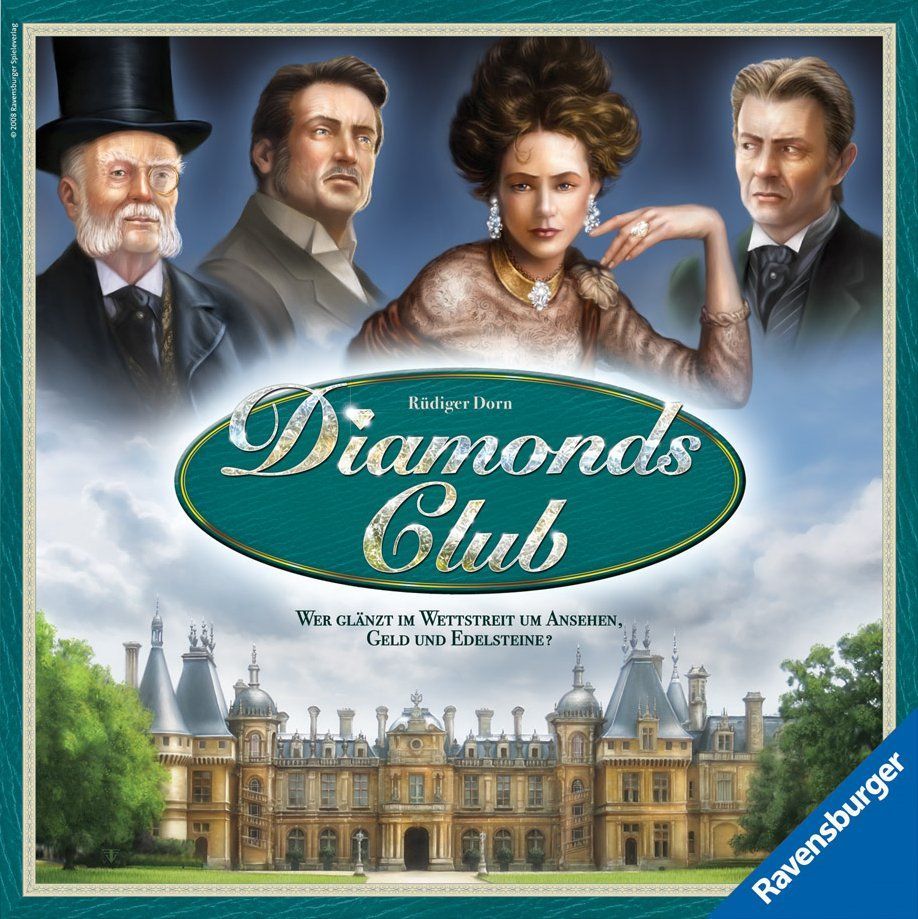
Diamonds Club drops you into the heart of 1899 London, where four gemstone magnates battle to turn their rural estates into dazzling palaces of precious stones. The game blends economics, industry, and resource strategy, requiring players to invest in mines, mining rights, and the latest tech of the era. Each turn is split into distinct phases: first, participants place coins on a central board, paying the coin value plus the sum of adjacent coins to unlock mines, ships, or prospecting rights. As more coins are placed, the benefits become pricier, creating a scaling rhythm that tests each player's planning skills.
Once everyone passes, the combinations of mines, ships, and rights can be exchanged for gems, the game's primary currency for buying attractions in the park. These attractions range from forests to zoos, and each combination can earn extra points if you complete certain objectives, such as owning five identical attractions or a specific set. Beyond attractions, players can also invest in technologies that boost gem production, increase the value of certain park pieces, or expand the number of coins available each round. Technologies are organized into tracks, letting players choose strategic paths that align with their park-building plans.
The ultimate goal is to finish the most valuable park before the others. As soon as one player completes their park, the game ends and everyone tallies victory points. The winner is the one with the highest score, combining the value of attractions, tech bonuses, and achievements earned throughout the game. Diamonds Club offers a rich economic decision-making experience, with a pace that can be both relaxed and intense, depending on how much players want to explore the interactions between resources, tech, and park construction.
Once everyone passes, the combinations of mines, ships, and rights can be exchanged for gems, the game's primary currency for buying attractions in the park. These attractions range from forests to zoos, and each combination can earn extra points if you complete certain objectives, such as owning five identical attractions or a specific set. Beyond attractions, players can also invest in technologies that boost gem production, increase the value of certain park pieces, or expand the number of coins available each round. Technologies are organized into tracks, letting players choose strategic paths that align with their park-building plans.
The ultimate goal is to finish the most valuable park before the others. As soon as one player completes their park, the game ends and everyone tallies victory points. The winner is the one with the highest score, combining the value of attractions, tech bonuses, and achievements earned throughout the game. Diamonds Club offers a rich economic decision-making experience, with a pace that can be both relaxed and intense, depending on how much players want to explore the interactions between resources, tech, and park construction.
Gallery
Box and component photos
Tap any photo to open fullscreen. Photos submitted by the community or publisher.
Rules videos
Learn by watching before you open the box
In English

Best player count
BGG community vote
2
REC
3
REC
4
BEST
Soundtrack
Ambience suggested by Melodice
Loading playlist...
Where to Buy
Prices monitored daily
Finding best prices...
Prices unavailable at this time.
Price history — last 6 months (lowest new offer)
As an Amazon Associate I earn from qualifying purchases. Prices and availability subject to change.
Alert enabled!
Join the BoardGamesBot deals group
Get the best board game deals every day — without message spam.
Join the WhatsApp groupGame details
Mechanics, categories, families and credits
Mechanics
Categories
Families
Publisher
Ravensburger AG
Designer
Rüdiger Dorn
Artist
Franz Vohwinkel
Community
Data from BoardGameGeek
1,651owners
392wishlist
139want to play
Frequently Asked Questions
Quick answers before you buy
How many players can play?
2 to 4 players.
What is the average playtime?
60 to 75 minutes, depending on experience.
How complex is the game?
Medium; requires resource planning and attention to detail.
What components are included?
Central board, mine, ship, prospecting rights pieces, gems, technology cards, park attractions, and coin tokens.
Who is the game recommended for?
Fans of economic strategy, resource management, and park-building who enjoy collections and tech trees.
How does the coin placement phase work?
Players place a coin on a board space; the cost is the coin plus the sum of adjacent coins, unlocking the benefit of that space.
Other Games You'll Like
Based on mechanics and theme