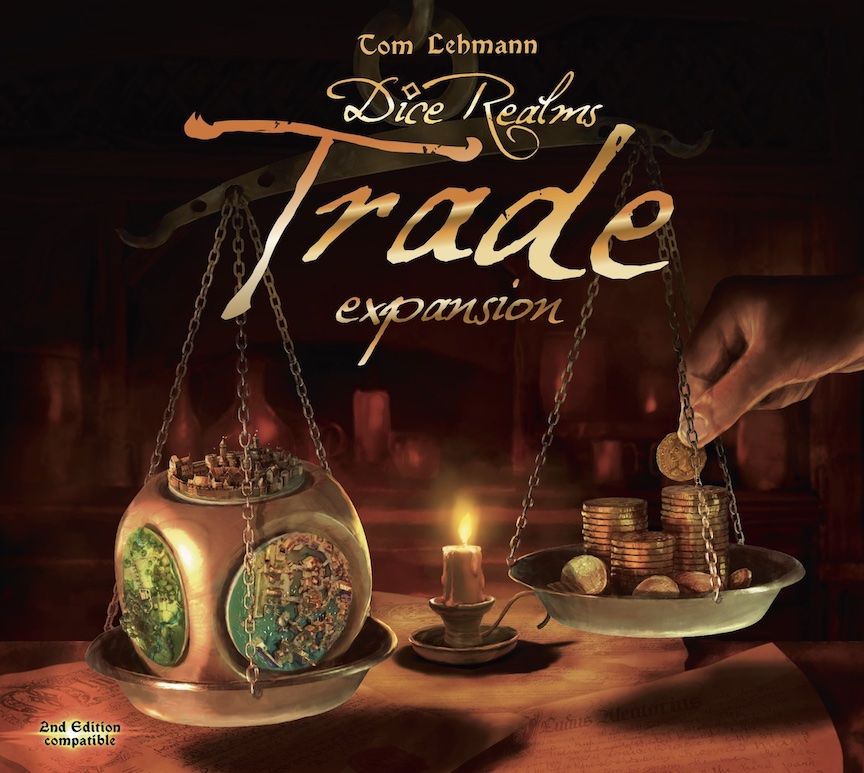
How to Play Dice Realms: Trade Expansion
Rio Grande Games · Board game · 2025What do you want to do now
Ask anything about Dice Realms: Trade Expansion: rules, setup, components, complexity, price, or whether it fits your group.
Step by step
1. Game Objective
In Dice Realms: Trade Expansion, kingdoms are recovering from the Great Plague. Trade has resumed, universities have been founded, and merchant houses are flourishing. Your goal is to build the most prosperous kingdom while dealing with the uncertainties of fate. Victory is achieved by accumulating prosperity points (VPs) throughout the game.
2. Setup
To set up the game, follow these steps:
- Dice Assembly: Assemble the 4 Trade dice (orange) using the appropriate faces.
- Organization: Organize the die faces in the tray compartments according to the expansion's storage sheet.
- Tiles: Remove the tiles from their frames and add the 22 randomizer tiles to the tile bag.
- Supplies: Add any extra grain chips or misery listed on the tiles to the general supply.
- Tile Selection: When drawing tiles, you may have a maximum of 1 tile per row or face in each of the 6 row colors (purple, yellow, orange, green, red, or brown). If you exceed this limit, set them aside and draw again.
- Trade Dice: Add 1 Trade die (orange) per player to the supply.
- Note: The red die and the 2nd edition upgrade items are intended for cooperative or solo games, as detailed in the player guide.
3. Game Flow
The game follows the basic structure of the original game, with the following additions and modifications:
- Trade Dice: These orange dice are purchased, rolled, require grain during Winter, and are affected by attacks normally, just like the gray or green dice.
- Upgrade Restriction: Trade die faces can only be upgraded to other orange die faces, either from the standard Trade row or, through cross-grading, to the Debt, Gems, or Mining rows that are in play.
- Events: This expansion introduces 8 events that modify the Fate Die, representing the tumultuous end of the Middle Ages.
4. Actions and How to Play
In addition to the standard mechanics, pay attention to the particularities of the new faces and actions:
- Green Faces (Rural Church or Courtier): These are not part of the standard Land row. A 1-point Barony face requires 2 upgrades to become a Courtier.
- Granary Master: This yellow face is not part of the standard Agriculture row.
- Courtier: This face grants a set-a-die token for use in future rounds. Additionally, they count as nobles for noble face powers.
- Gems: The conversion power of the Lapidary or Jeweler occurs in the first part of the Collection phase, before the Purchase phase, and requires a previously stored treasury coin.
- Inventor: The upgrade is earned in the reroll phase, but occurs during the Upgrades phase.
- Land Speculator: A die cannot be returned for negative VPs. When returned, the die is restored to its starting faces.
- Wheel of Fortune: Determine all gains before carrying out any of them.
5. End of Game and Scoring
Consult the manual for details on this section.
6. Tips for Winning
- Resource Management: In grain-based setups, timing is everything. Evaluate whether you can earn enough VPs to win before the game ends.
- Expansion Strategy: Consider whether it is worth going into debt to gain dice quickly or if it is better to focus on building grain stocks to maximize the use of the Granary Master.
- Defense vs. Growth: In games with Raiders, they create a lot of pressure. Use the Merchant House, Banker, and Steward to find paths to growth while trying to defend yourself.
Rules manual
Official PDF file
Frequently Asked Questions
Quick answers about the rules