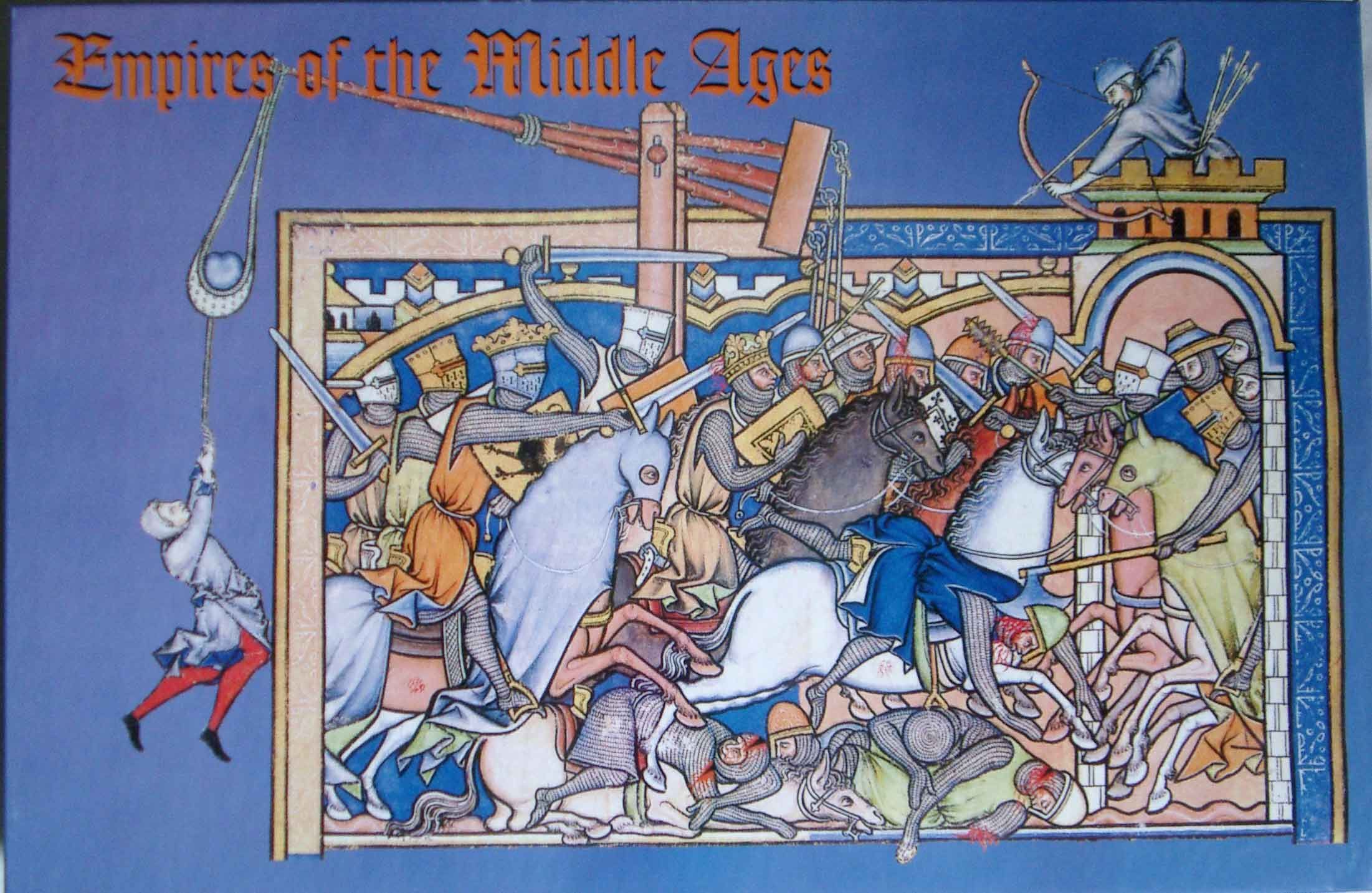
Empires of the Middle Ages
Decision Games (I), Hobby Japan, SPI (Simulations Publications, Inc.) · Board game · 1980
1–6 · best 6
Solo
240–360 min
Weight 3.5/5
Buy · from US$ 69.95
—
rating
Ludopedia
7.2
rating
BGG
Our Verdict
FOR GENRE FANS
If you're a fan of complex historical games and love deep simulation, Empires of the Middle Ages is a perfect fit for exploring the Middle Ages!
Highlights
- Immersive historical simulation
- Long-term strategic depth
- Innovative diceless mechanics
- Rich historical detail
- High replayability with scenarios
Keep in mind
- Very long playtimes
- Steep learning curve
- Language dependency
Rules manual not indexed yet
Upload the PDF rulebook to ask questions about this game with AI.
About the game
What you do in a play session
Empires of the Middle Ages is a classic 1980 board game that throws you into the political and economic cauldron of Medieval Europe, covering a massive period from 771 to 1467. Get ready for a deep historical immersion, where you'll guide your empire through centuries of change. The game unfolds on an area map and offers various scenarios, from solo games focusing on Charlemagne's reign to the epic “Grand Scenario,” which covers the entire historical timeline, allowing you to experience the trends and challenges of the entire era. A second edition, released in 2004, brought a redesigned map and added optional expansion rules, with new counters for armies, fleets, and civilization markers, plus a much larger number of Event Cards, jumping from 56 to 164. At the start of each round, players draw Event Cards that can drastically change the strategic situation (think plagues or bountiful periods) or offer specific advantages. The descriptions on these cards are a highlight, packed with historical information that greatly enriches the experience. Each turn, representing 25 years, each player can attempt up to five “Endeavors.” There are six main types: Conquest, Pillage, Diplomacy, Defense, Fortification (which includes building armies and fleets), and Ruling. Additionally, moving armies/fleets and taxation are always available actions. Endeavor resolution is diceless; instead, “Year Cards” are drawn, showing a range of possible outcomes for each action type. These cards might also require a Leader Stature Check, which can alter your ruler's Combat, Administration, and Diplomacy ratings. The success of your endeavors is influenced by your leader's rating and regional factors like language, religion, population, and the Social State of the area, which is constantly changing. Poor performance can lead to unrest or rebellion. An area's Social State value fluctuates with events and endeavors, and improving it is crucial for victory. Optional rules further add non-player Raiders and Magnates, making the challenge even more dynamic. Interestingly, Empires of the Middle Ages' game system served as the basis for The Sword And The Stars, a galactic empire game, showcasing the versatility of its mechanics.
Gallery
Box and component photos
Tap any photo to open fullscreen. Photos submitted by the community or publisher.
Rules videos
Learn by watching before you open the box

Best player count
BGG community vote
1
OK
2
OK
3
REC
4
REC
5
BEST
6
BEST
Soundtrack
Ambience suggested by Melodice
Loading playlist...
Where to Buy
Prices monitored daily
Finding best prices...
Prices unavailable at this time.
Price history — last 6 months (lowest new offer)
As an Amazon Associate I earn from qualifying purchases. Prices and availability subject to change.
Alert enabled!
Join the BoardGamesBot deals group
Get the best board game deals every day — without message spam.
Join the WhatsApp groupGame details
Mechanics, categories, families and credits
Mechanics
Categories
Families
Publisher
Decision Games (I), Hobby Japan, SPI (Simulations Publications, Inc.)
Designer
Anthony F. Buccini, Jim Dunnigan, Redmond Aksel Simonsen
Artist
Joe Youst, Morgan Crusader Bible, Redmond Aksel Simonsen
Community
Data from BoardGameGeek
1,221owners
353wishlist
100want to play
Frequently Asked Questions
Quick answers before you buy
What is the average playtime for Empires of the Middle Ages?
Prepare for a marathon! A full game can take anywhere from 4 to 6 hours, or even more, depending on the scenario and the number of players. It's a game that requires a significant time commitment.
How many players does Empires of the Middle Ages support?
The game can be played by 1 to 6 players. Yes, it includes solitaire rules, which is great for those who want to delve into history without needing a group.
What is the complexity level of Empires of the Middle Ages?
It's considered a highly complex game (BGG weight of 3.5439/5). Expect detailed rules, many interactions, and a considerable learning curve. It's not for beginners!
Are the components numerous and of good quality?
The original 1980 edition had simpler components, but the 2004 second edition by Decision Games brought a refreshed map and more counters. It's a classic wargame, so expect many tokens and a large map.
Is Empires of the Middle Ages a game that relies heavily on luck?
Interestingly, the resolution of 'Endeavors' is diceless, meaning no dice are used! It's determined by 'Year Cards' and your leader's and the area's statistics. This focuses more on strategy and less on raw luck.
Is it necessary to know medieval history to play?
It's not strictly necessary, but it greatly aids immersion and understanding of the context. The Event Cards, for example, are rich in historical information, which is a bonus for those who enjoy the period.
Who is Empires of the Middle Ages recommended for?
It's highly recommended for fans of historical wargames, complex civilization games, and political/economic simulators who aren't afraid of long playtimes and dense rules. If you love the Middle Ages and deep strategy, you've found your game!
Other Games You'll Like
Based on mechanics and theme