—
rating
Ludopedia
—
rating
BGG
Our Verdict
If you love military strategy with plenty of surprise, this game will hook you! What you’ll enjoy: cards that change history and battles that require quick thinking.
Highlights
- Cards that change history
- Hexagonal grid movement
- Combat with results table
Keep in mind
- Long playtime in some scenarios
- Moderate learning curve
RECOMMENDED
Rules manual not indexed yet
Upload the PDF rulebook to ask questions about this game with AI.
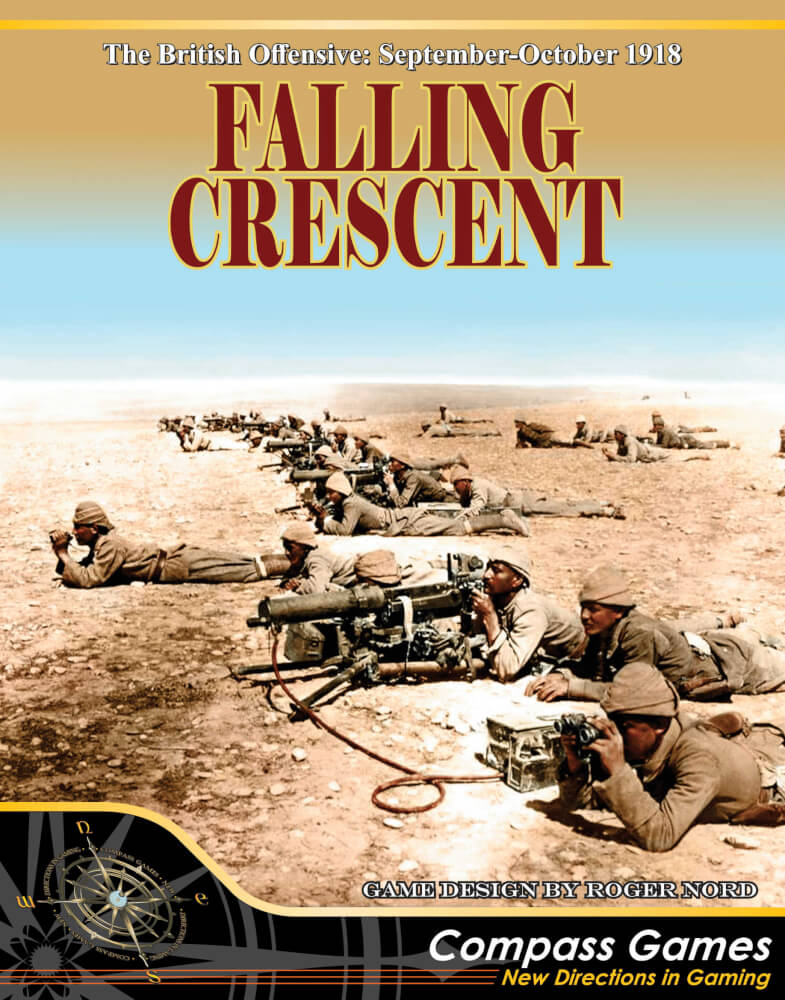
Falling Crescent is an operational-level wargame that places players at the heart of the 1918 British offensive against the Ottoman Empire in Palestine. One player commands the Turkish, German, and Bedouin forces, while the other leads British, French, and Arab guerrilla troops—or, in a three‑player variant, controls the Arabs separately. The game stands out for its blend of campaign and battle cards, which introduce events, tactical decisions, and unexpected reactions, keeping the game unpredictable and exciting. Movement takes place on a hexagonal grid, with units using movement points to advance and position strategically. When two armies clash, the combat results table combined with dice rolls determines the victor, reflecting the chaotic nature of World War I battles. The zone‑of‑control mechanic adds tension, as enemy units can be forced to retreat or suffer penalties when entering controlled territory. Designer Roger Nord’s work captures the flavor of cavalry, guerrilla warfare, and the changes to come in the years ahead, offering a blend of history, strategy, and surprise. For those who enjoy deep tactical military simulations with varied replays, Falling Crescent promises hours of strategic analysis and fun.
The game is suitable for 2–3 players, with playtime ranging from 120 to 360 minutes depending on the chosen campaign complexity. The learning curve is moderate, requiring attention to card details and combat tables. Components are robust: a hexagonal board, miniature army pieces, campaign and battle cards, dice, movement‑point tokens, and a well‑structured rulebook. If you’re a fan of wargames that favor strategic decisions and dynamic narratives, this title will surprise you with its depth and excitement.
In short, Falling Crescent offers an engaging war experience, with solid mechanics and a historical narrative that keeps players on constant alert. If you’re looking for a game that blends strategy, history, and surprise, this title is an excellent choice.
The game is suitable for 2–3 players, with playtime ranging from 120 to 360 minutes depending on the chosen campaign complexity. The learning curve is moderate, requiring attention to card details and combat tables. Components are robust: a hexagonal board, miniature army pieces, campaign and battle cards, dice, movement‑point tokens, and a well‑structured rulebook. If you’re a fan of wargames that favor strategic decisions and dynamic narratives, this title will surprise you with its depth and excitement.
In short, Falling Crescent offers an engaging war experience, with solid mechanics and a historical narrative that keeps players on constant alert. If you’re looking for a game that blends strategy, history, and surprise, this title is an excellent choice.
GALLERY
1 photos · from the community
Tap any photo to open fullscreen. Photos submitted by the community or publisher.
2
OK
3
OK
Loading playlist...
Finding best prices...
Prices unavailable at this time.
Price history — last 6 months (lowest new offer)
Mechanics
Categories
Publisher
Compass Games
Designer
Roger Nord
Artist
Bruce Yearian
How many players can play the game?
Falling Crescent is designed for 2 or 3 players, depending on the chosen variant.
What is the typical playtime?
The game usually lasts between 120 and 360 minutes, depending on the campaign complexity.
How difficult is the learning curve?
The learning curve is moderate; it’s recommended to read the rules and try short games first.
What are the main components?
Hexagonal board, army miniatures, campaign and battle cards, dice, movement‑point tokens, and the rulebook.
Who is the target audience?
Ideal for wargame enthusiasts who enjoy strategic decisions, dynamic cards, and historical narratives.
Are there any language limitations?
Yes, the rules and cards are in English, but the mechanics are universal and can be translated.