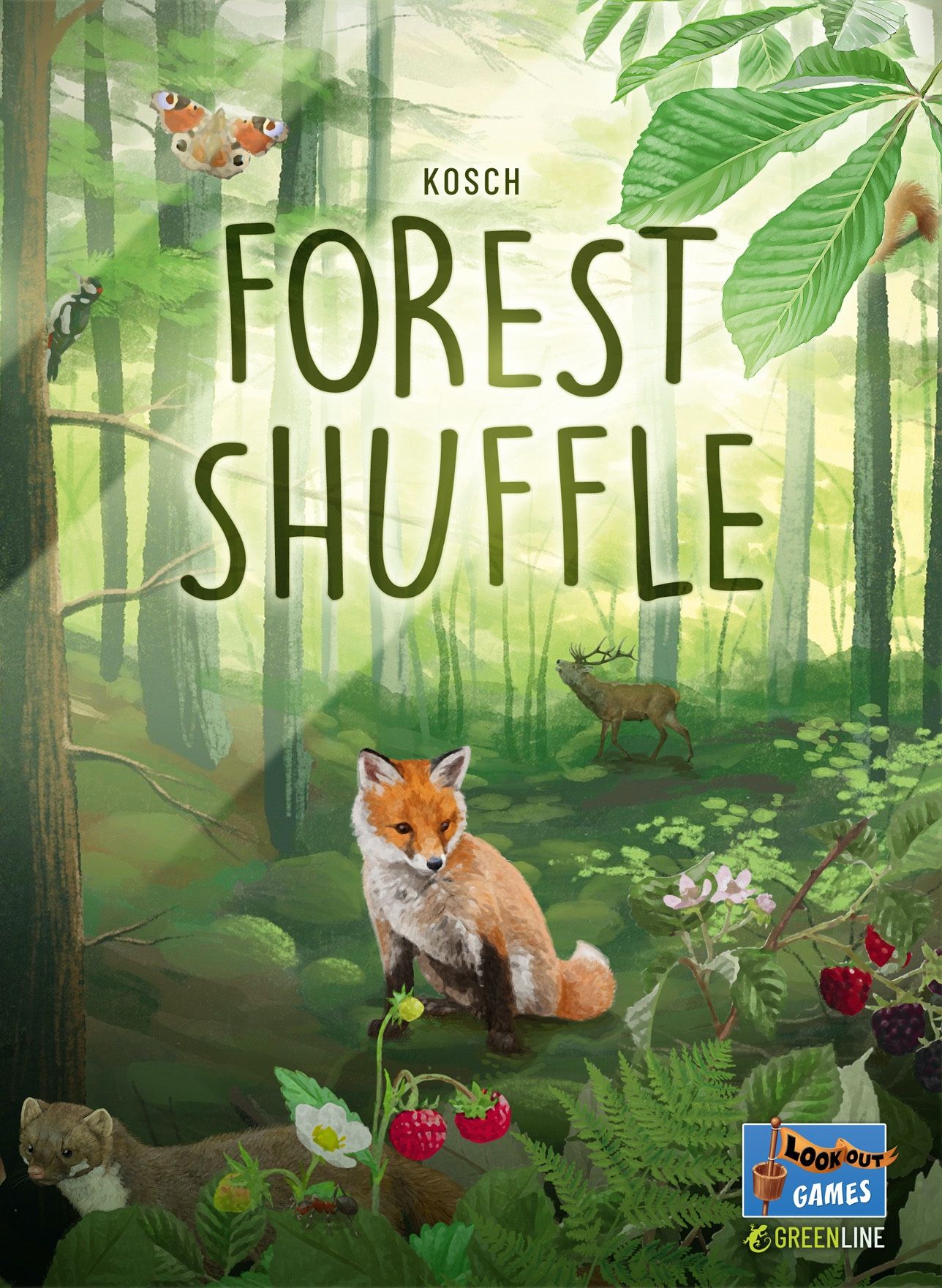
Forest Shuffle — How to Play
Lookout Games, ADC Blackfire Entertainment, Bluebird Games · Board game · 2023What do you want to do now
Ask anything about Forest Shuffle: rules, setup, components, complexity, price, or whether it fits your group.
Video: How to Play
Start here, then follow the written guide
Step by step
Game Objective
Hey everyone! Ready to dive into nature and create the most lush and harmonious forest ever seen? In **Forest Shuffle**, our objective is simple yet challenging: build **ecologically balanced habitats** for local flora and fauna. We'll plant **trees**, which will serve as the foundation for various **animals, plants, and mushrooms** to thrive. But it's not just about playing cards! To be the true master of the forest, you need to be clever and respect the **preferences of each creature**. Some like company, others specific habitats or food. Ultimately, whoever has the **highest score** will be the winner and the proud guardian of the richest forest!Setup
Let's set up this table and prepare our little corner of the forest!- First, take the **board** – our **clearing** – and place it in the center of the table, where everyone can reach it. The **14 reference cards** go next to it, to clear up any doubts during the game.
- Each player takes a **cave card** and places it in front of them. It will be important for scoring!
- Separate the **3 winter cards** for now. They have a special role at the end of the game.
- Shuffle the rest of the cards (all of them, except the winter cards). Now, let's remove some cards from the game, depending on the number of players:
- **2 players**: Remove 30 cards.
- **3 players**: Remove 20 cards.
- **4 players**: Remove 10 cards.
- **5 players**: No cards are removed (play with all of them!).
- Divide the remaining cards into **three face-down piles**, of roughly equal size.
- Now, take **two winter cards** and shuffle them into **one of these piles**. Then, place the **third winter card** on top of that same pile.
- Place the other two piles on top of the pile containing the winter cards, forming a large **deck**. Leave this deck to the left of the **clearing**.
- Each player draws **6 cards** from the deck to form their **starting hand**. If you don't draw any **trees** in this hand, you can **mulligan**: return the six cards to the game box and draw another six. But be careful, you can only do this **once**!
- Finally, the player who **most recently walked in a forest** will be the first to play. Let the adventure begin!
The Game Turn
Starting with the first player, everyone plays their turns clockwise. On your turn, you must perform **exactly one of the two possible actions**:A) Draw Two Cards
In this action, you draw two cards, one at a time, and add them to your hand. For each card, you can choose whether to take the **top card of the deck** (face down) or a **face-up card from the clearing**. At the start of the game, the clearing will be empty, so the first cards will come from the deck.
Important: You have a limit of **10 cards in hand**. If you already have 9 cards, you can only draw one. If you have 10, you cannot draw any!
Winter Cards: Keep an eye out! The last third of the deck contains the **3 winter cards**. If you draw a winter card, you must place it **face up next to the clearing** and immediately draw another card from the deck to replace it. When the **third winter card** is drawn, the game ends immediately!
B) Play a Card and Check the Clearing
This is the action of building your forest! To play a card from your hand, you must first **pay its cost**. The cost is paid by **discarding other cards from your hand** face up into the **clearing**, in the quantity indicated by the cost of the card you want to play. If you are playing a **split card**, choose only one of the halves to play and pay only the cost of that half.
Normally, it doesn't matter which cards you discard as payment. But some species offer a **bonus** if you pay with **specific cards** (we'll talk about this in "Effect and Bonus").
After paying, place the card in front of you, face up. This collection of cards is your **forest**!
Trees and Tree Saplings
- **Trees** are the foundation of your forest. They offer **four card spaces** on their edges: top, bottom, left, and right. As long as no card is played in a space, it is considered **empty**. A tree is considered **fully occupied** if it has at least one card on each of its four edges.
- Whenever you play a **tree**, you must also **draw the top card of the deck** and place it **face up in the clearing**. This is important to keep the clearing active! (Beware, this might reveal a winter card!)
- Instead of playing a specific tree, you can play any card from your hand **face down** as a **generic tree sapling**. It also offers four card spaces, but does not belong to any tree species.
Animals, Plants, and Mushrooms (Split Cards)
- **Split cards** feature two forest inhabitants (animal, plant, or mushroom). When playing a split card, you must place it in an **empty space on the corresponding edge of a tree** in your forest.
- For example, if you want to play an inhabitant that is on the left half of the card, it must be placed on the left edge of a tree. The unused half of the card is slid under the tree and is not relevant for the game or scoring.
- Attention: Split cards can only be played if one of your trees has an empty card space available on the corresponding edge.
Effect and Bonus
If the card you just played has an **effect** or **bonus** (or both), you can use them now. If you want to use both, use the **effect before the bonus**. Using an effect or bonus is optional.
- Effects:
- Most cards offer an **instant effect**, used **once** immediately after playing the card.
- **Mushrooms**, however, offer a **permanent effect**, which you can use for the rest of the game, starting from your next turn. For example, a mushroom might allow you to draw a card from the deck whenever you place a card in a space below a tree.
- Bonus ☘️:
- Some species have a colored arrow with the ☘️ symbol and offer a **bonus** if you pay for them with **compatible cards**. To activate the bonus, **all cards** you discard as payment must have the **same card color** (i.e., the same tree symbol) as the card being played. When paying with split cards, it doesn't matter which half has the compatible tree symbol.
How to Check the Clearing
At the end of your turn, if there are **10 or more cards** in the **clearing**, it must be **emptied**. Remove all cards from the clearing and return them to the game box.
Then, **your turn ends**, and the next player clockwise will play their turn, unless an effect or bonus allows you to play another turn.
End of Game and Scoring
The game ends suddenly when the **third winter card** is revealed! No more turns, and it's time to count points.Scoring
Calculate the **🌰 points** of all **visible cards in your forest**. Additionally, add the number of cards that are **under your cave** to the total, if any. This is your final score!
If you have questions about how to score a specific card, consult the **reference cards** or the digital appendix.
The player with the **highest score is the winner**! In case of a tie, victory is shared. Congratulations, guardians of the forest!
Tips for Winning
To avoid getting lost in the woods, here are some tips to start off on the right foot in **Forest Shuffle**:- Plan Your Trees: **Trees** are the backbone of your forest, as they create spaces for **animals, plants, and mushrooms**. Think carefully about where and when to play your trees, as they determine your future options for fitting split cards. Trying to occupy all four edges of a tree can be a good strategy to maximize your spaces.
- Take Advantage of Effects and Bonuses: Don't underestimate the power of **instant effects** and, especially, the **permanent effects of mushrooms**! They can give you significant advantages throughout the game, such as drawing more cards or playing creatures for free. Also, pay attention to the **☘️ bonuses** on cards; paying with cards of the same color can provide an extra boost to your strategy.
- Manage Your Hand and the Clearing: The **drawing cards** action is crucial to keep your options open. Keep an eye on your 10-card limit and the **clearing**. Drawing cards from the clearing can be strategic to pick up something another player discarded or that was revealed. Remember that the clearing empties when it reaches 10 cards, so sometimes it's worth discarding to force the emptying and refresh options for other players (or for yourself on your next turn, if you're lucky!).
More videos
More rules explanations from the community
In English
-
 Forest Shuffle - How to Play - With Tips!
-
 How to Play Forest Shuffle
-
 Genius Features of Forest Shuffle Smart Counter App You Have to See
-
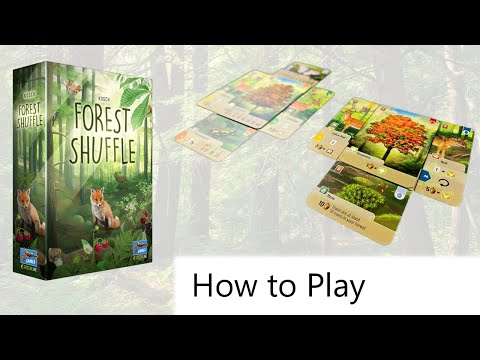 How to play Forest Shuffle
-
 how to play Forest Shuffle
-
 You're Up in Forest Shuffle
-
 All the Games with Steph: Forest Shuffle
-
 Forest Shuffle Board Game Overview
-
 Forest Shuffle | Solo Board Game Playthrough and Tutorial
-
 How To Play Forest Shuffle On BGA (In Under 15 Minutes)
Rules manual
Official PDF file