
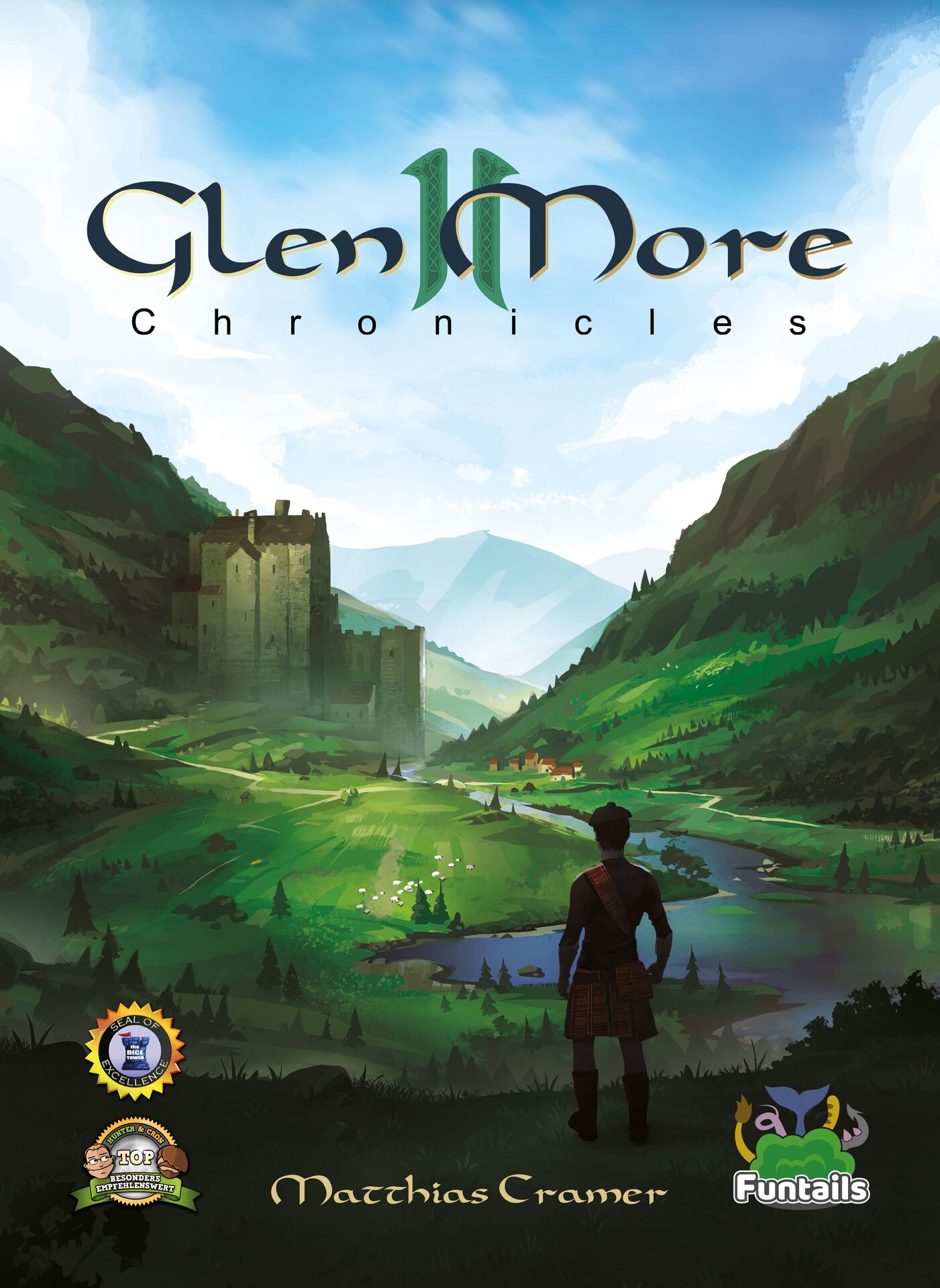
Glen More II: Chronicles
Funtails, Broadway Toys LTD, Delirium Games · Board game · 2019Objective of the Game
Welcome, future clan leader! In Glen More II: Chronicles, you'll step into the shoes of a Scottish clan leader, from the early medieval ages to the 19th century. Your goal? To expand your territory, grow your wealth, and leave the biggest impact on Scottish history!
Will you focus on whisky production, trade goods in bustling markets, befriend other Highland clans, or seize control of iconic landmarks like lochs and castles? The path to glory is yours to choose, but only one clan will reign supreme. The player with the most Victory Points (VP) at the end of the game wins! Slàinte mhath!
Preparation (Setup)
Alright, let's get your Scottish Highlands ready for expansion!
- Choose Your Clan: Each player picks one of the available colors and receives:
- Their Home Territory Tile (a double tile piece with the Home Castle and Village along the River).
- All Scotsmen in their chosen color (10 per player).
- All Clan Markers in their chosen color (10 per player).
- Set Up the Table:
- Place the Clan Board and the Rondel in the middle of the table.
- Create a general pool for Whisky Casks, Resource Tokens (Wood, Stone, Barley, Sheep, Cattle), Coins, and all Victory Point chips next to the board.
- Place the Landmark Cards next to the board. For your first game, we recommend placing only the A Landmark Cards face up, adding B, C, and D cards as their respective tile stacks come into play.
- Determine Initial Player Order:
- Take one Scotsman from each player's supply (these act as Playing Pieces).
- Shuffle them in your hand and then place them in a random order in consecutive spaces on the Rondel, starting anywhere.
- The player whose Playing Piece is in the last position on the Rondel is the starting player and receives 5 Coins. The next players in order receive 6, 7, and 8 Coins respectively.
- For 2 players, place the Die in the space clockwise ahead of the first Playing Piece. For 3 or 4 players, the Die is optional (it shortens play time); if used, place it in the space clockwise ahead of the first Playing Piece.
- Sort the Tile Stacks:
- Assemble and shuffle the four Tile stacks (A to D, identified by the letter on their back) and place them face down on their marked areas on the board.
- Place "The End" Tile roughly in the middle of the D-Stack. For a shorter, introductory game, place "The End" Tile on top of the D-Stack.
- Set Up the Rondel:
- Take the 5 Starting Tiles (marked with 'S' on the back) and place them face up in front of the Playing Pieces (or the Die, if used).
- Fill the remaining spaces of the Rondel clockwise with Tiles from the A stack.
- The space behind the last Playing Piece remains empty.
- For 2 and 3 players only, place 1 Coin from the general pool on the leftmost space (marked with a '1') of each Market row.
- Place Additional Material:
- Place the David Hume Tile near the Clan Board.
Note: Resources, Coins, Victory Points, and Whisky are unlimited. Scotsmen are limited.
The Turn of Play
Unlike many other games, there's no fixed player order in Glen More II: Chronicles! The player whose Playing Piece is at the rear of the Rondel (next to the empty space) takes their turn. You can advance your Playing Piece as far as you like, which means you might take several turns in a row if you stay in last position!
Here's how a player's turn unfolds:
- Advance and Take a Tile:
- Move your Playing Piece to any space on the Rondel that has a Tile on it.
- If the Tile has a cost (Resources, Coins, Whisky, or Scotsman), you must pay it before taking the Tile. You can use resources from any of your Tiles or Coins from your pool. You can even use the Market to buy needed resources (see "The Market" below). If a Scotsman is required, it must come from a Tile within your Home Territory. If you can't pay, you can't take that Tile.
- If you cannot legally take any available Tiles, you can discard a Tile by moving onto it. You then take 1 Coin from the pool OR receive 1 Movement Point.
- Place your Playing Piece in the now-empty space where the Tile was.
- Place the Tile:
- If you took a Person Tile, it's not added to your territory; instead, place it in a separate supply next to your Whisky Casks and Landmark Cards. Taking a Person Tile does not activate any tiles in your territory.
- If you took any other Tile, add it to your territory following these rules:
- It must touch at least one side of an already placed Tile (corners don't count).
- It must be placed orthogonally or diagonally adjacent to one of your Scotsmen. No Scotsman, no placement!
- If the Tile has a river, it must extend your existing river. You can only have one continuous river in your territory. No non-river tiles can be placed to the left or right of a river tile.
- Overbuild Tiles: Some tiles can be placed on top of existing tiles of the same type (matching golden type icon). The river must also match. Resources and Scotsmen on the overbuilt tile move to the new tile. Only the topmost tile is used for the rest of the game.
- Trigger One-Time Effects:
- After placing a Tile, immediately gain any one-time effect shown in its lower-left corner. This could be placing a Clan Marker, taking a Landmark Card, placing a Scotsman, gaining a Joker Resource (any resource except Whisky), taking a Whisky Cask, gaining a Coin, or receiving Victory Points.
- Activate Tiles:
- Immediately activate the newly placed Tile and all orthogonally and diagonally neighboring Tiles (up to 8). You can activate them in any order you choose, but each tile can only activate once per turn. All activations are optional.
- Types of Activations:
- Gaining Resources: Take the shown resource(s) from the pool and place them on the activated Tile (max 3 resources per tile).
- Exchanging Resources: Trade specific resources for Victory Points, Whisky Casks, or to place Clan Markers. Exchanged resources return to the pool. For example, exchange 1 Barley for 1 Whisky Cask.
- Movement Points: Gain 1 Movement Point for each activated Tile with the Movement Icon. Each point lets a Scotsman move to an adjacent tile in your territory.
- Victory Points: Immediately gain the shown number of Victory Points.
- Refill the Rondel:
- Add 1 or more Tiles from the current Tile stack (A, B, C, or D) to the Rondel in a clockwise direction until only one empty space is left, right behind the last Playing Piece.
- If you place the last Tile from a stack (A, B, or C), a Scoring Phase immediately takes place before the next player's turn. The D-Stack is handled differently.
The Market
At any point during your turn, you can buy or sell resources at the Market, located in the middle of the Rondel. It has numbered rows (1, 2, 3) for each of the five resources.
- Buying: Place Coins on the leftmost empty field for the desired resource (1, 2, or 3 Coins as indicated). You can buy as many resources as you want, but you must use them immediately to pay costs (e.g., for Tiles or via a Trade Tile). You cannot buy resources to keep in supply.
- Selling: Return resources to the pool and take the rightmost stack of Coins from that resource's row. You can sell any number of resources as long as there are Coins on the Market row. Selling can happen at any time, even before activation, to make room for new resources.
Important: Whisky Casks and Scotsmen are NOT resources and cannot be bought or sold at the Market.
Persons, Clan Markers, and the Clan Board
When you take a Person Tile, you don't add it to your territory. Instead, it goes into a separate supply. This means it doesn't activate adjacent tiles or count towards your territory size. However, Persons grant a one-time effect: you gain the favor of another Clan!
- Place one of your Clan Markers on an empty Clan Field on the Clan Board.
- You must pay the Coin cost indicated on the roads connecting your chosen Clan Field to either the green Start Field or any Clan Field with an already placed Clan Marker (regardless of its color). If you can't pay, you can't choose that field.
- Then, you receive the bonus from that Clan. Each Clan Field can only be claimed once per game.
End of Game and Scoring
The game is played over 4 rounds. The first three rounds end when the last Tile of stacks A, B, and C respectively is placed on the Rondel, triggering an immediate Scoring Phase.
The 4th round, and thus the game, ends when the last player has moved their Playing Piece on or over "The End" Tile. Players usually move over "The End" Tile to take one last tile from the Rondel. If a player prefers not to take another tile, they can end their game immediately by moving onto "The End" Tile. More than one player can move onto "The End" Tile.
A Final Scoring Phase then takes place, which works as follows:
- Normal Scoring: A regular Scoring Round occurs (see below).
- Territory Size Comparison: Compare the size of each player's territory (number of tiles) to the smallest player territory. For each tile you have more than the player with the fewest tiles, you lose 3 Victory Points. (Person Tiles do not count towards territory size).
- Coins: Each player receives 1 Victory Point for each Coin they possess.
- Landmark Cards: Some Landmark Cards award additional Victory Points at the end of the game.
The player with the most Victory Points wins! In case of a tie, the player with the highest number of resources held wins. If there's still a tie, players share the victory.
The Scoring Rounds
There are 4 Scoring Rounds. The first three happen when the last Tile of stacks A, B, and C is placed. The fourth is part of the End of Game. All Scoring Rounds work identically:
- The game is suspended for the Scoring Round.
- Players compare their achievements in four categories against the player with the least in each category:
- Number of Scotsmen on their Home Castle Tile.
- Number of Landmark Cards.
- Number of Whisky Casks.
- Number of Person Tiles.
- You earn points based on your lead over the player who has the LEAST of each item.
- Difference to player with lowest number: 1 VP
- Difference to player with lowest number: 2 VP
- Difference to player with lowest number: 3 VP
- Difference to player with lowest number: 4 VP
- Difference to player with lowest number: 5 VP
- Difference to player with lowest number: 8 VP
Note: Players keep their Scotsmen, Landmark Cards, Whisky Casks, and Person Tiles after scoring; they are not returned to the pool.
Tips for Winning
Ready to make your mark on Scottish history? Here are a few pointers to get you started:
- Master the Rondel: Since player order is dynamic, always be aware of your position on the Rondel. Being last means it's your turn, and you can move as far as you like. Sometimes, taking a less-than-ideal tile to stay last and take multiple turns can be a powerful strategy!
- Strategic Tile Placement and Activation: Think about where you place your tiles. Activating the new tile and all its neighbors is huge! Try to place tiles that create a cluster of valuable activations, especially those that generate resources you need or Movement Points to reposition your Scotsmen for future placements. Remember the 3-resource limit per tile!
- Don't Neglect the Clan Board: Person Tiles don't expand your territory, but their one-time effects from the Clan Board can be incredibly potent. Look for bonuses that align with your current strategy, whether it's gaining Coins, Victory Points, or powerful ongoing effects. Don't be afraid to pay a few Coins for a strong Clan Marker placement!
In English
-
 Glen More II: Chronicles Tutorial & Playthrough - JonGetsGames
-
 Game in a Nutshell - Glen More Chronicles II (how to play)
-
 Board To Death Video Preview (3 Minutes)
-
 Glen More II: Chronicles - Chronicle I: The Dragon Boat Races (English)
-
 Glen More II: Chronicles - Chronicle III: Ol’ Jamey’s Single Cask Reserve (English)
-
 Pit Stop: Glen More II - Chronicles
-
 Glen More II: Chronicles - Chronicle II: Highlander - There can be only one (English)
-
 Glen More II: Chronicles - Chronicle IV: Hammer of the Scots (English)
-
 Glen More II: Chronicles - Chronicle VI: The Dubious Tome of Scottish History (English)
-
 Glen More II: Chronicles - Chronicle VII: Between a rock and a hard place (English)
-
 Glen More II: Chronicles - Chronicle VIII: The Penny Mobs (English)
-
 Glen More II: Chronicles - Chronicle V: Address to a Haggis (English)

