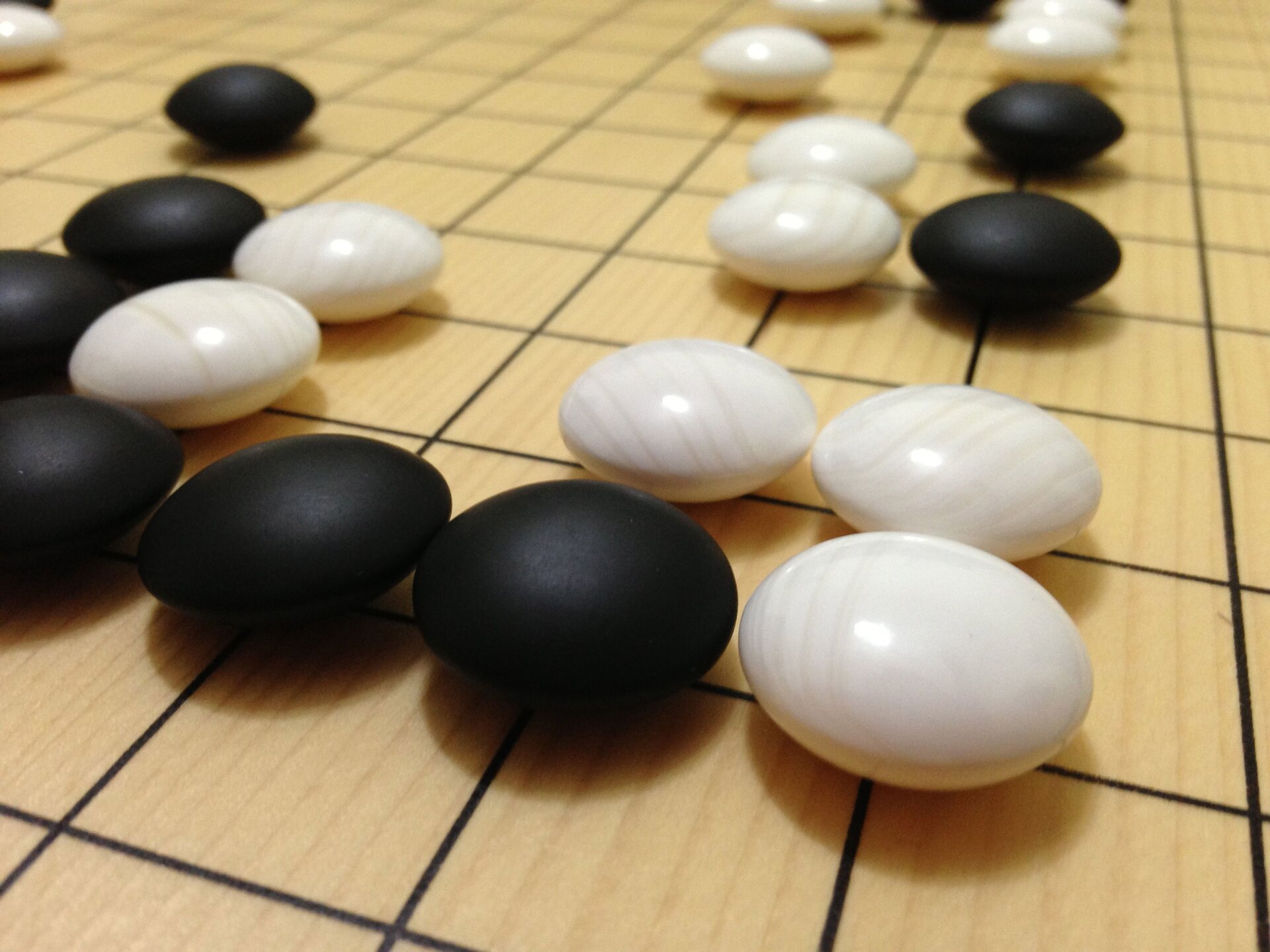
How to Play Go
(Public Domain), (Self-Published), (Unknown) · Board gameWhat do you want to do now
Ask anything about Go: rules, setup, components, complexity, price, or whether it fits your group.
Video: How to Play
Start here, then follow the written guide
Step by step
Game Objective
Alright, strategist! Ready to dominate the board? In Go, your objective is simple yet challenging: conquer a greater amount of territory than your opponent. Think of the board as a vast, untouched field, and you and your opponent are the pioneers, each seeking to surround the most advantageous areas. The game is a constant struggle for space, where every move counts to ensure your territorial supremacy!
Preparation (Setup)
Let's set up the table for battle! Go is played on a board that can be 9x9, 13x13, or the official tournament size, 19x19. For this version, we have a 13x13 line board, 85 black pieces, and 84 white pieces.
- First, position the board so that the bowls (where you will store your pieces) face each player.
- Next, players choose by drawing lots who will play with the black pieces and who will play with the white pieces. An important note: if there is a skill difference between players, the less experienced player always takes the black pieces.
- All stones (the Go pieces) start off the board. Each player stores their pieces in their respective bowl.
- The player with the black pieces always starts the game.
- If using the handicap system (to balance games between players of different skill levels), the weaker player (who plays black) starts with a number of stones placed on the marked points of the board (the "hoshi"). The number of handicap stones is proportional to the skill difference between the players, and can be up to 9 stones.
The Game Turn
The dynamics of Go are elegant and profound. Moves are alternated and follow some crucial rules:
- Stones are placed on the intersections of the lines, including the intersections on the edges of the board.
- Once placed, stones do not move. They stay where they were played, defining the boundaries of your territory.
- The player with the black pieces always makes the first move.
- A fundamental term is Liberty: these are the adjacent spaces (connected by a line) to a stone or group of stones. Think of them as the "breaths" of your stones.
- Capturing Stones: A stone or a group of connected stones is captured if all of its liberties are occupied by the opponent. This means they have been completely surrounded! Captured stones are removed from the board and do not return to the game.
- Illegal Moves:
- You cannot place a stone on a space that has no liberties (i.e., where it would be immediately surrounded and without "breath"), unless that move results in the capture of one or more of the opponent's stones.
- If a move results in a capture, but the opponent has the chance to make the same move with the same group of stones consecutively (which would lead to an infinite cycle), this move is not allowed. This prevents indefinite repetitions.
- Passing a Turn: At any time, a player can choose to pass their turn, without placing any stones.
End of Game and Scoring
A game of Go is a journey of construction and containment, and it ends in a very specific way:
- The game ends when both players pass consecutively. This usually happens when territories are "hermetically sealed," with no further possibilities of invasion.
- After the game ends, the territory counting begins.
- Territory is composed of the free intersections that are completely surrounded by a player's stones, in such a way that they cannot suffer any more invasions.
- To count points, simply sum the number of free intersections within your territory. The stones that form the boundary of a territory must be of the same color, and no enemy stone can be on the boundary line.
- The player with more territories (more points) wins the game!
Tips for Winning
Want to start dominating the board? Here are some essential tips for beginners:
- Surround Efficiently: Remember that the goal is to conquer territory. Try to surround large areas with your stones, but always ensure that your territory is well protected and without "gaps" for the enemy. Think about building solid walls!
- Pay Attention to Liberties: Your stones need liberties to survive. When attacking opponents, focus on reducing their liberties. When defending your own stones, make sure they have enough liberties so they are not easily captured. A stone without liberty is a captured stone!
- The First Move Matters (Feng Shui): The player with the black stones traditionally makes the first move in the bottom left corner of the board. While not a scoring rule, following this tradition can give you an initial strategic base, setting up a "Feng Shui" for the game.
More videos
More rules explanations from the community
In English
-
 Level Up 08 : Go/Igo/Weiqi Basic Strategy for beginners
-
 How to Play Go in 5 Minutes
-
 How to Play Go — Beginner Tutorial | Go Rules
-
 Level Up 26 : Go/Igo/Weiqi Basic Strategy for beginners 2
-
 How to Play Go : by Clossius
-
 How to Play Go | Learn to Play Board Games
-
 Drako Learns a Game: GO - Part1 - How to Play
-
 3 Important tips for beginners
-
 Beginner Level Branching Joseki Videos
-
 Level Up 17: Free App/websites to play real players for Go/Igo/Weiqi/Baduk
-
 How to Play Go
Rules manual
Official PDF file
Frequently Asked Questions
Quick answers about the rules
What is the objective of Go?
How do you set up Go?
How does Go end, and how do you score?
What are some tips for winning Go?
Other Games You'll Like
Based on mechanics and theme