
Great Western Trail: 13th Building Tile
eggertspiele · Board game · 2019
2–4 · best 3, 4
75–150 min
Weight 3.0/5
13.0
rating
Ludopedia
7.9
rating
BGG
13.0
rating
Ludopedia
7.9
rating
BGG
Our Verdict
FOR GENRE FANS
A tiny upgrade that brings crucial strategic choices for cattle masters.
Highlights
- New building options
- Boosts cash flow
- Increased tactical flexibility
Keep in mind
- Requires base game
- Requires cattle management
Rules manual not indexed yet
Upload the PDF rulebook to ask questions about this game with AI.
About the game
What you do in a play session
If you're already a master of the cattle routes in Great Western Trail, get ready to add another piece to your strategic puzzle! The '13th Building Tile' isn't a full-blown expansion, but rather a promotional item that introduces a new layer of possibilities to your construction planning. It acts as an 'upgrade' to your private building board, offering two distinct paths (sides A and B) for you to choose from depending on your current game needs.
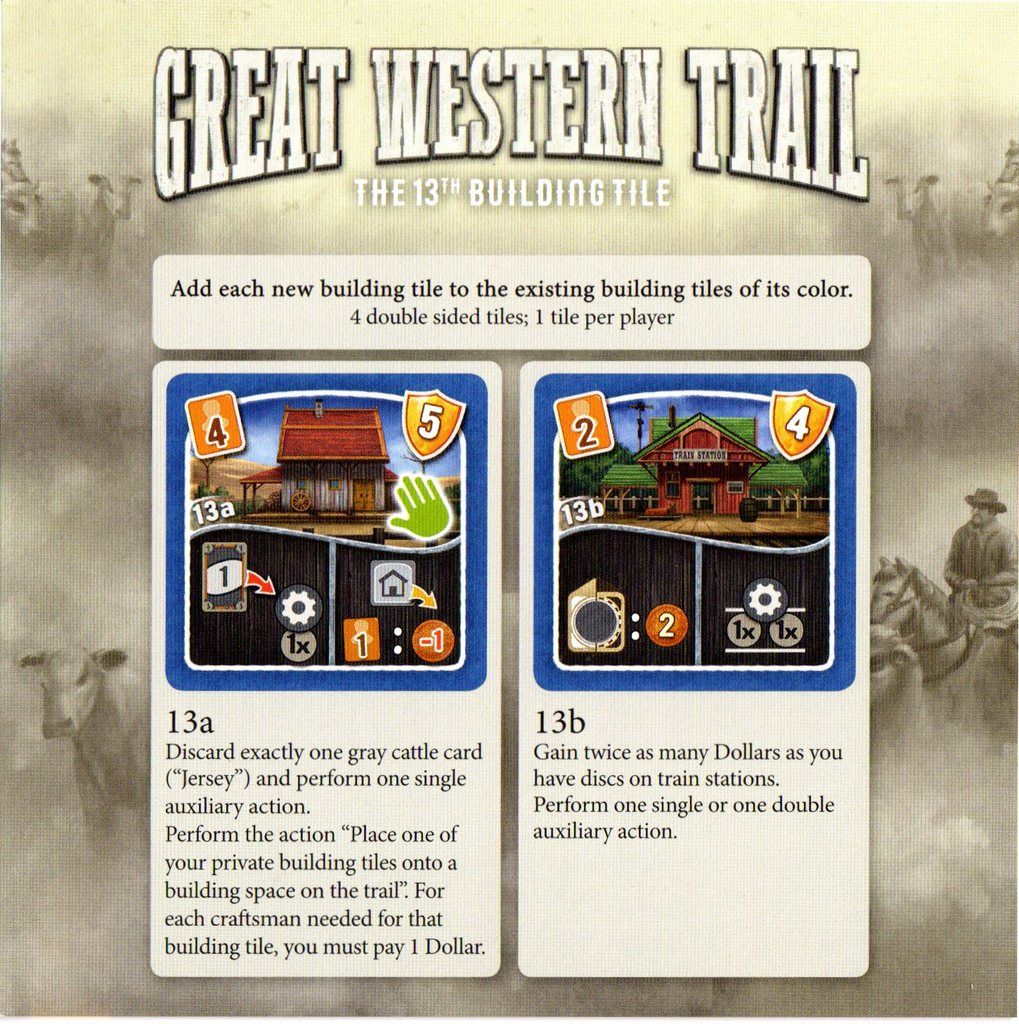
On side A, the focus is on territorial expansion and infrastructure. You discard exactly one gray cattle card (the 'Jersey') to perform a single auxiliary action and place one of your private buildings onto a building space on the trail. It's a fantastic move for players looking to solidify their presence on the map, but keep an eye on your wallet: for every craftsman required by that building tile, you must pay 1 dollar. It's a classic 'pay to grow' mechanic.
On side B, the game shifts slightly toward capital accumulation and agility. Here, the financial reward takes center stage: you gain twice as many dollars as you have discs on train stations. To top it off, you get to perform either one or two auxiliary actions. This is the ideal choice for those moments when you need a quick cash injection or an extra move to fine-tune your end-game strategy.
Just a reminder: this is a supplement, meaning you'll definitely need the base game to make use of it. The set comes with four identical tiles, one in each player color, ensuring everyone at the table gets a shot at using this new resource management and construction tool. It's a small addition that can make a massive difference in your final score!
On side A, the focus is on territorial expansion and infrastructure. You discard exactly one gray cattle card (the 'Jersey') to perform a single auxiliary action and place one of your private buildings onto a building space on the trail. It's a fantastic move for players looking to solidify their presence on the map, but keep an eye on your wallet: for every craftsman required by that building tile, you must pay 1 dollar. It's a classic 'pay to grow' mechanic.
On side B, the game shifts slightly toward capital accumulation and agility. Here, the financial reward takes center stage: you gain twice as many dollars as you have discs on train stations. To top it off, you get to perform either one or two auxiliary actions. This is the ideal choice for those moments when you need a quick cash injection or an extra move to fine-tune your end-game strategy.
Just a reminder: this is a supplement, meaning you'll definitely need the base game to make use of it. The set comes with four identical tiles, one in each player color, ensuring everyone at the table gets a shot at using this new resource management and construction tool. It's a small addition that can make a massive difference in your final score!
Expansion for
Published additional content
Gallery
Box and component photos
Tap any photo to open fullscreen. Photos submitted by the community or publisher.
Best player count
BGG community vote
2
REC
3
BEST
4
BEST
Soundtrack
Ambience suggested by Melodice
Loading playlist...
Where to Buy
Prices monitored daily
Finding best prices...
Prices unavailable at this time.
Price history — last 6 months (lowest new offer)
Alert enabled!
Join the BoardGamesBot deals group
Get the best board game deals every day — without message spam.
Join the WhatsApp groupGame details
Mechanics, categories, families and credits
Mechanics
Categories
Families
Publisher
eggertspiele
Designer
Alexander Pfister
Artist
Andreas Resch
Community
Data from BoardGameGeek
Frequently Asked Questions
Quick answers before you buy
Can I play with just this item?
No, this is a promotional supplement and requires the Great Western Trail base game to play.
How many players can use it?
The set includes 4 tiles, one for each player color (supporting 2-4 players).
What is the difference between side A and side B?
Side A focuses on building on the trail by discarding Jersey cattle; side B focuses on earning money from stations and extra actions.
Does this increase the game's complexity?
Not significantly; it just adds new action options that fit within the existing game flow.
Is it hard to learn?
Not at all! If you know how to play the base game, you'll grasp these new options immediately.
