Halma
(Public Domain), (Unknown), A. N. Myers & Co · Board game · 1884
2–4 · best 2
30 min
Weight 1.8/5
Buy
6.2
rating
Ludopedia
5.5
rating
BGG
Our Verdict
FOR GENRE FANS
Perfect for those who love pure strategy and fast-paced reasoning. Its strongest point is the tactical simplicity.
Highlights
- Rules learned in minutes
- Spatial awareness challenge
- Versatile (solo, duo, or group)
- Dynamic game pace
Keep in mind
- Can be repetitive for some
- Lack of immersive theme
Rules manual not indexed yet
Upload the PDF rulebook to ask questions about this game with AI.
About the game
What you do in a play session
If you enjoy pure mental challenges without flashy themes or 50-page manuals, Halma is right up your alley. The name comes from the Greek word for 'jump', and that's exactly what you'll be doing: jumping your pieces to cross the board as quickly as possible. Created around 1883 by Dr. George Howard Monks, a Harvard surgeon, the game was inspired by a British pastime called Hoppity and quickly became a hit across Europe.
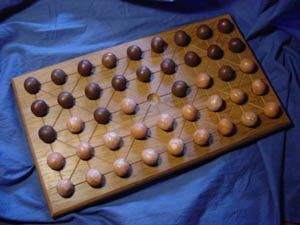
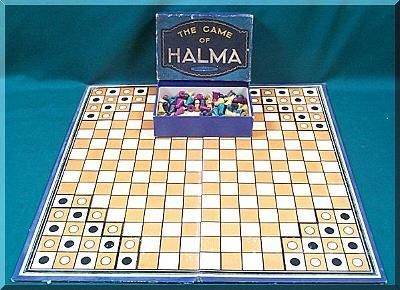
The board is a 16x16 grid where the goal is simple, though the execution is where the real challenge lies: you must move all your pieces to the opposite side of the board. The magic happens during the jumps. You can leap over pieces (either your own or your opponent's) to shorten the distance, turning the game into a strategic race of positioning. If you're clever, you'll create 'bridges' for your pieces to fly across the map; if you're careless, you'll end up giving your opponent a free ride to leap over you and win the race.
Halma is incredibly versatile. It can be played as a duel, in teams of four, or even as a solitaire challenge for those who want to train their spatial awareness. Fun fact: you know Chinese Checkers? Well, it's basically an evolution of Halma, adapting the board into a star shape to accommodate more players. It's a game of pure spatial vision and planning, where every move can either open or close the door to victory. It's the kind of game that seems easy at first, but leaves you thinking 'how did I miss that jump?' five minutes later.
The board is a 16x16 grid where the goal is simple, though the execution is where the real challenge lies: you must move all your pieces to the opposite side of the board. The magic happens during the jumps. You can leap over pieces (either your own or your opponent's) to shorten the distance, turning the game into a strategic race of positioning. If you're clever, you'll create 'bridges' for your pieces to fly across the map; if you're careless, you'll end up giving your opponent a free ride to leap over you and win the race.
Halma is incredibly versatile. It can be played as a duel, in teams of four, or even as a solitaire challenge for those who want to train their spatial awareness. Fun fact: you know Chinese Checkers? Well, it's basically an evolution of Halma, adapting the board into a star shape to accommodate more players. It's a game of pure spatial vision and planning, where every move can either open or close the door to victory. It's the kind of game that seems easy at first, but leaves you thinking 'how did I miss that jump?' five minutes later.
Gallery
Box and component photos
Tap any photo to open fullscreen. Photos submitted by the community or publisher.
Rules videos
Learn by watching before you open the box

Best player count
BGG community vote
2
BEST
3
OK
4
BEST
Soundtrack
Ambience suggested by Melodice
Loading playlist...
Where to Buy
Prices monitored daily
Finding best prices...
Prices unavailable at this time.
Price history — last 6 months (lowest new offer)
Alert enabled!
Join the BoardGamesBot deals group
Get the best board game deals every day — without message spam.
Join the WhatsApp groupGame details
Mechanics, categories, families and credits
Mechanics
Categories
Families
Publisher
(Public Domain), (Unknown), A. N. Myers & Co, ABRA, Adolf Sala, Anglo-American Games Co., ASS Altenburger Spielkarten, Brückner Spiele, Carlit, Chad Valley Co Ltd., Dourios, Drechsler, E.I. Horsman, Euer Spielemännlein, F. H. Ayres, F.X. Schmid, Fairylite, Fratelli Fabbri Editori (Fabbri Editore), G. J. Hayter & Co, Ltd., The Game Crafter, LLC, Gibsons, H. P. Gibson & Sons, Halma Co., Hausser, Hexagames (I), Ilex, Information Erdgas, Jeux Stella, John Jaques of London, Josef Friedrich Schmidt, Juegos Ya S.L., Jumbo, Klee, L. P. Septímio, Lederbogen Karl-Marx-Stadt, M. Klein & Co. GmbH, Merit, Milton Bradley, Mitra, Nederlandse Spellenfabriek B.V. Amsterdam, Otto Maier Verlag, Parker Brothers, Piatnik, Playtime Games, Royal Series, Schmidt Spiele, Si-Si-Spiele, Spear's Games, Das Spiel, SPIKA GmbH, Stockinger & Morsack, R Turner, Victory Spelen, Watilliaux, Werner & Schumann, Wild Horse, WOSI "Wspólna Sprawa", Οδύσσεια
Designer
George Howard Monks
Community
Data from BoardGameGeek
653owners
42wishlist
3want to play
Frequently Asked Questions
Quick answers before you buy
Is the game hard to learn?
Not at all! The rules are very simple and you can learn how to play in just a few minutes.
How many people can play?
The game supports 2 or 4 players, but it can also be played solo as a logic challenge.
How long does a game last?
Usually around 30 minutes, depending on how strategic the match gets.
Is it suitable for children?
Yes, it's great for developing spatial awareness and logical reasoning in kids.
What is the difference from Chinese Checkers?
Chinese Checkers is a Halma variant with a star-shaped board to accommodate more players.
Other Games You'll Like
Based on mechanics and theme