

Kemet
Matagot, asmodee, Asterion Press · Board game · 2012Game Objective
Welcome to Ancient Egypt, where powerful gods send their troops into epic battles! In Kemet, your objective is to demonstrate power by summoning mythological creatures and developing your abilities. To win, you need to be the first to accumulate 8 Victory Points (VP) in Quick Mode, or 10 VP in Extended Mode, at the end of a Day Phase. The mode choice is made even before the sand starts to heat up!
Preparation (Setup)
Setting up the table for Kemet is like assembling your divine army. Let's go:
- Board in the Center: Place the Board in the center of the table, choosing the correct side for the number of players (3 or 5 players use one side; 2 or 4, the other). Remember: for 2 or 3 players, the East bank is not accessible.
- Power Tiles: Spread the 48 Power Tiles (16 white, 16 red, and 16 blue) face up, near the board.
- Victory Points:
- Place the temporary VPs on their respective Temples.
- The permanent VP of the Sanctuary of All Gods is placed on it.
- The other VPs (square and round) are placed next to the board, forming a reserve.
- Divine Intervention (DI) Cards: Shuffle the Divine Intervention Cards and place them in a face-down deck near the board.
- For Each Player: Each player chooses a color and receives:
- 1 individual Player Board.
- 5 Action markers (silver).
- 1 Intercession Points marker, which is placed on the 5th space of the Intercession Points scale on their individual player board.
- 12 Units of their color: 10 units are distributed in the districts of their city (limited to 5 units per space, in districts with a pyramid); the remaining 2 are placed in their reserve.
- 6 Battle Cards.
- 3 Pyramids (1 white, 1 red, and 1 blue). Level 0 pyramids are placed in their reserve.
- Initial DI Cards: Each player receives 1 random DI Card.
- Initial Turn Order: For the first turn, the order is determined randomly.
- Initial Pyramid Allocation: In turn order, each player allocates 3 points among their pyramids, choosing one of the following combinations for the initial level: 1/1/1 or 2/1/0. Level 0 pyramids are not placed on the board, but in the reserve. Pyramids of level 1 or higher are immediately placed in a free district of the player's city.
The Game Turn
The game unfolds in cycles of Night Phases (preparation) and Day Phases (action). Let's understand how it works:
A - Night Phase (Preparation Phase)
This phase sets the stage for the day's actions:
- Distribution of Intercession Points: Each player receives 2 Intercession Points, plus any bonuses from Night Power Tiles. Remember: you can never have more than 11 Intercession Points!
- Distribution of Divine Intervention (DI) Cards: Each player receives 1 random DI Card, distributed in turn order. There is no limit to the number of DI Cards in hand. Playing a DI Card does not count as an action and can be done multiple times in the same phase, with cumulative effects. To play, pay the cost (if any, usually 1
 ) and use it at the appropriate time.
 - Effects of Night Powers: In turn order, each player applies the effects of their Power Tiles that have the Night symbol.
- Determination of Turn Order: The turn order is defined as follows:
- The player with the fewest VPs determines the order.
- In case of a tie, the player who played first in the previous turn order decides.
B - Day Phase (Action Phase)
This is where the magic happens! Each player has 5 Action markers to use:
In turn order, each player places 1 Action marker on an empty space on their individual Player Board and the effect applies IMMEDIATELY. This process repeats for 5 turns until all markers are used. At the end, each player must have placed at least one marker on each of the first 3 levels of the action pyramid on their individual player board.
The golden space at the top of the pyramid is exclusive to the Divine Will Power (golden marker).
Available Actions:
- Intercession: Gain 2 Intercession Points immediately.
- Raising a Pyramid:
- Increase the level of one of your Pyramids. You can raise multiple levels at once.
- The cost in Intercession Points is equal to the level to which the pyramid will be raised. If raising multiple levels, the costs accumulate.
- Pyramid Effects:
- Allow teleportation to an obelisk for 2 .
- Allow buying Power Tiles of the same color and level.
- A Level 4 Pyramid grants 1 temporary VP.
- Allow teleportation to an obelisk for 2
- If an opponent controls your pyramid, they gain its benefits (including the temporary VP), and you lose them.
- Level 0 pyramids are placed on the board in a free city district when they reach level 1 or higher.
- Buying a Power Tile:
- Buy a Power Tile of the specified color. You can only buy one tile of the same color per turn.
- Purchase Condition: You must have a Pyramid of the same color and at the same level (or above) as the desired Power.
- Purchase Cost: The cost is equal to the tile's level. Power Tiles are permanent and remain visible in front of you.
- Important: It is not possible to buy or gain 2 identical Power Tiles (same effects and illustrations).
- Recruitment:
- Spend X Intercession Points to recruit X Units.
- Units come from your reserve and are placed in one, two, or three districts of your city.
- You can only recruit in your own districts. If an opponent controls one of your districts, they cannot recruit there, but you can. Recruiting in a district occupied by an opponent causes a battle.
- Important: A troop cannot have more than 5 units.
- Move / Attack:
- Move 1 Troop. You do not need to move all units of the troop and can gather units from spaces along the way.
- The standard movement capacity is 1 space, but can be increased by Power Tiles, Creature abilities, or DI Cards.
- Movement Forms:
- Land transport: Move units to an adjacent space.
- Port crossing: Cross the Nile between two Ports connected by an arrow (counts as 1 movement space, no additional cost).
- Pyramid teleportation: Pay 2 to teleport a troop from a Pyramid (yours or an opponent's) to an Obelisk. Teleporting does not consume movement capacity.
- You can switch between movement types in the same turn, within your capacity limits.
- Walls: To enter an opponent's city, your troop must start its movement from a space adjacent to the wall (it is not possible to move and enter in the same action). Your own walls do not affect you.
- Attack! If you cross or reach a space occupied by an enemy troop, a battle occurs.
Battle Progress:
- Card Selection: Attacker and defender secretly select 2 Battle Cards. The first is discarded immediately (face up or face down), and the second is played in the battle. DI Cards can be added hidden under the Battle Card.
- Reveal: Reveal the Battle Cards and DI Cards. Pay the necessary costs of the DI Cards.
- Determining the Winner: The Battle Value is the sum of:
- Number of units in the troop.
- Strength Value of the Battle Cards.
- Attack/defense bonuses from Power Tiles.
- Creature bonuses.
- DI Card bonuses.
- Calculating Losses: Winner and loser lose units equivalent to the opponent's total Damage Value, minus their own Protection Value. The winner still wins even if they lose all units.
- Victory Points: If the attacker wins and at least one unit remains, they gain 1 permanent Battle VP. The defender does not gain VPs, even if they win.
- Post-Battle:
- Retreat: The defeated player can choose to return the troop or retreat to an adjacent empty space chosen by the winner. If there are no empty spaces, retreating is not possible. Exception: If the winner has no units remaining, the defeated player can remain in place.
- Return Troop: Winner and loser can return surviving units to the reserve, gaining 1 for each unit returned. It is not possible to split the troop.
Creatures:
Creatures grant advantages to troops. To acquire them, buy the corresponding Power Tile. They can be placed in a district of your city with at least one unit. A creature does not count as a unit (it does not affect the 5-unit limit or the number of units in battle, only its bonuses). If the last unit with a creature is destroyed, it returns to the city (or to the reserve if there are no districts with units).
Assignment of Intercession and Permanent Victory Points (End of Day Phase)
After all Action markers have been used, it's time to reap the rewards:
- The player who controls the Delta Temple can remove one unit to the reserve and receive 5 .
- Players who control other Temples receive 2 or 3 and keep the corresponding temporary VP.
- The player who controls the Sanctuary of All Gods can remove two units to the reserve and receive 1 permanent VP.
- Any player who controls at least two Temples (the Sanctuary does not count) receives 1 permanent VP.
End of Game and Scoring
The game ends as soon as a player reaches or exceeds 8 VPs (or 10 VPs, depending on the chosen mode) at the end of a Day Phase. That player is declared the winner!
In case of a tie, the winner is determined by the following order:
- The player with the most VPs.
- The player with the most Battle VPs.
- The player who played earlier in the previous Day Phase.
Tips for Winning
To dominate the sands of Kemet, here are some tips from a veteran:
- Attack is the Best Defense (and Scoring!): Don't wait! Winning battles as an attacker is one of the most consistent ways to gain permanent VPs. Sometimes, it's worth abandoning a "safe" position to go after an opponent. Your troops are potential targets, so use them aggressively.
- Don't Neglect the Nile Delta: This is a powerful area, with temples that provide many Intercession Points and, sometimes, the Sanctuary of All Gods. Although it's a "no return" area for teleportation, decisive battles happen there, and its benefits are enormous throughout the game.
- Know When to Return Your Units: After a difficult battle, it can be tempting to keep your units in a newly conquered temple. However, a weakened troop is an easy target. Returning your units to the God allows you to recover Intercession Points to recruit new troops and plan a stronger new attack. Don't get too attached to a single unit in a temple!
In English
-
 Kemet - How To Play, by Watch It Played
-
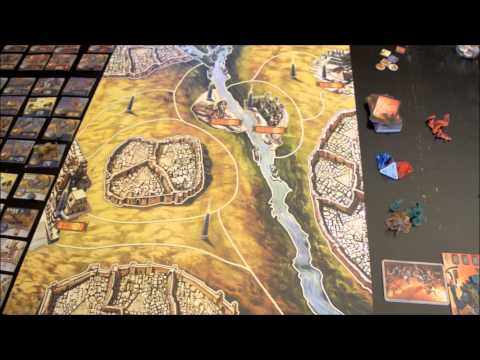 Kohatsu Cave of Games #11: Kemet!
-
 Kemet Unboxing
-
 Game Trailer English
-
 Strategic Analysis
-
 Unboxing: Kemet
-
 Kemet - How to play and win
-
 Coin Collectors For Power Tiles
-
 Kemet - How to play
-
 Sweethearts or Rivals: Overview of Kemet
-
 Setup, How To Play, Sample Turns of Kemet (2012)
-
 Master the White Pyramid Strategy: Kemet Board Game Tactics

