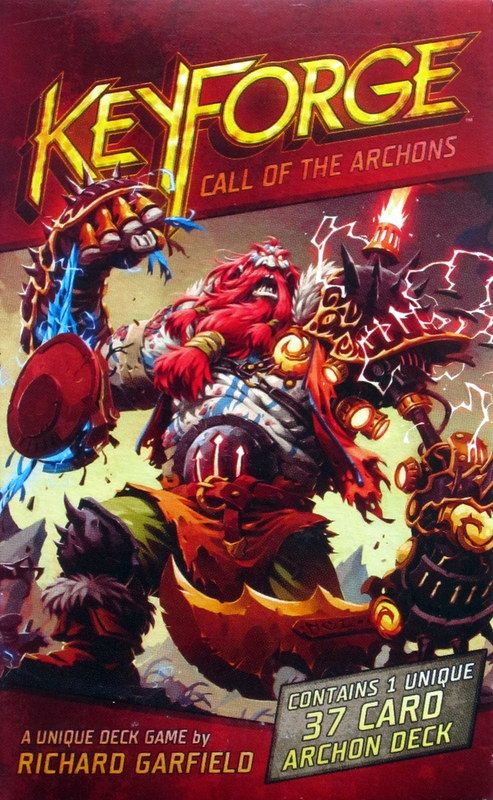
How to Play KeyForge: Call of the Archons – Archon Deck
Fantasy Flight Games, Asterion Press, Galápagos Jogos · Board game · 2018What do you want to do now
Ask anything about KeyForge: Call of the Archons – Archon Deck: rules, setup, components, complexity, price, or whether it fits your group.
Step by step
Game Objective
In KeyForge: Call of the Archons, you take on the role of an Archon, a wise and powerful figure born in the Crucible, an artificial world in constant renewal. Your mission is to lead your followers in search of Vaults hidden by the enigmatic Architects. To open these Vaults, you need to forge keys using a mysterious psychic substance called Æmber.
The main objective of the game is to be the first player to forge three keys. Once a player has their three keys forged, they immediately win the game.
Preparation (Setup)
To start a game of KeyForge, follow these steps in order:
- Place all damage tokens, Æmber tokens, and condition cards in a general supply within reach of both players.
- Each player positions their identity card to the right or left of their play area.
- Each player places three key tokens, one of each color, near their identity card, with the un-forged side facing up.
- Randomly determine the first player. This player will take the first turn. (In a series of games, the player with the defeated deck in the previous game chooses the first player.)
- Each player shuffles their deck and offers it to the opponent for further shuffling and/or cutting.
- The first player draws an opening hand of seven cards. The other player draws an opening hand of six cards.
- Each player, starting with the first player, is entitled to a mulligan: the player may shuffle their opening hand back into the deck and draw a new hand with one fewer card. (This step is skipped in the Quick Start game.)
The game can then begin.
Game Flow
A game of KeyForge consists of a series of turns, with players alternating until one of them wins. Each turn consists of five mandatory steps, performed in the following order by the active player:
- Step 1: Forge a key
- Step 2: Choose a house
- Step 3: Play, discard, and use cards from the active house
- Step 4: Ready cards
- Step 5: Draw cards
The active player is the only one who can perform actions or make decisions during their turn.
Step 1: Forge a key
If the active player has enough Æmber to forge a key in this step, they are obligated to do so. To forge a key, the active player spends Æmber from their Æmber pool (on their identity card), returning it to the general supply. Then, they flip one of their key tokens to the forged side. The standard cost to forge a key is six Æmber, but card abilities can modify this value. Only one key can be forged in this step per turn, even if there is enough Æmber for more.
Some cards allow the Æmber on them to be spent when forging keys. If the total Æmber on these cards plus the Æmber in your pool is sufficient, you must forge a key.
Step 2: Choose a house
Each KeyForge deck is composed of three different houses, indicated on the player's identity card. The active player chooses one of these three houses to be the active house for the remainder of the turn. The active house determines which cards the active player can play, discard from their hand, or use in the turn.
After choosing a house, the active player may take all cards from their archive and place them in their hand.
If a player controls a card that does not belong to one of the three houses in their deck, they may (if they wish) choose that card's house as the active house in this step.
Step 3: Play, discard, and use cards from the active house
The active player may play or discard from their hand as many cards as they wish that belong to the active house and may use as many cards as they wish from the active house that are in play under their control. Eligible cards can be played, used, or discarded in any order.
A card's house is determined by an icon in the upper left corner. If the active house matches a card's icon, the card can be played, used, or discarded.
First Turn Rule: On the first player's first turn, they cannot play or discard more than one card from their hand.
The active player cannot play, use, or discard cards from other (non-active) houses, unless a card ability allows it.
Step 4: Ready cards
The active player readies all their exhausted cards. Ready cards are oriented vertically and can be used. Exhausted cards are rotated 90 degrees and cannot be used until they are readied.
Step 5: Draw cards
The active player draws cards from the top of their deck until they have six cards in hand. After a player completes this step, their turn ends.
If the active player has more than six cards in hand, they do not discard down to six. If a player has to draw cards and cannot do so because their deck has run out, they shuffle their discard pile to restore their deck, and then continue to draw cards.
When a player's turn ends, if they have enough Æmber in their pool to forge a key, they must announce "Ready!", so that the opponent knows a key may be forged at the start of that player's next turn.
Actions and How to Play
During Step 3: Play, discard, and use cards from the active house, the active player can perform various actions with cards from the active house.
Card Types
There are four types of cards in the game:
- Action Cards
- Artifacts
- Upgrades
- Creatures
Playing Cards
In step three of their turn, the active player is free to play as many cards as they wish that belong to the active house.
- Æmber Bonus: When a card with an Æmber bonus (indicated below the house icon) is played, the active player gains that amount of Æmber, which is placed in their Æmber pool.
- Play Abilities: Some cards have a bold "Play:" ability. Such abilities are resolved after the card's Æmber bonus is collected (if any) and after it enters play.
- Action Cards: When an action card is played, the active player resolves the card's "Play:" ability and, after resolving as much of the ability as possible, places it in their discard pile.
- Artifacts: Artifacts enter play exhausted and are placed in a row in front of the player, but behind their battle line. Artifacts remain in play from one turn to the next.
- Upgrades: Upgrades enter play attached to a creature chosen by the player who controls the upgrade. They remain in play from one turn to the next and modify the card to which they are attached. If the card to which an upgrade is attached leaves play, the upgrade is discarded. If an upgrade cannot be attached to a card in play, it cannot enter play.
- Creatures: Creatures enter play exhausted and are placed in a row at the front of the active player's play area, called the battle line. They remain in play from one turn to the next and have power and armor values. Whenever a creature enters play, it must be placed on a flank (left or right end) of its controller's battle line. If a creature leaves play, the battle line shifts inward to close the gap.
Discarding Cards
In step three of their turn, the active player may discard from their hand as many cards as they wish that belong to the active house. Cards are discarded one at a time, at any point during this step.
Using Cards
In step three of their turn, the active player may use as many cards as they wish that belong to the active house and that are in play under their control. Usage varies depending on the card type.
- Upgrades: An upgrade modifies the creature to which it is attached and is not used independently of it.
- Artifacts: To use an artifact, the player exhausts it and resolves its abilities. "Action:" abilities can only be used if the artifact belongs to the active house. "Omni:" abilities can be resolved even if the artifact does not belong to the active house. Some artifacts require being sacrificed as part of the cost of use, being discarded to the owner's discard pile. Artifacts cannot be used to reap or fight.
- Creatures: When a player uses a creature, they must exhaust it and then have the option to reap, fight, or activate the creature's "Action:" or "Omni" ability.
- Reap: Any ready creature from the active house can reap. The creature becomes exhausted and its controller gains 1 Æmber for their Æmber pool. Then, all of the creature's "Reap:" abilities are resolved.
- Fight: Any ready creature
Rules manual
Official PDF file
Frequently Asked Questions
Quick answers about the rules