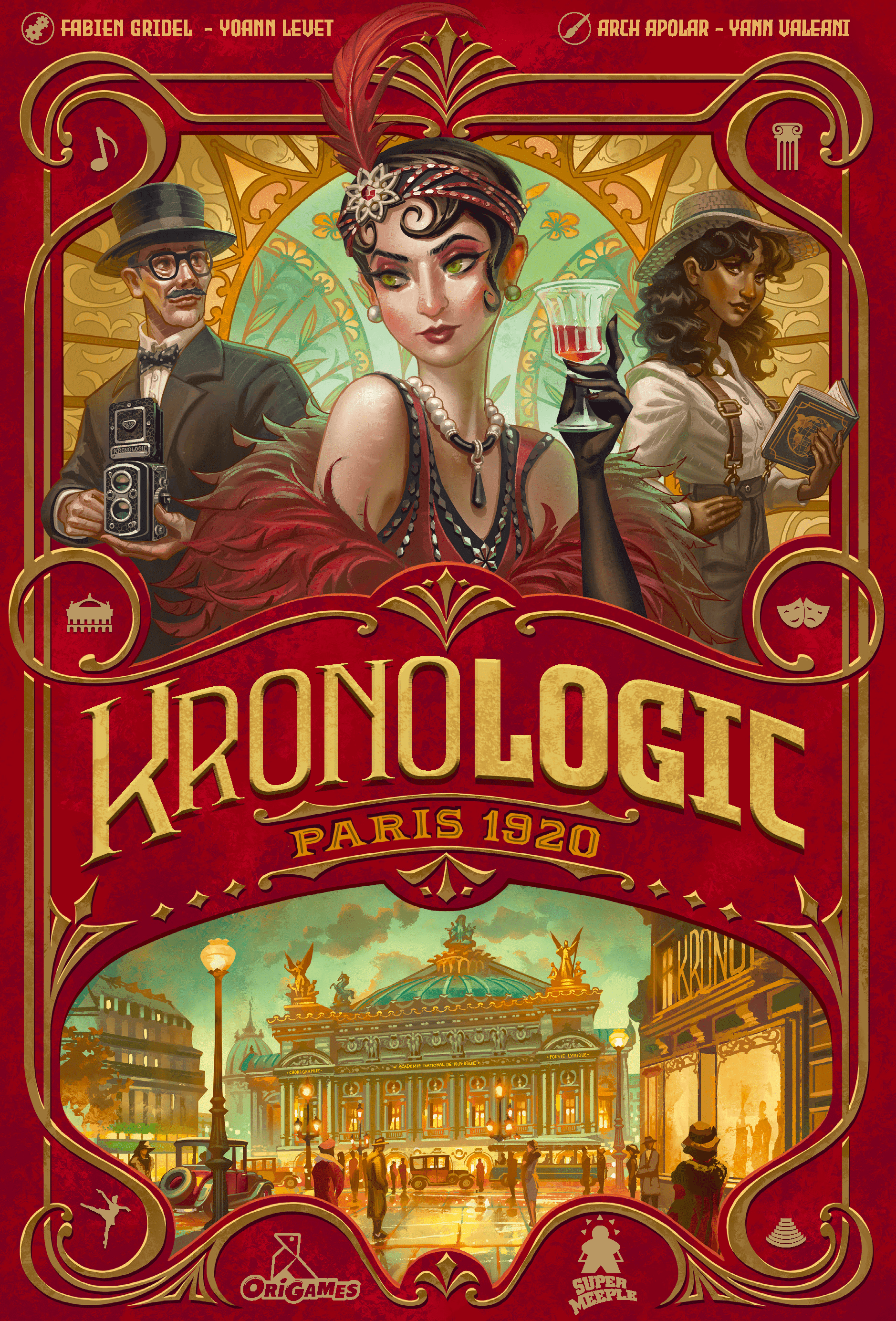
How to Play Kronologic: Paris 1920
Origames, Super Meeple, Gémklub · Board game · 2024What do you want to do now
Ask anything about Kronologic: Paris 1920: rules, setup, components, complexity, price, or whether it fits your group.
Video: How to Play
Start here, then follow the written guide
Step by step
Game Objective
In Kronologic: Paris 1920, you take on the role of investigators trying to solve a mystery. The central theme is the investigation of events that occurred in Paris in the year 1920. The main objective is to be the first to correctly deduce the solution to a specific Investigation. The victory condition is the correct association of a LOCATION card with a TIME frame or CHARACTER.
Setup
The provided manual does not detail the game setup. Please refer to the manual for details on this section.
Game Flow
The game flow in Kronologic: Paris 1920 revolves around performing inquiries to gather information. The exact structure of turns, rounds, or phases is not detailed in the provided context.
In solo mode, the game focuses on finishing the Investigation as quickly as possible. Every time an inquiry is made, the player receives SECRET and SHARED information.
An inquiry is defined as the association of a LOCATION card with a TIME frame or CHARACTER.
The number of inquiries made is recorded and, at the end of the game, determines the player's success level.
Important Note for Solo Mode: If the "play again immediately" icon appears during an investigation, that action counts as an extra inquiry. There are no "free" inquiries in this case.
Actions and How to Play
The main action described in the context is performing an inquiry. An inquiry consists of:
- Associating a LOCATION card with a TIME frame.
- Associating a LOCATION card with a CHARACTER frame.
When performing an inquiry, the player receives SECRET and SHARED information. This information is crucial for deduction.
The manual mentions TIME frames and CHARACTER frames. When used, the side with the Time number or the Character initial should face up, respectively. The note indicates that the rounded corner of the frame and the card should match.
The annotation example illustrates how players can record information, such as:
- Initial information marked on the sheet.
- The fact that a Journalist was never in a certain Location.
- That only one Character is in a specific Location at a certain Time.
- That there are 2 Characters in a Location, but without knowing who they are.
The context does not detail other possible actions or restrictions.
End of Game and Scoring
End of Game: The game ends when a player believes they can answer all the questions of the Investigation. This can happen at any time during the game.
How to Play:
- The player informs the others that they believe they have the solution (without revealing what it is).
- The player writes down their answer on their notepad, keeping it secret.
- The answer is checked in the scenario booklet.
Victory Condition: If the player's deduction is correct, they win the game.
Defeat Condition: If the player's deduction is incorrect, they are eliminated from the game. One should not discuss the correct or incorrect answers.
Joint Victory: Multiple investigators can find the solution at the same time and win together.
Collective Defeat: If all players are confused and unable to find the solution, everyone loses.
Scoring (Solo Mode): In solo mode, the score is based on the number of inquiries made to solve the Investigation. The player compares this number with specific tables for each scenario and difficulty level (Golden Magnifying Glass, Silver Magnifying Glass, Bronze Magnifying Glass) to determine their success level.
- Solo Scoring Example: Playing the level-2 Investigation of the "Poisoning in High Society" scenario and finding the solution after 12 inquiries results in the Silver Magnifying Glass, as 12 falls within the "10-15" range.
The context does not detail other scoring criteria or victory/defeat conditions for multiplayer mode.
Tips for Winning
- Write everything down: Use your notepad to record all information obtained through inquiries. Knowing who was where and when is essential.
- Manage your inquiries: In solo mode, every inquiry counts. Try to get the maximum amount of information with the minimum number of questions to achieve the best scoring ranges.
- Logical Deduction: Use the collected information to eliminate possibilities and focus on the most likely associations between LOCATIONS, TIMES, and CHARACTERS.
Remember, the key to victory in Kronologic: Paris 1920 is careful observation and logical deduction!
More videos
More rules explanations from the community

Rules manual
Official PDF file
Frequently Asked Questions
Quick answers about the rules
What is the objective of Kronologic: Paris 1920?
How do you set up Kronologic: Paris 1920?
How do you play Kronologic: Paris 1920?
How does Kronologic: Paris 1920 end, and how do you score?
What are some tips for winning Kronologic: Paris 1920?
Other Games You'll Like
Based on mechanics and theme