
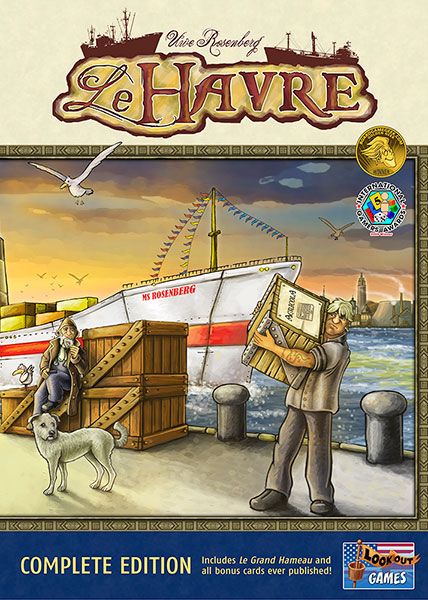
Le Havre
Lookout Games, 999 Games, asmodee · Board game · 2008
1–5 · best 3
Solo
30–150 min
Weight 3.7/5
8.4
rating
Ludopedia
7.8
rating
BGG
Objective of the Game
Welcome to Le Havre, a bustling French port city where your entrepreneurial spirit will be put to the test! In this game, you're not just moving goods; you're building an empire. Your ultimate goal is to amass the largest fortune by the end of the game. This means investing wisely in buildings and ships, managing your cash reserves, and strategically converting goods to maximize their value. Will you be the richest magnate in Le Havre?Preparation (Setup)
Getting your harbor ready is key! Here’s how to set up Le Havre for a full game:- Game Board: Place the three-part folded game board in the center of your table.
- Playing Pieces: Each player chooses a color and takes 1 person disc, 1 ship marker, and 1 Game turn overview card. You can flip your Game turn overview card to the "Buttery" side if you wish.
- Supply Tiles: Shuffle the 7 Supply tiles and place them face down on the round spaces on the game board. Place each player's ship marker beside the first game board, near the first Supply tile.
- Goods and Food Tokens: Place all the various goods and food tokens on their corresponding Supply spaces on the board. Don't worry about placing every single token; the majority can stay in the box and be added as needed. Remember, Francs are your currency!
- Upgrading Goods: Get familiar with your goods! Each goods token has a standard side and an upgraded side (distinguished by their borders). Only standard goods enter the game via offer spaces; you'll upgrade them later using building actions.
- Starting Offers: Before the game officially begins, place 2 Francs, 2 wood, 2 fish, and 1 clay onto their respective offer spaces.
- Starting Resources: Each player begins the game with 5 Francs and 1 coal.
- Special Buildings: Shuffle the Special Building cards. Deal 6 of them face-down onto the "Special Buildings" space on the board. The rest go back in the box.
- Town's Starting Buildings: Take the green Construction Firm card and the two Building Firm cards from the pile of Building cards. Place them beside the game board. These belong to the town and are available for use.
- Sorting Standard Buildings: Look at the back of each Standard Building card. For a full game, use the darker ticks to determine which cards are in play for your number of players. Remove any cards without a tick for your player count.
- Building Proposals: Shuffle the remaining Standard Building cards and divide them into 3 equally-sized piles. Flip each pile over and sort the cards by their sort order number (top right corner), with the lowest number on top. Fan them out from the Building Proposals spaces so the bottom line of each card is visible. This shows which buildings are available next.
- Ship Cards: The Round cards have ships on their reverse. These will be introduced as the game progresses.
- Loan Cards: Place the Loan cards beside the board. Hopefully, you won't need them!
- Round Overview Card: Select the Round overview card that corresponds to your number of players. One side is for the full version, the reverse for the shortened.
- Round Cards: Turn the Round cards to the "Harvest" (or "No harvest") side. Sort them by round number for your player count and place them face-up on the Round card space, with Round 1 on top.
- Food Production Tokens: Place the food production tokens beside the board.
The Turn of Play
A game of Le Havre unfolds over a series of rounds, each consisting of 7 individual player turns. Here's how a typical turn works:Player's Turn: Two Mandatory Actions + Optional Actions
Each player's turn has two mandatory actions, followed by optional additional actions:- Supply Action: New goods arrive in the harbor!
- Main Action: Choose to either collect goods or use a building.
- Additional Actions (Optional): Buy or Sell buildings/ships.
1. Supply Action
This is where the harbor gets its fresh goods!- The current player places their ship marker on the next free Supply tile (following the arrow). In the first round, Supply tiles are face down until occupied, then they stay face up.
- Each Supply tile shows two different tokens (goods or Francs). The player takes 1 token from each of these Supply spaces and places them, standard side up, on the appropriate offer spaces.
- The turn a ship is placed on the seventh Supply tile is the last in a round. The current Round card is then resolved.
- Interest for Loan cards: One Supply tile has "Interest" written on it. When any player places a ship on this tile, all players with Loan cards must immediately pay 1 Franc in interest. If you can't pay, you must sell a building/ship or take another Loan card.
2. Main Action
After supplying the harbor, you must choose one of these two main actions:Main Action A: Take Goods from an Offer Space
- Simply take all tokens (goods or Francs) from one of the seven offer spaces.
- There's no limit to your personal supply! All goods and Francs are kept face up.
- Remember, coal and hides are only available through building actions, not from offer spaces.
Main Action B: Use a Building Action
This is where you'll refine goods, build new structures, and launch ships!- Entering a Building: To use a building's action, move your person disc to an unoccupied building. You can enter buildings owned by the town or by other players. You can't re-use a building that already has your person disc. Buildings still in the Building Proposals area cannot be entered.
- Entry Fee: Using another player's building often incurs an entry fee, shown at the top right of the Building card. This fee (in food or Francs) is paid to the owner. If food and money costs are separated by a "/", you only pay one. You cannot enter a building if you can't pay the fee. Town buildings require fees paid to the Treasury (the Supply). You don't pay fees for your own buildings.
- Note: Food can always be replaced 1:1 by Francs, but Francs can never be replaced by food.
- Constructing New Buildings: Use the town's Construction Firm or Building Firms. When you enter one of these, you can build any of the top buildings in the Building Proposals area by paying the required building costs (materials shown on the card).
- Note: Brick can always be used instead of clay, and steel instead of iron.
- These buildings allow you to build *buildings*, not ships.
- Building Ships: Ships are crucial for managing your food requirements! You build ships at a Wharf.
- Pay any required entry fee to the Wharf owner, then pay the building resources and 3 energy shown on the Ship card (found on the reverse of Round cards).
- Energy comes from wood (can be upgraded to charcoal) or coal (can be upgraded to coke).
- Modernizing a Wharf: The first player to build a non-Wooden Ship (Iron, Steel, or Luxury Liner) at a particular Wharf must modernize it by placing 1 brick on it. This brick stays for the rest of the game, indicating the Wharf is modernized for everyone.
- Ships are very important! Building or buying ships early is vital for long-term food planning. You essentially cannot win the game without ships.
Additional Actions: Buying and Selling
You can perform these actions at any time during your turn, even before your Supply or main action!- Buying:
- You can buy one or more Building and/or Ship cards.
- Buildings: All buildings owned by the town and the top buildings of the three Building Proposal piles are available for purchase. The purchase price is usually the building's value, or indicated separately as 'Cost'.
- Ships: Only the topmost face-up card on each ship pile can be purchased. The cost is indicated below the value. Wharves are only needed to *build* ships, not to *buy* them. (Luxury Liners cannot be purchased, only built.)
- When you buy a building or ship, you take the card and place it in front of you.
- Note: Buying a building returns any occupying person discs to their owners.
- Selling:
- You can sell buildings and ships to the town at any time, even during another player's turn (but not while they are taking an action).
- Buildings and ships are sold for half of their value. The value is shown to the left of the card's name.
- When you sell a building, it goes back with the town's buildings. When you sell a ship, it goes on top of its type's ship pile.
- Note: You cannot sell and then buy the same building in the same game turn. You also cannot sell buildings or ships to other players.
End of Game and Scoring
The game ends after a fixed number of rounds (determined by player count).Final Stage
- Once the last Round card is resolved, the final stage begins.
- Each player gets exactly one more turn to take a final action, which is a main action.
- Supply and Buying actions cannot be taken, and Interest is no longer paid.
- You can still repay loans and sell buildings/ships.
- During this final stage, person discs *can* be moved to buildings already occupied by other discs. This gives everyone a chance to visit their chosen building.
Game End and Winner
The game ends immediately after all final actions. The player with the largest fortune wins! Your wealth is calculated by adding:- The indicated values of your buildings and ships (the number to the left of the card name).
- Any additional value from buildings with a plus symbol (like the Bank), which depend on other buildings you own.
- Your cash in hand (Francs).
- Deduct 7 Francs for each Loan card you still possess.
Tips for Winning
Ready to dominate the docks of Le Havre? Here are a few pointers to get you started:- Ships, Ships, Ships! Seriously, don't underestimate the importance of ships. They are your long-term solution to food requirements. Building or buying one early can save you a lot of turns and resources later that would otherwise be spent just scrounging for food. The game manual explicitly states, "The game essentially cannot be won without ships."
- Master Your Resources and Upgrades: Le Havre is all about efficiency. Learn which buildings allow you to upgrade basic goods (like wood to charcoal, clay to brick, iron to steel, grain to bread, cattle to meat, fish to smoked fish, coal to coke, hides to leather). Upgraded goods are often worth more or are required for more advanced buildings and ships. For example, the Joinery is a great early-game building to convert wood into Francs, which can then finance a Wooden Ship.
- Strategic Building Acquisition: Pay attention to the Building Proposals and the town's starting buildings. The Construction Firm and Building Firms are crucial for constructing new buildings. Also, remember you can *buy* buildings and ships as an additional action, which can sometimes be more flexible than building them as a main action. Consider buildings like the Bank or Dock that gain value from other buildings or ships you own – they can be huge end-game point multipliers! And don't forget the Bridge over the Seine for converting leftover goods into Francs at the end of the game.
In English


Prefer the Official PDF?
Download the official Le Havre rulebook or browse it online with our AI rules assistant.
View Rulebook PDF
Want to compare prices and check reviews?
Find where to buy at the lowest price, price history, and our full game review.
View Le Havre

