
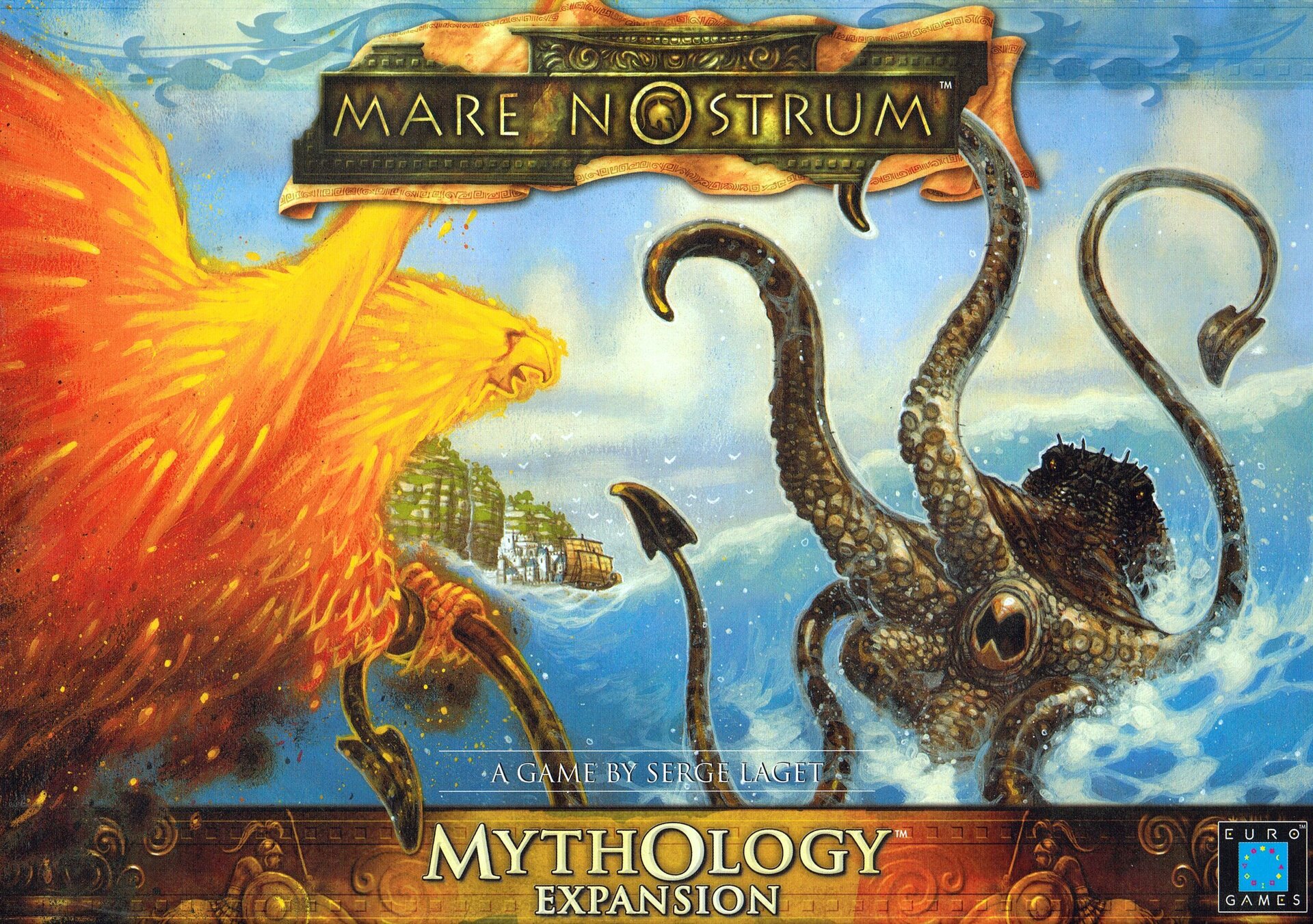
How to Play Mare Nostrum: Mythology Expansion
asmodee, Cafe Games, Descartes Editeur · Board game · 2005What do you want to do now
Ask anything about Mare Nostrum: Mythology Expansion: rules, setup, components, complexity, price, or whether it fits your group.
Step by step
Objective of the Game
In Mare Nostrum: Mythology Expansion, players aim to expand their empires and achieve victory through several paths. The winner is the first player to either build the Pyramids, or to own 4 Heroes and/or Wonders. For a longer, more strategic game, players can agree to change the victory conditions to 5 Heroes and/or Wonders and change the cost of the Pyramids to 13 cards, as the expansion introduces a 13th resource.
Preparation (Setup)
Starting Setup
- The expansion board is placed on the western edge of the basic board, representing the western Mediterranean, including the “Pillars of Hercules” and the mythical island of Atlantis.
- If playing with 6 players, the civilization of Atlantis is introduced, with its starting capital at Poseidonis.
- All Resource Cards and Building Tokens are sorted and placed face up beside the game board. If playing with fewer than 6 players, refer to the chart in the manual to choose the appropriate number of Building Tokens and remove the excess from play.
- The new Heroes and Wonders from the expansion are shuffled together with those from the basic game. Then, 8 Heroes and Wonders are randomly drawn from this pile and set aside; these 8 will not be used in the game.
Predetermined Setup
- Each player randomly chooses one of 6 Starting Civilizations and the corresponding Player Aid Card.
- Players take their Civilization Specific Hero cards (e.g., Hannibal for Carthage) and possibly a Player Role Card if indicated on the Basic Setup (e.g., the Rome player takes the Military Leader card), placing these cards face up in front of themselves.
- Referring to the Basic Setup for their civilization, players place the indicated number of influence markers, building tokens, and 3 mythological creature pawns in the appropriate spaces on the game board.
- If playing with fewer than 6 players, any unchosen civilizations become “neutral civilizations.” For each neutral civilization, place 1 influence marker, 1 mythological creature pawn, 1 legion, and 1 fortress in its capital province. Additionally, place 1 influence marker, 1 legion, and 1 fortress in each region adjacent to that capital. These neutral civilizations do not grow, move, or change, and only defend their provinces if attacked.
- After initial deployment, Role Cards are assigned based on building possession. In case of a tie, tied players randomly determine who receives the role, but avoid giving one player two roles during setup.
Free Setup (for experienced players)
- Players skip the predetermined setup and instead start with 45 construction points (instead of 36) to spend on Influence Markers, Buildings, Military Units, Creatures, and/or their Civilization Specific Hero (but not General Heroes or Wonders).
- The cost for each item is shown on the Construction Cost Chart (refer to page 7 of the manual).
- The Capital Province for each civilization is the same as in the predetermined setup, except for the Greek player, who can occupy any region adjacent to the Aegean Sea, and the Atlantian player, who can also settle on the western-most regions of Europe and Africa.
- All items built may only be placed in the players’ Capital Provinces and immediately adjacent provinces, and all normal construction rules apply. Legions or Triremes built must begin in the player’s Capital Province and can move out on the first movement phase.
- Randomly determine the order in which players will build. Starting with the first player, each player picks and places 9 construction points' worth of items on the board. This continues until each player has built 5 times, spending all 45 construction points.
- During this building phase, each player MUST place at least one influence marker on their capital.
- After initial deployment, Role Cards are assigned based on building possession. During normal gameplay, Role Cards only change hands at the end of each game turn based on the same building criteria.
Fluxo do Jogo
Each turn is divided into 4 phases, which are always played in the following order:
- Commerce Phase
- Offering to the Gods Phase
- Construction Phase
- Military Phase
Players take their turns in a specific order during each phase, determined by a privileged player holding a special Role Card. At the start of the game, each role is given to the player indicated on their Player Aid Card. After that, Role Cards are reassigned at the start of each new turn based on specific criteria:
- Director of Commerce: The player with the most caravans and markets in their provinces.
- High Priest: The player with the most temples and markets in their provinces.
- Political Leader: The player with the most cities and temples in their provinces.
- Military Leader: The player with the most military units (legions, triremes, creatures, and fortresses combined) deployed on the game board.
In case of a tie for a Role Card, the current owner keeps the card. If two or more OTHER players are tied, the current owner decides which of the tied players inherits the role.
Ações e Como Jogar
Commerce Phase
This phase consists of two steps:
A) Collect Revenues
The Director of Commerce gives each player their income (Resource Cards) based on their controlled provinces:
- 1 Tax Card per City marker (2 Tax cards if there is a Temple in the province).
- 1 Commodity Card for each resource icon marked by a Caravan Token (2 if there is a Market in the province).
If a player occupies a City with their Legion and wants the Temple bonus, they must also occupy the Temple with a Legion. The same applies to occupying a Caravan for a Market bonus. Buildings in provinces being converted produce revenue for the original owner until fully converted.
B) Trading Between the Players
- The Director of Commerce decides how many Resource Cards must be offered for trade. They can ask for 0 cards or a number of cards up to what they have in hand.
- Each player chooses that number of Resource Cards (taxes and commodities) from their hand and places them facedown. These are the offered trade cards. Players without enough cards cannot participate.
- All offered trade cards are simultaneously turned face up.
- The Director of Commerce chooses 1 offered trade card from any other player and places it face down in front of themselves.
- The player whose card was taken then takes a card from another player, and so on until all cards are taken.
- Players can take cards from the player who just took from them, but cannot take a face down card back. Only two trades in a row may be made between the same two players.
- If the last card was taken and everyone has the same number of face down cards, players take these into their hands.
- If the player from whom the last card was taken is one card short, the Director of Commerce must choose a card from their own hand (either face down or in hand) and give it to the shorted player.
Offering to the Gods Phase
This phase is inserted between the Commerce and Construction phases. The High Priest determines the order in which players call upon a God by making an offering. Making an offering is optional.
To make an offering, a player spends a set of 3 cards (as defined in the Construction Phase) to enlist the aid of any available God. The player takes the appropriate God card and places it face up in front of them. This God Card remains until the next Offering Phase. At any point while holding the God card, the player can activate its power. The God’s effects are applied immediately, and the God card is flipped face down to indicate its power has been used. At the beginning of each new Offering Phase, all God Cards (used or unused) are returned to "the heavens" (beside the board) and become available for further offerings.
Construction Phase
The Political Leader chooses the order in which players improve and expand their empires. When it's a player's turn, they cash in one or more Sets of Resource Cards to purchase Heroes or Creatures, construct Buildings and Military Units, and place Influence Markers.
Sets of Resource Cards
A set is composed of either:
- Tax Cards ONLY, or;
- Non-matching Commodity Cards ONLY.
All Commodity Cards not used to make sets must be discarded at the end of the Construction Phase. Players may keep two Tax Cards for subsequent turns. Cashed in and discarded Resource Cards are returned to the bank.
The value of a set equals the number of cards in it, determining what can be built:
- 3 Cards: Most buildings and markers (e.g., Influence Marker, City Token, Caravan Token, Legion, Trireme, Fortress).
- 6 Cards: Powerful buildings and creatures (e.g., Temple, Market, Mythological Creature).
- 9 Cards: Heroes and Wonders.
- 12 Cards: The Pyramids (instant victory).
Rules for Construction
- Players may construct buildings and military units (including creatures) only in provinces where they already have an influence marker. They cannot build in un-owned or opponent's provinces, even with legions present.
- Influence markers can only be placed in a province adjacent to a province already controlled at the beginning of the turn, and not under another player's influence.
- During the turn an influence marker is placed in a province, nothing else may be constructed there. The player must wait until their next turn.
- Players cannot build more than one city per site, one caravan per resource, or more than one temple, market, or fortress per province (except with Statue of Zeus).
- Triremes are built in provinces (not sea spaces) on island provinces or provinces adjacent to a sea space. They move to an adjacent sea space during the Military Phase.
- Players cannot build in a province "at war" or under military occupation, except in their own Capital Province.
- Advantages from a Hero or Wonder are conferred immediately upon purchase.
- Reduced costs from Heroes or Wonders are not cumulative; only the single best reduction applies.
Military Phase
The Military Leader decides the turn order for this phase. On each player’s turn, they first perform all naval moves and resolve naval combats, then all ground moves and resolve ground combats.
A) Movement
Players may move as many units as they choose.
- Naval Movement:
- Triremes just constructed move to an adjacent sea space. Already at sea, they may move to an adjacent sea space.
- Naval battles are NOT required when moving into an occupied sea space (except for the "Greek Blockade").
- If a player chooses to attack, they must do so before moving any Legions, as naval battle results may impact Legion transport.
- Naval Battles (Optional): Conducted using the Rules for Battle if the moving player chooses to fight.
- Legion Movement:
- Ground units (Legions and Mythological Creatures) move to an adjacent province through a shared border or a chain of Triremes.
- Ground Battles (Obligatory): Conducted using the Rules for Battle. Legions and Creatures MUST fight when in a space occupied by opposing units (Legions, Creatures, or Fortresses).
B) Combat General Rules for Battle
- All battles last a single round only.
- Ground units (Legions, Mythological Creatures, Fortresses) fight ground units. Naval units (Triremes) fight naval units.
- Un-launched Triremes cannot attack or be attacked.
- If no opposing ground units are in the attacked province, the invading player does not roll dice; only one invading player survives.
- Fortresses: Automatically "roll" a 6. Add 6 points to the die roll sum for the owner. Fortresses are military units, cannot move, and must be destroyed before a province can be sacked, occupied, or converted.
- All Mythological Creatures automatically "roll" a 6 in combat. They are limited to 3 per player and cost a set of 6 cards to build.
- Attacker and defender simultaneously roll as many dice as they have legions in the contested province or triremes in the contested sea space. Sum the dice (adding bonuses from Heroes, Wonders, Fortresses, etc.). The opponent removes one unit for every 5 points of the sum (rounding down). The owning player chooses which units to lose.
After Battle
After losses are decided, a surviving attacker has two possibilities:
- More than one player’s Military Units survive: The province is considered "At War." Invading units remain, and opposing units must continue to fight in subsequent Combat Phases. A province "At War" still collects revenue for the influence token owner, but no building can occur there. Players in an "At War" province who haven't moved can move their Legions out. Sea spaces with multiple players' triremes are NOT "At War."
- Only one invading player survives: The invader chooses one of three options for remaining legions:
- Sack the Province: Destroy ONE BUILDING (city, caravan, temple, or market, but NOT a fortress). The destroyed building returns to the general stock.
- Occupy the Province: Place a single Legion or Creature Token on each City or Caravan to claim income. Place a single Legion or Creature Token on each Market or Temple to double income. Control reverts to the legitimate owner when invader units leave.
- Convert the Province: Place a single Legion or Creature Token on top of an opponent’s Influence Marker. During the next building phase, the invading player MAY construct their own influence marker to replace the existing one, respecting normal construction rules (province must be adjacent to empire, cost paid). The province and its buildings will then be controlled by the new owner.
NEW RULE: “The Greek Blockade”
This special rule applies only to the Greek player. If a player attacks a Greek-controlled province using triremes to transport ground units, the attacker must declare they are attempting to break the Greek blockade and specify units and triremes. The Greek player can then use their own triremes to attack any of the opponent’s triremes transporting invading units in any sea space where transportation occurs, provided the Greek player also has a trireme there. This attack is only against transporting triremes. If a Greek player destroys a transporting trireme, the invading unit is not lost but returns to its starting space and can make another move. If the Greek player is unsuccessful, the invading player
Rules manual
Official PDF file
Frequently Asked Questions
Quick answers about the rules
