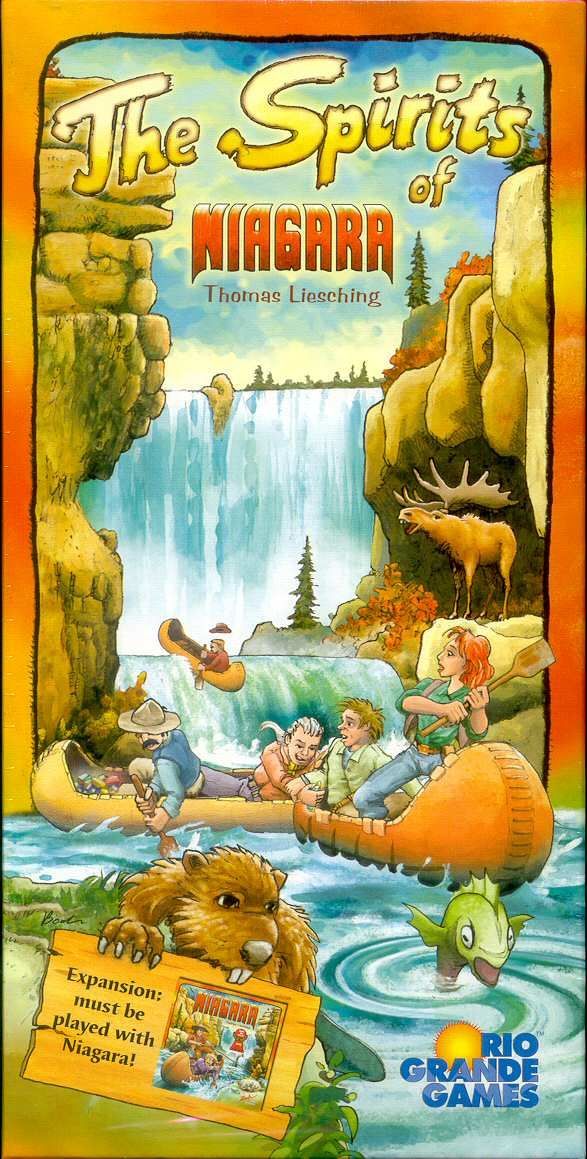
How to Play Niagara: The Spirits of Niagara
Rio Grande Games, Zoch Verlag · Board game · 2006
3–6 · best 4
45 min
Weight 2.1/5
8.0
rating
Ludopedia
6.8
rating
BGG
What do you want to do now
Ask questions about the game
Ask anything about Niagara: The Spirits of Niagara: rules, setup, components, complexity, price, or whether it fits your group.
Example questions
Continue this chat in the Assistant
Game page
Prices, ratings and our review
Rules manual
Official PDF file
Step by step
Objective of the Game
Be the first player to bring back to land:
- 4 gems of the same color.
- 5 different gems each of a different color.
- 7 total gems of any combination of colors.
Preparations (Setup)
- If there are three players, place 6 gems in their matching discovery sites. Place 8 gems in their matching discovery sites if six are playing. Otherwise, put 7 gems in their matching sites. The extra gems are spares.
- Place 9 of the river disks in the river so that the uppermost disk is below the rope. The “whirlpool” disk is placed next to the lilac discovery field. The other 3 disks go next to the game board.
- Place the weather marker (the cloud) on space 0 (zero) of the weather track.
- Each player’s two canoes (a double and a single) are placed on the land in the docking area.
- The beaver is placed next to the weather track.
- Hurried Elk card is placed at the red gem discovery site.
- Each player picks her space on the game board (from the places with rectangles and circles) where she will play her paddle cards and store the gems she wins. Then, the starting player is chosen. To mark the fact that she is the starting player for the round, give her the life preserver, which is placed in her circle space.
- Each player takes all 10 of their paddle cards: Seven cards numbered 1-7, a lasso card, a 1/2/3 card and a cloud card. The players keep these face-down or otherwise concealed.
Flow of the Game
A. In each ROUND there are four phases:
- Choose a card and places it face-down in their rectangle.
- After everyone has placed their card, the person with the life preserver plays first. Each player in clockwise order takes a turn. Depending on the card they played, they will either move their canoe(s) or influence the weather.
- After everyone has played, the river moves.
- The life preserver goes to the next person in a clockwise direction.
REPEAT until the game is over.
M. End of a round:
- After everyone has played and the river has moved, that round is over.
- The previously-played paddle cards are flipped over. (The paddle cards create a discard pile that remains on the board until all 10 cards have been played. Then, the players take their cards off the board to start over.)
- The life preserver is passed to the next person clockwise—they start the next round.
Actions and How to Play
B. Each TURN:
- The active player flips over her paddle card.
- If it is a number (1-7), then she will move her canoe(s).
- If it is a 1/2/3 card, then only one canoe is moved (player’s choice of 1, 2 or 3 paddle points). You may load or unload gems in accordance with the rules. The card does NOT influence river speed.
- If a lasso card is played, the canoes are removed from the river and are placed on the nearest riverbank. The card does NOT influence river speed.
- If it is a cloud card, then she will only influence the weather, and does not move her canoe(s).
- If both canoes are on land, you may only move one canoe, and you are required to move a canoe.
- If one canoe is on land and one canoe is in the water: you are required to move the canoe that is in the water, and you may choose to move the canoe that is on the land or not move it.
- If both canoes are in the water, you are required to move both of them.
- If you are moving both canoes, the full amount of paddle points on the card is assigned to each canoe.
C. Canoe movement:
- A canoe can never stay on the whirlpool river space.
- Down-river: If a canoe ends its movement on the whirlpool, it moves one space down-river and is left there.
- Up-river: A canoe crossing the whirlpool uses an additional paddle point. If the canoe ends its movement on the whirlpool, it moves one space down-river and is left there. The owner of this canoe may not steal gems when on this space.
- Move one river space per each paddle point.
- Any canoe may be passed, and any number of canoes may occupy the same river space.
- You may move one canoe upriver and one canoe downriver, or both down or both up—it’s your decision. However, you may not move the same canoe upriver and downriver in the same turn, nor may you come up one branch of the creek and go down the other branch with the same canoe.
- A canoe moved upstream past the rope is removed from the river and placed in the docking area. If the canoe is carrying a gem, that gem is placed in the player’s area and they own the gem. Empty canoes may be moved onto land as well.
- If moving your canoe, you must count every paddle point, & you may go over the waterfall by doing so. You can only “waste” paddle points by going beyond the rope (going upstream, of course)—for example, you may play a 6 even if you only need to move 1 space to go over the rope & take your canoe out of the river. The extra points are lost.
- It does not cost extra paddle points to take your canoe out of the river when you cross the rope, nor does it cost extra points to bring gems to land by crossing the rope.
D. Loading and unloading gems:
- A single canoe can only hold 1 gem at a time. A double canoe can hold up to 2 gems at a time.
- For each canoe, loading and/or unloading may be done before you have moved or after you have moved, but not both before and after (with the same canoe). One of your canoes may do its loading and/or unloading before it moves, and one canoe may do it after it moves, or both may follow the same plan—it’s your decision.
- Loading and unloading each cost 2 paddle points.
- If at the beginning of a turn, your canoe is next to a discovery site, you may “spend” two paddle points per action to load and/or unload a gem, and then you must move your canoe any remaining paddle points.
- Or you may first move your canoe to a discovery site and use up your remaining paddle points (2 points per action) to load and/or unload.
- The full amount of paddle points still apply to your other canoe.
- If there are different colored gems in a discovery site, the player may choose which gem to load.
- You can never unload a gem onto a discovery site that is the same color as the gem.
- Having unloaded a gem at a discovery site, a player may reload her canoe at once, but the color of the reloaded gem must be different than the unloaded gem. (This is two actions and thus costs 4 paddle points.)
- You cannot load a gem & then unload it in the same turn.
- You can never unload a gem from a canoe, then move that canoe, then load another gem into that same canoe in one turn [see D-2].
- Gems can never be traded between any canoes.
E. Stealing gems:
- When a player moves a canoe with an empty gem space UP-river and ends her movement on a river space with another player’s loaded canoe, she may then steal the gem(s) from the loaded canoe.
- Stealing does not cost extra paddle points.
- You can steal even if you have unloaded a canoe at the beginning of your turn.
- If there is more than one other loaded canoe on the river space, the player may choose which one to steal from.
- You can never unload a gem on a river space and then steal a gem on the same river space.
- A player may not end her movement early to steal a gem—a player must use the full amount of paddle points when moving the canoe.
F. Bringing a gem to land:
- A player moves her canoe across the rope, thus taking her canoe out of the river.
- When a player moves a canoe back to land, she need not reach land by the exact number of paddle points, and any unused paddle points are lost.
- The player then takes the gem and puts it in her play area. Bringing a gem to the dock area doesn’t cost paddle points.
- The player leaves the canoe on the beach in the dock area and cannot move it until the next turn.
- You may load and/or unload gems and bring your canoe and/or its gems to land on the same turn.
G. Playing a cloud card:
- When a player plays a cloud card, she then influences the weather, thus changing the speed of the river.
- The player moves the cloud on the weather track one space up or down—it is her choice. The player must move the cloud when she plays the cloud card and may not leave it where it is.
- A player who plays a cloud card may not move a canoe in that round nor may she load, unload, or steal a gem.
H. The river moves:
- After every player has completed their play (by moving their canoes or influencing the weather), the river will move.
- The speed of the river (the number of spaces the river moves) depends on the number-cards played during the round and also on the weather.
- With neutral weather (when the cloud is on 0 on the weather track), the river moves as many spaces as the lowest number-card played that round. This does not change when several paddle cards have the same lowest number.
- In non-neutral weather (when the cloud is not on 0), the position of the cloud on the weather track adds (+1 or +2) or subtracts (-1) from the river movement as determined above.
- If only cloud cards (no number-cards) are played, then the river only moves if the weather track is positive. Thus it moves 1 space if it is on +1, 2 spaces if it is on +2, and does not move at all if it is on 0 or -1.
- For each space the river moves, place one river disc on the empty river space above the rope. Then push it downriver until it passes the rope, thus moving the rest of the discs. One river disk should fall over the waterfall for each disk that is added.
- At the land tongue where the river splits, the discs flow to the left or right, usually alternating, but not always. (If a disc gets stuck on the point of the land tongue, simultaneously push both the lowermost discs by hand one disc-length upriver to get it unstuck & continue pushing discs from the top of the river.)
I. The Lasso Card effects:
- You cannot land your canoe on the “tongue” of land containing the blue and red gem discovery spaces.
- As long as a canoe is on the river bank, nobody can steal gems or load or unload gems into or out of it.
- After the river movement, players place their canoe back on the river space where they left the river. If this is a whirlpool space, then the canoe immediately moves one space down-river.
J. Bathing Beaver:
- As soon as a player places the cloud on the +2 space, the beaver is immediately placed on the first river space next to the landing space.
- If the whirlpool is on this place, the beaver
Rules manual
Official PDF file
Prefer the Official PDF?
Download the official Niagara: The Spirits of Niagara rulebook or browse it online with our AI rules assistant.
View Rulebook PDF
Frequently Asked Questions
Quick answers about the rules
What is the objective of Niagara: The Spirits of Niagara?
Be the first player to bring back to land: 4 gems of the same color. 5 different gems each of a different color. 7 total gems of any combination of colors.
How do you set up Niagara: The Spirits of Niagara?
If there are three players, place 6 gems in their matching discovery sites. Place 8 gems in their matching discovery sites if six are playing. Otherwise, put 7 gems in their matching sites. The extra gems are spares. Place 9 of the river disks in the river so that the uppermost disk is below the rope. The “whirlpool” disk is placed next to the lilac discovery field. The other 3 disks go next to the game board. Place the weather marker (the cloud) on space 0 (zero) of the weather track. Each…
How do you play Niagara: The Spirits of Niagara?
B. Each TURN: The active player flips over her paddle card. If it is a number (1-7), then she will move her canoe(s). If it is a 1/2/3 card, then only one canoe is moved (player’s choice of 1, 2 or 3 paddle points). You may load or unload gems in accordance with the rules. The card does NOT influence river speed. If a lasso card is played, the canoes are removed from the river and are placed on the nearest riverbank. The card does NOT influence river speed. If it is a cloud card, then she will…
Want to compare prices and check reviews?
Find where to buy at the lowest price, price history, and our full game review.
View Niagara: The Spirits of Niagara