
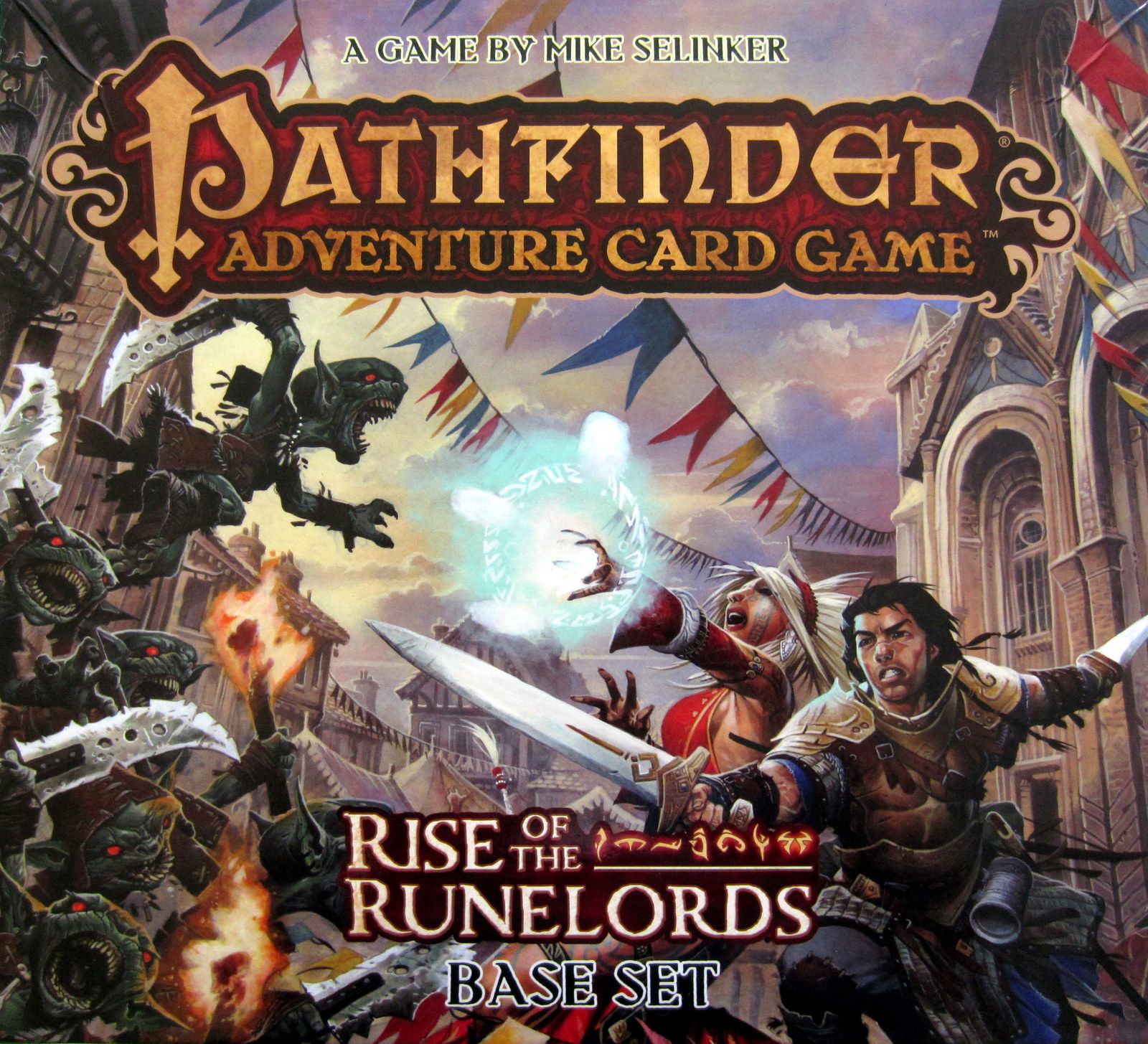
Pathfinder Adventure Card Game: Rise of the Runelords – Base Set — How to Play
Paizo Publishing, Arclight Games, Black Book Éditions · Board game · 2013Video: How to Play
Start here, then follow the written guide
Step by step
Game Objective
Prepare for an epic adventure in Varisia! In Pathfinder: The Adventure Card Game, you and your group of heroes must race against time to hunt down and defeat a dangerous villain. Your main objective is to explore various locations, clear or secure them to corner the villain, and then take them down before the blessings deck runs out. Each scenario is a new challenge, and throughout your journey, you will improve your deck, customize your character, and face increasingly greater threats. Do you have what it takes to become legends and stop the ancient evil that rises?
Setup
Preparation is key to a successful adventure! Let's set up the table and get everything ready for action:
- Organize the Cards: The game box comes with a special tray. Separate all cards by type (character, role, tokens, adventure paths, adventures, scenarios, locations, banes, boons, etc.). The character cards, tokens, and roles for each character should be grouped. The adventure cards, scenario cards, location cards, villain cards, henchman cards, and loot cards can be organized alphabetically for easy searching. The remaining cards should be shuffled.
- Choose Your Character: Each player chooses a character card. Find the corresponding token and place them in front of you on the table.
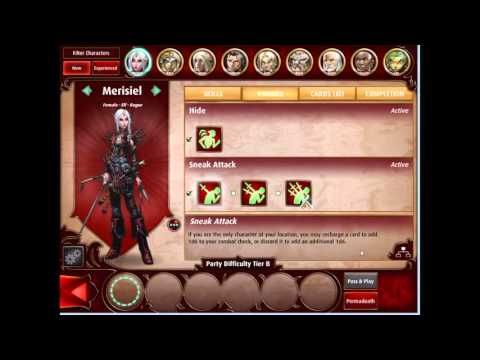
- Build Your Character Deck: Each character needs a character deck. If you want to start quickly, use the suggested deck for your character. Otherwise, build your deck following the Card List on your character card, using only cards with the word "Basic" in their traits.
- Trade Cards (Optional): Before starting, you can freely trade cards from your character decks, as long as the deck still conforms to your character's Card List.
- Choose Game Mode:
- Scenario: For a quick session, choose a scenario (such as "Bandit Infestation!"). Place the scenario card face up on the table.
- Adventure: For a longer story, choose an adventure (such as "Perils of the Lost Coast"). Place the adventure card face up on the table. It will list the scenarios that compose it.
- Adventure Path: For the full campaign, place the Rise of the Runelords Adventure Path card face up. It will list the adventures.
- Separate the Locations: The scenario card indicates how many location cards to use per number of players. Separate the corresponding location cards for the number of players and place them face up on the table.
- Build the Location Decks: For each location card, follow the list of card types to build its location deck. Shuffle the cards of each type and deal the correct number, placing them face down next to the location card.
- Add Villains and Henchmen: The scenario card lists the villains and henchmen. Create a pile with the villain(s) and add henchmen until the pile has the same number of locations in play. Use copies of the last henchman on the list if necessary. Shuffle this pile, place one card on top of each location deck, and then shuffle each location deck again.
- Create the Blessings Deck: Take 30 random blessing cards from the box, shuffle them, and place them face down on the table.
- Position the Tokens: Each player chooses a location and places their character token next to it. Multiple characters can start in the same location.
- Draw Starting Hand: Each player draws cards from their character deck up to the number indicated by their Hand Size. If they do not draw at least one card of their Favored Card Type, they must discard their hand and draw again until they do. Shuffle the discarded cards back into the character deck.
- Decide Who Starts: The group chooses a player to start, and turns proceed clockwise.
The Game Turn
Each turn, a player follows these steps, in order. Remember, only "Advance the Blessings Deck," "Reset Hand," and "End Your Turn" are mandatory!
- Advance the Blessings Deck: Flip the top card of the blessings deck and place it in the blessings discard pile. If there are not enough cards in the blessings deck to flip, the group is defeated!
- Give a Card (Optional): You may give 1 card from your hand to another character who is in your same location. Other players cannot give cards to you at this time.
- Move (Optional): You may move your token to another location. This may activate location entry or exit effects. If you do not move, these effects are not activated.
- Explore (Optional): You may explore your location once per turn. Flip the top card of the location deck where you are.
- If it is a boon: Attempt to acquire it by performing a test. If you fail, the card is banished. If successful, it goes to your hand.
- If it is a bane (villain, henchman, monster, barrier): Attempt to defeat it.
How to Encounter a Card (Boon or Bane):
- Avoid the Card (Optional): If you have a power or card that allows it, you can shuffle the card back into the deck and the encounter ends.
- Apply Effects Before the Encounter: Resolve any effects that occur before the encounter.
- Perform the Test:
- Determine Which Die to Use: The card specifies the skill(s) that can be used. Choose one. If you do not have any of the listed skills, use 1d4. Weapons usually indicate the skill for combat tests; if not, use Strength or Melee.
- Determine the Difficulty: The difficulty is the number in the circle below the chosen skill on the card, or in the text next to the skill for other tests.
- Use Cards and Powers That Affect the Test (Optional): Use cards from hand and powers that modify the test. Each player can use only 1 card of each type and activate one power once per test.
- Gather the Dice: Use the number and type of dice determined by your skill and the cards/powers used. Ex: Strength 1d10.
- Make the Roll: Roll the dice, sum the results, and add/subtract modifiers. If the result is greater than or equal to the difficulty, you are successful. The final result cannot be less than 0.
- Perform the Next Test (If Any): If the card requires multiple tests (e.g., "then"), resolve them in sequence.
- Apply Effects After the Encounter: Resolve any effects that occur after the encounter.
- Resolve the Encounter:
- If you defeated a bane: It is banished (returns to the box).
- If you did not defeat a bane: It remains unharmed and is shuffled back into the location deck. If you failed against a monster, you suffer damage equal to the difference between the difficulty and your result.
- If you acquired a boon: It goes to your hand.
- If you did not acquire a boon: It is banished.
- Close a Location (Optional): If you are in a location that has no more cards and is not yet closed, you can attempt to close it. (Detailed rules on how to close a location were not provided in the context, but it is an important action!)
- Reset Hand:
- First, apply any effects that happen at the end of the turn.
- Then, you may discard as many cards as you wish.
- If you have more cards in hand than your Hand Size, discard until you have the correct number.
- If you have fewer cards, draw until you reach your Hand Size.
- End Turn: Pass the turn to the player on your left.
End of Game and Scoring
The game ends in a few ways:
- Victory: The group wins the scenario if they manage to find and defeat the villain and close all locations before the blessings deck runs out.
- Defeat: The group is defeated if the blessings deck runs out and there are no more cards to flip.
After the Scenario:
- You must rebuild your character deck so that it once again conforms to the Card List on your character card, though not necessarily with the same cards.
- Upon completing scenarios, adventures, or the Adventure Path, you may gain rewards, such as new feats for your character, which can increase your Hand Size, grant proficiency with new types of weapons or armor, or allow you to have more cards of a specific type in your deck.
- Role cards are a special reward obtained by completing the third adventure of the Rise of the Runelords Adventure Path, allowing your character to specialize in one of two paths.
There is no traditional "scoring" in Pathfinder: The Adventure Card Game. Success is measured by completing scenarios and advancing the story, improving your characters and their decks along the way.
Tips for Winning
To do well in Varisia, it's good to have some tactics up your sleeve:
- Blessings Deck Management is Everything: The blessings deck is your timer! Each card flipped is one less turn. Explore as much as possible to find the villain and close locations, but don't forget that sometimes it's smart to slow down. If your character deck is getting small, a turn at the Apothecary or Temple to heal can be crucial.
- Group Communication and Positioning: While not a traditional RPG, communication is vital. Discuss whether it's better for the group to split up to cover more locations or stay together to face bigger threats. Think about each character's strengths: Harsk might be great in a Treacherous Cave, but Ezren might struggle to close a location if the villain appears there alone. Knowing where the villain is can change the entire positioning strategy for closing locations.
- Know Your Character and Your Cards: Understanding your character's skills, powers, and Favored Card Type is fundamental. Ezren, the Wizard, for example, has many spells and accesses them quickly, but can run out of cards. Kyra, the Cleric, is great at healing and fighting undead, but this can cost explorations. Use your character's abilities strategically, and remember that each card can have multiple uses – choose wisely which power to activate in each situation!
More videos
More rules explanations from the community
In English




Rules manual
Official PDF file
