How to Play Petrichor: Honeybee
Mighty Boards, Schwerkraft-Verlag · Board game · 2019What do you want to do now
Ask anything about Petrichor: Honeybee: rules, setup, components, complexity, price, or whether it fits your group.
Video: How to Play
Start here, then follow the written guide
Step by step
Objective of the Game
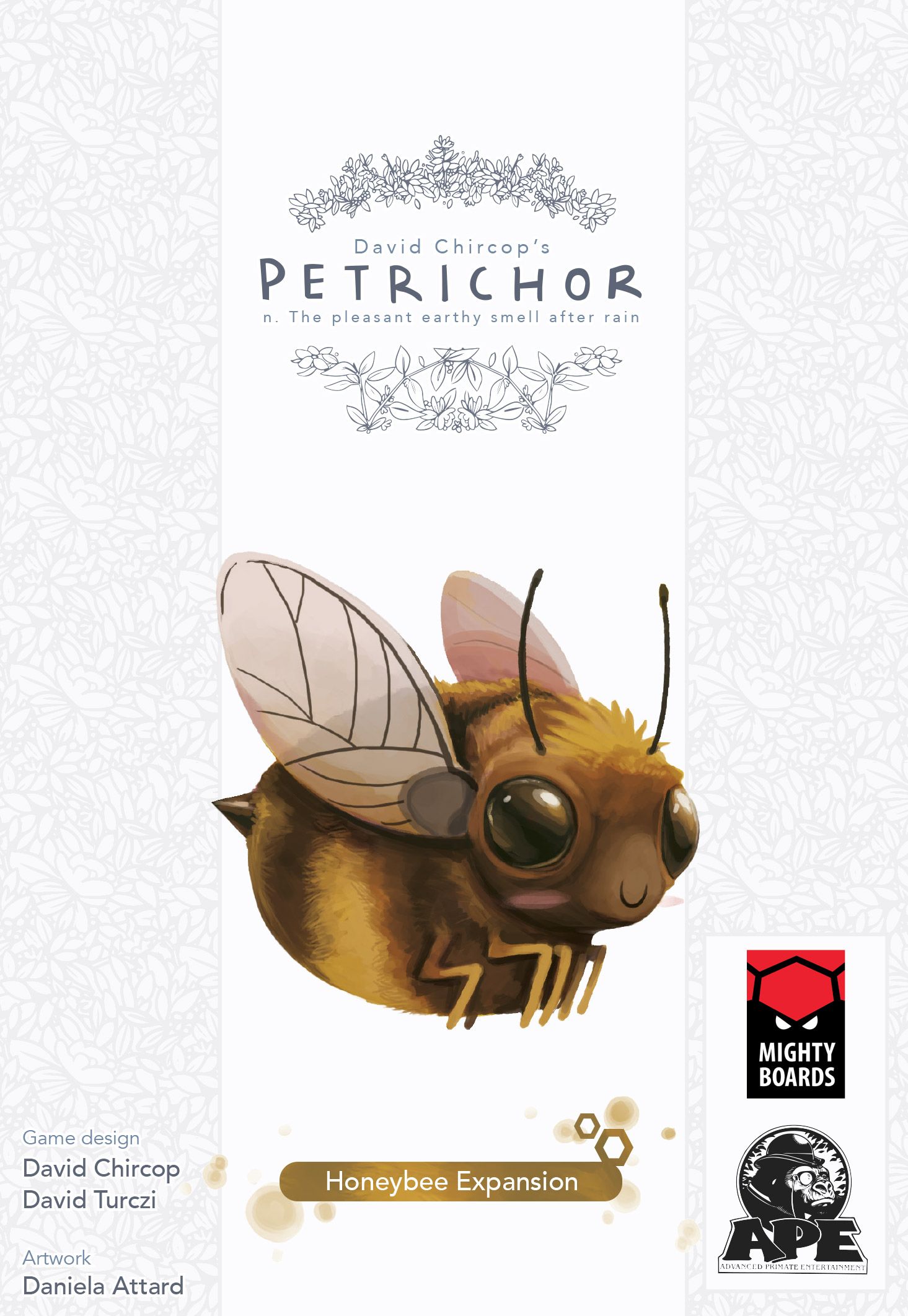
Petrichor: Honeybee is an expansion for the base game Petrichor. It introduces a new Bee action, a new resource called Honey, and four specialized Honey producing tiles. Players compete to manage their resources and influence the board to score the most points by the end of the game. Honey tokens act as currency, and players aim to accumulate the most Honey to secure bonus points at the end of the game.
Setup
Follow the standard Petrichor setup with these specific additions:
- Tiles: Use the following distribution based on player count:
- 1 player: 2 Honey producing tiles, 4 Regular tiles.
- 2 players: 2 Honey producing tiles, 5 Regular tiles.
- 3 players: 3 Honey producing tiles, 6 Regular tiles.
- 4 players: 4 Honey producing tiles, 8 Regular tiles.
- 5 players: 4 Honey producing tiles, 12 Regular tiles (requires Petrichor: Flowers).
- Bee Piece: Place the wooden Bee piece on the designated tile before players place their clouds.
- Pollen: Place 1 dormant pollen token on every tile (excluding the Anthill and Lake, if in play).
- Starting Honey: Each player receives 2 Honey.
Gameplay
The game follows the standard structure, but players have new options for their second action. Instead of the normal second action (discarding 2 matching cards to perform a weather action and vote), a player may choose one of the following:
- Discard any one card to move the Bee to an adjacent tile.
- Discard any one card and 1 Honey to move the Bee to any tile (including its current one).
After moving the Bee, the player must perform one Bee action at the new location if able. Note that you cannot take a Bee action as your first action, nor after another player has passed.
Harvesting: Harvest proceeds as usual. Most Honey producing tiles require at least one germinated pollen token to be considered growing. Once a tile is harvested, remove all germinated pollen tokens from it. Then, place one dormant pollen token on every tile (excluding Anthill and Lake). If the general supply of pollen is low, prioritize Honey producing tiles.
Actions and How to Play
When the Bee lands on a tile, the player may choose ONE of the following Bee actions:
- Collect Pollen: Take all dormant pollen tokens from the current tile into your personal supply (maximum capacity of 4).
- Place Pollen/Water: Discard up to 2 pollen tokens from your supply. For each discarded, place 1 water drop from your supply onto the tile. If the tile is a Honey producing tile and below its germinated pollen limit, place the spent pollen tokens on the tile with the germinated side up.
- Collect Honey: Collect Honey tokens equal to the number shown on the Honey icon of the tile. This is only available on Honey producing tiles.
Honey tokens function as currency; you may exchange three 1-value tokens for one 3-value token at any time.
End of Game and Scoring
The game ends according to the base game rules. At the end of the game, bonus points are awarded based on the amount of Honey in each player's personal supply:
- 2-3 Players: 1st place (10 pts), 2nd place (0 pts).
- 4 Players: 1st place (12 pts), 2nd place (6 pts), 3rd place (0 pts).
- 5 Players: 1st place (15 pts), 2nd place (9 pts), 3rd place (4 pts), 4th place (0 pts).
- 6 Players: 1st place (15 pts), 2nd place (9 pts), 3rd place (4 pts), 4th place (0 pts), 5th place (0 pts).
If players are tied for a position, they and everyone below them in scoring order receive the lower rank's points.
Tips for Winning
- Manage your Honey: Since Honey is used as currency to move the Bee to any tile, balance your spending to ensure you have enough left at the end of the game to secure the bonus points.
- Prioritize Pollen Limits: Be aware of the germinated pollen limits for each tile (Apple: 1, Blueberry: 1, Passion fruit: 2, Watermelon: 4). Placing pollen on a tile that is already at its limit is inefficient.
- Coordinate with Harvests: Ensure you have the required water drops and germinated pollen on a tile before a Harvest occurs, as these are required for the tile to sprout and score points.
Rules manual
Official PDF file
Frequently Asked Questions
Quick answers about the rules