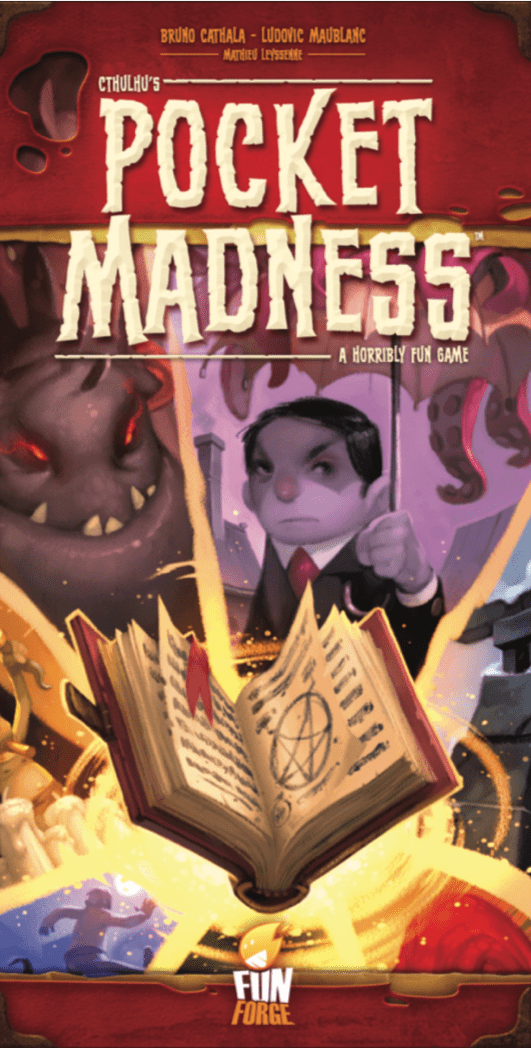
Pocket Madness
Arclight Games, Broadway Toys LTD, Funforge · Board game · 2016If you enjoy quick card games with a touch of Lovecraftian madness and a dash of dark humor, Pocket Madness might be your next fun time! It's a light game that delivers tension and laughs.
- Engaging Lovecraftian theme
- Fast-paced and dynamic matches
- Push your luck mechanics
- Direct player interaction
- Can be a bit chaotic
- Luck plays a significant role
- Theme might not appeal to everyone
About the game
What you do in a play session
The game unfolds with a row of face-up cards visible to all, from which you can take one to three cards per turn. But be careful, as the row can disappear quickly! Want to speed things up? You can open a portal by gathering three or more cards of the same type to activate a special power. Each portal has a unique effect, and using it at the right time can turn the game around. Oh, and if someone steals your portal, too bad for you!
Another option is to start an investigation by discarding specific cards. The catch is that this grants madness tokens to all other players. And madness is the central theme here: the more madness tokens you accumulate, the closer you are to the end of the game – and to losing! The round ends when someone runs out of cards or the card row is depleted. At the end of the round, everyone gains more madness tokens based on the cards still in their hand. If you manage to empty your hand, you get temporary relief, and others gain more madness. The game ends when a player reaches ten or more madness tokens, and whoever has the fewest tokens (and is still in the game) wins. It's an insane race against time and sanity!
Gallery
Box and component photos
Tap any photo to open fullscreen. Photos submitted by the community or publisher.
Rules videos
Learn by watching before you open the box
In English

Best player count
BGG community vote
Soundtrack
Ambience suggested by Melodice
Where to Buy
Prices monitored daily
Price history — last 6 months (lowest new offer)
As an Amazon Associate I earn from qualifying purchases. Prices and availability subject to change.
Alert enabled!
Join the BoardGamesBot deals group
Get the best board game deals every day — without message spam.
Join the WhatsApp groupGame details
Mechanics, categories, families and credits
Mechanics
Categories
Families
Community
Data from BoardGameGeek
Frequently Asked Questions
Quick answers before you buy
What is the average playtime for Pocket Madness?
Is Pocket Madness very complicated to learn?
Is the game good for playing with 2 people?
What is the main objective of the game?
Is there a lot of text dependency?
Is it a game focused more on luck or strategy?
Other Games You'll Like
Based on mechanics and theme