
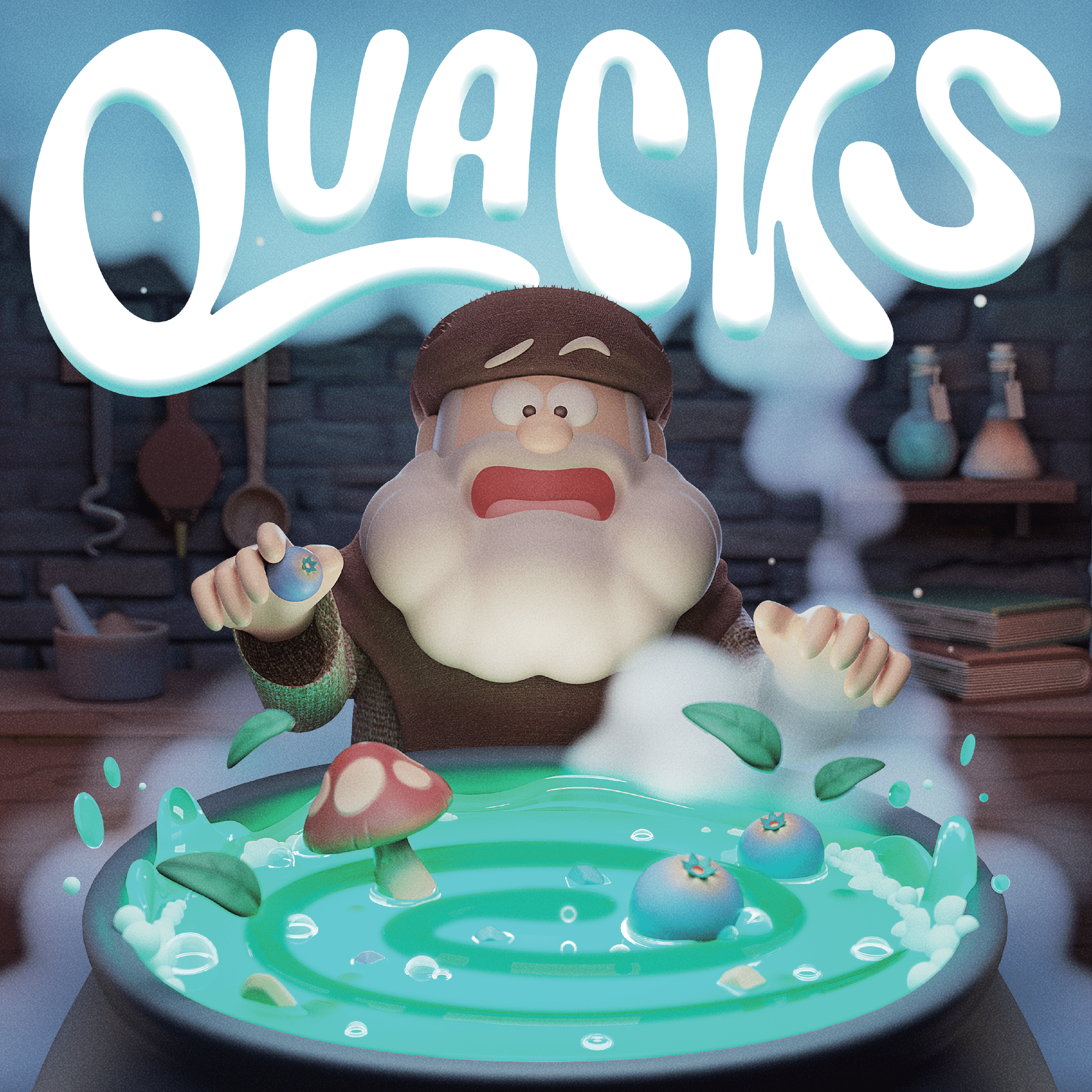
Quacks — How to Play
CMYK, Schmidt Spiele, 999 Games · Board game · 2018Video: How to Play
Start here, then follow the written guide
Step by step
Objective of the Game
Welcome, aspiring alchemists and charlatans, to the bustling bazaar of Quedlinburg! In The Quacks of Quedlinburg, your goal is to brew the most potent and profitable potions over nine exciting rounds. You'll be drawing ingredients from your personal bag, hoping to create a concoction that earns you the most Victory Points. But beware! Too many Cherry Bombs (white chips) and your pot could explode, costing you valuable opportunities. The player who masterfully balances risk and reward, accumulating the most Victory Points by the end of the 9th round, will be crowned the greatest quack of Quedlinburg!
Preparation (Setup)
Let's get those cauldrons ready! Here’s how to set up your alchemical lab:
- The player who last cooked something gets the honor of being the start player. They will shuffle the fortuneteller cards and place them face down in a draw pile in front of them.
- Lay out the scoring track. Place the flame (round marker) on the "1" field of the round indicator.
- Place the four seal tiles on their corresponding seal fields with the "0" side facing up.
- Sort all the ingredient chips into three random groups in the middle of the table, separated by their values: one group for value 1, one for value 2, and one for value 4.
- Lay out the orange and black ingredient books. These are used in every game. For the black book, ensure you're using the page corresponding to your player count (indicated by the number of pots at the bottom).
- Prepare the other ingredient books. They are grouped into sets of five (green, blue, red, yellow, purple), indicated by the number of bookmarks on their lower edge.
- For your first game, we recommend using Set 1 (books with 1 bookmark).
- Initially, only lay out the green, blue, and red books from your chosen set. Keep the yellow and purple books off to the side for now.
- Each player chooses a color and receives:
- One pot (player board), placed in front of them with the side without test tubes facing up.
- One bag.
- One scoring marker, placed on the seal tile of the same color.
- One droplet, placed on the "0" field in the middle of their pot.
- One flask, placed on the large trivet next to their pot (bottom right) with the full side facing up.
- One rat stone, placed on the small trivet right next to the flask.
- Finally, each player takes the following starting ingredients and puts them into their bag:
- 4 white 1-chips
- 2 white 2-chips
- 1 white 3-chip
- 1 orange 1-chip
- 1 green 1-chip
The Game Round
A game of Quacks unfolds over 9 rounds. The flame on the round indicator will always show you which round you're currently in. Each round follows a specific sequence of phases:
1. Fortuneteller Cards
At the start of each round, the player with the fortuneteller cards in front of them draws the top card, reads it aloud, and places it face up next to the scoring track to start the discard pile. The action described on the card applies to all players.
- If it's a purple fortuneteller card, its action is carried out immediately before the round begins.
- If it's a blue fortuneteller card, its effect applies for the entire round or at the end of the round.
- Note: If a card allows you to take a yellow or purple chip, you can only do so if the corresponding ingredient book is already uncovered (check the round indicator!).
2. The Rats (from Round 2 onwards)
After the fortuneteller card is resolved, the rats make their appearance! These little critters help players who are lagging behind.
- Everyone, except the player currently in the lead on the scoring track, can move their rat stone forward in their pot.
- To determine how many spaces to move, count the number of rat-tails between yourself and the leading player on the scoring track.
- Place your rat stone on the field with your droplet, then move it forward by the number of rat-tails counted. This effectively gives you a head start for drawing chips!
3. Preparing the Potions
This is the heart of the game! All players simultaneously draw chips from their bags and place them on the number track in their pots. There are no turns here – everyone brews at the same time!
- First Chip: Place the first chip you draw on the space directly after your droplet (or rat stone, if you have one in your pot).
- Subsequent Chips: Place each following chip after the previously laid chip, according to its value.
- A 1-chip goes 1 space after the previous chip.
- A 2-chip goes 2 spaces after the previous chip.
- A 3-chip goes 3 spaces after the previous chip.
- A 4-chip goes 4 spaces after the previous chip.
- Decide to Stop or Keep Drawing: After drawing and placing each chip, you must decide: do you want to draw another chip, or do you want to stop? If you stop, lay your bag in front of you to indicate you're out of the round.
- No Peeking! You are never allowed to look inside your bag during the game.
- Explosions! Be careful with white chips (Cherry Bombs)! If the sum of all white chips you've drawn exceeds 7, your pot explodes!
- If your pot explodes, you are immediately forced to stop drawing chips.
- The last chip drawn is still placed in your pot.
- Important: Only the values of white chips count towards an explosion. Other colored chips do not!
- Chip actions and fortuneteller card effects are not affected by an explosion.
- Chip Actions: Most chips have special actions.
- White and orange chips have no additional actions.
- Blue, red, and yellow chips have immediate actions activated as soon as they are drawn. You can choose whether or not to perform these actions.
- Green, purple, and black chips have actions that are applied only at the end of the round (during the Evaluation phase).
- Using Your Flask: Once per round, you can use your flask to put the last chip drawn back into your bag.
- Important: If the last chip drawn caused your pot to explode, you cannot use your flask!
- After using your flask, you can continue drawing chips.
- To show it's used, flip your flask to the "empty" side. It can only be refilled in the End of Round phase.
4. End of Phase
The "Preparing the Potions" phase ends when all players have either decided to stop drawing chips or have been forced to stop due to an explosion.
End of Round and Scoring
Once all players have stopped drawing chips, the Evaluation Phase begins. Your scoring field for the round is the space directly after your last drawn chip, regardless of whether your pot exploded or not. Follow these steps from left to right on the scoring banner:
A) Bonus Die
Only players whose potions did not explode participate in this step.
- Determine which player reached the highest scoring field. If there's a tie, check who went further with their chips in their pot (multiple fields can have the same number).
- That player rolls the bonus die and receives its benefit:
- 1 Victory Point
- 2 Victory Points
- 1 Ruby
- Move your droplet 1 space forward (move chips aside if needed)
- Receive 1 orange 1-chip into your bag
- If there's still a tie for the highest scoring field, all tied players roll the bonus die.
B) Chip Actions (Green, Purple, Black)
Starting with the start player and proceeding in turns, resolve the actions of any black, green, or purple chips drawn this round. Refer to the specific ingredient book for each chip's effect.
- For example, with Set 1 Green chips (Garden Spider), you receive 1 ruby for every green chip that was drawn last or next to last in your pot.
- For Black chips (African Death's Head Hawkmoth), compare your number of black chips to your opponents' to potentially move your droplet or gain a ruby.
C) Rubies
All players, regardless of whether their pot exploded, receive 1 ruby for each ruby symbol depicted on their scoring field.
D) Victory Points
Starting with the start player and proceeding in turns, all players receive the Victory Points shown on their respective scoring field. Move your scoring marker along the scoring track accordingly.
- Important: If your pot exploded, you must choose between receiving the Victory Points shown on your scoring field (D) OR buying chips (E). You cannot do both!
- If you reach or pass the last field in your pot (33), place your last chip on field 33 and take the bonus shown on the spoon: 15 Victory Points and 35 coins for shopping. You also roll the bonus die if your pot didn't explode.
E) Buying Chips
Starting with the start player and proceeding in turns, all players can buy 1 or 2 chips of different colors this round.
- The number of your scoring field determines the value (coins) you have available for buying ingredients.
- The prices for chips are listed in the ingredient books. The leftmost value is for a 1-chip, the middle for a 2-chip, and the rightmost for a 4-chip. If only one value is listed, only 1-chips are available for that ingredient.
- Higher-valued chips allow you to move further in your pot and can influence certain green and blue chip actions.
- Any unused money is forfeited.
- Chips are limited. If your desired chip is unavailable, choose another.
- After everyone has finished shopping, put all purchased chips into your bag, along with all the chips you drew this round.
F) End of Round
At the end of the round, players can perform the following actions (more than once) by spending rubies:
- Move Droplet Forward: For 2 rubies, you can move your droplet 1 space forward in your pot. This gives you a head start in future rounds.
- Fill Up Flask: For 2 rubies, you can flip your flask back to the "full" side, allowing you to use it again in the next round.
- Each player takes their rat stone out of their pot and returns it to the small trivet.
- Pass the pile of fortuneteller cards clockwise to the next player, who becomes the new start player.
- Move the round indicator (flame) to the next field.
- Begin the next round!
Round Indicator Special Rules:
- Before Round 2, lay out the yellow ingredient book.
- Before Round 3, lay out the purple ingredient book.
- Before Round 6, each player must add one more white 1-chip into their bag.
- In the last round (Round 9), everyone simultaneously draws chips on command. The player who read the fortuneteller card gives the command "Stir!" once everyone has either drawn a chip or decided to stop.
- Players can also decide to draw simultaneously in rounds 1-8 to prevent hesitation from giving anyone an advantage.
End of Game and Scoring
The game ends after the 9th round has been fully evaluated.
- The player whose scoring marker is furthest down the scoring track wins!
- If there's a tie for first place, the tied player who was able to fill their pot the most in the last round (i.e., reached the highest field number) wins.
- If it's still a tie, they all share the title of Quedlinburg's greatest quack!
- Set 1 Bonus: At the end of the last round, you can convert 5 coins or 2 rubies into 1 Victory Point as many times as you like.
Tips for Winning
- Know When to Stop: This is crucial! Pushing your luck for a few more points can lead to an explosion, forcing you to choose between valuable victory points or essential coins for new ingredients. Sometimes, a smaller, safer potion is better than a risky explosion.
- Manage Your Cherry Bombs (White Chips): Keep a mental tally of the white chips in your pot. While they are cheap and plentiful, exceeding a total value of 7 will blow up your potion. Strategically use your flask to mitigate bad draws, but remember it's a one-time-per-round deal!
- Invest in New Ingredients: Don't just rely on your starting chips. Use your coins to buy more powerful and diverse ingredients. Higher-valued chips help you move further, and colored chips offer unique actions that can significantly boost your potion's power, grant rubies, or even manipulate your bag contents for future rounds.
More videos
More rules explanations from the community
In English
-
 How to Game | The Quacks of Quedlinburg
-
 The Quacks of Quedlinburg - In Focus
-
 How To Play - The Quacks of Quedlinburg
-
 Peaky Boardgamer Episode #60 - The Quacks of Quedlimburg - Full rules explanation (English)
-
 How to Play The Quacks of Quedlinburg in under 8 minutes
-
 The Quacks of Quedlinburg - The Herb Witches - (Quackalope Gameplay)
-
 The Quacks of Quedlinburg | How To Play | Board Game
-
 How to play The Quacks of Quedlinburg
-
 Learn how to play Quacks of Quedlinburg better and faster
-
 How to Teach - Quacks of Quedlinburg
-
 How to play - The Quacks of Quedlinburg
Rules manual
Official PDF file
