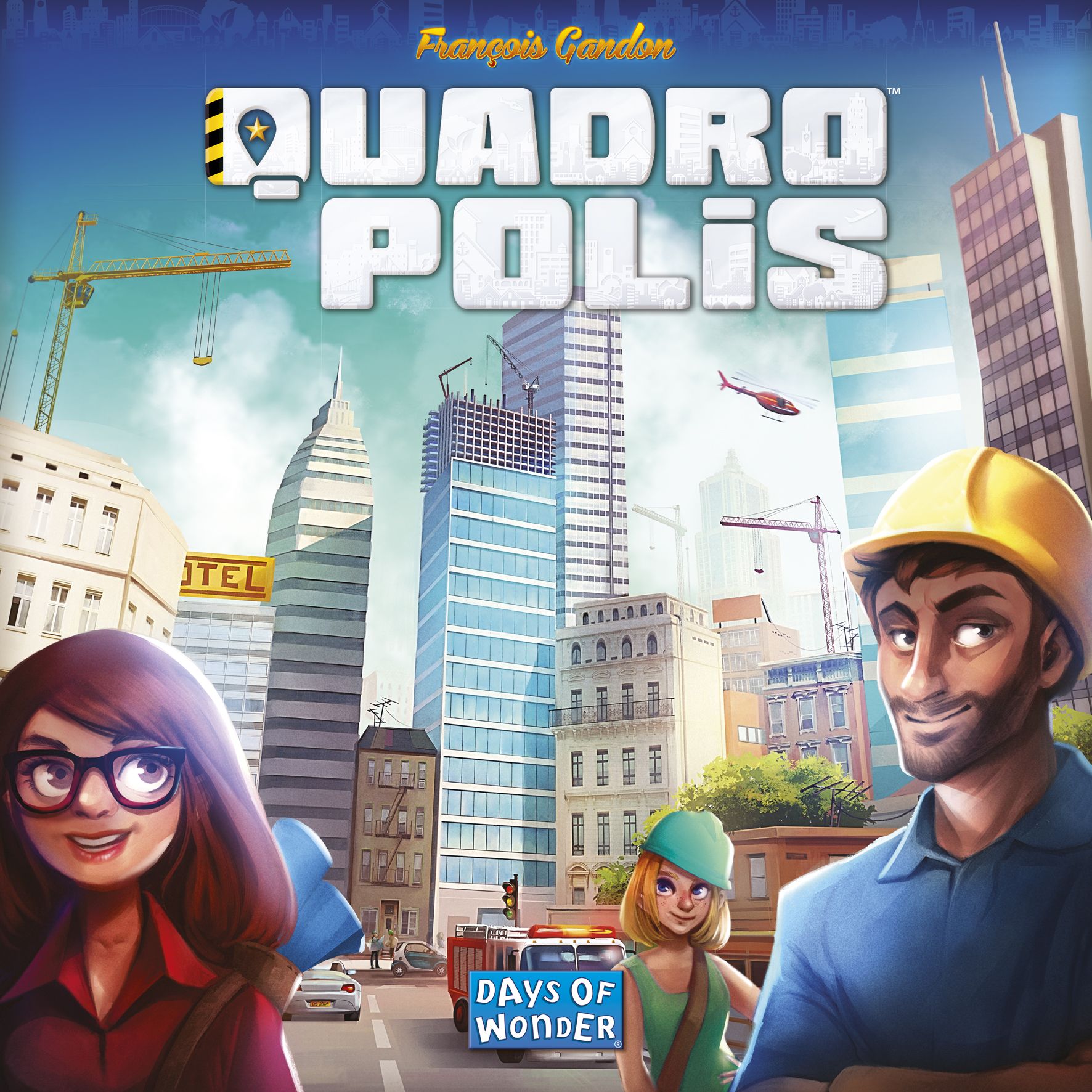
How to Play Quadropolis
Days of Wonder, ADC Blackfire Entertainment, Asterion Press · Board game · 2016What do you want to do now
Ask anything about Quadropolis: rules, setup, components, complexity, price, or whether it fits your group.
Video: How to Play
Start here, then follow the written guide
Step by step
Game Objective
Alright, future Mayor! In Quadropolis, your objective is simple yet challenging: build the most incredible and efficient city for your inhabitants, accumulating the highest number of Victory Points (VP). Each Building you place in your city has a unique scoring pattern, and their strategic location is key to success. Get ready to plan, build, and outmaneuver your rivals to become the greatest Mayor in history!
Preparation (Setup)
Let's set up the table to start building your metropolis! Follow these steps for Classic Mode:
- Place the Building Board in the center of the table.
- Keep the Inhabitants (blue meeples) and Energy Units (red cylinders) near the Building Board, where everyone can reach them.
- Each player receives:
- 1 Player Board (use the colored side for Classic Mode).
- 1 Reference Sheet.
- Their 4 Architects of their color, numbered #1 to #4.
- Separate the Buildings with the "Expert" mark on the back and put them back in the box – they will not be used in Classic Mode.
- Organize the remaining Buildings by the number on the back (#1 to #4).
- Take all Buildings #1, place them in the Cloth Bag, mix well, and draw them randomly, placing them face down in the spaces of the Building Board.
- Flip the Buildings face up, following these rules:
- For 4 players: Flip all Buildings.
- For 3 players: Do not flip the Buildings marked with a 4.
- For 2 players: Do not flip the Buildings marked with a 4 and 3•4.
- Place the Urbanist near the Building Board, easily accessible to everyone.
- Choose the first player as you prefer and give them the Mayor token.
The Game Turn
A game of Quadropolis is divided into 4 rounds, and each round has 4 turns. On your turn, the first player starts, and play proceeds clockwise. Here's what you do:
- Take a Building from the Construction Zone:
- Choose a row or column on the Building Board and place one of your Architects in front of it.
- Attention: You cannot place an Architect in a space already occupied by another Architect, nor point to the Urbanist.
- The number of your Architect indicates which Building you will take. For example, if you use your Architect #3 in row 4, you take the Building from the third space in that row.
- Note: If your Architect only gives you access to empty spaces or Buildings you don't want, you must still position it.
- Move the Urbanist:
- As soon as you take a Building, move the Urbanist to the space where the Building was. If you took an empty space, the Urbanist still moves there.
- Tip: To avoid forgetting, a player can be designated to move the Urbanist after each turn.
- Place the Building in your city:
- You can place the Building you took in an empty space in the row OR column that corresponds to the number of the Architect you used.
- Some Buildings, like Residential Blocks, can be stacked. If so, an existing Residential Block is considered an available space if the row/column it is in corresponds to the Architect's number, OR if the floor you want to build corresponds to the Architect's number.
- If there is no available space in your city, or if you took a Building you don't want, you simply discard it. In this case, skip the next "Receive Resources" phase.
- Receive Building Resources (if possible):
- Take the number of Inhabitants and/or Energy Units indicated in the upper left corner of the Building tile and place them near your city. These resources are essential to activate your Buildings and score at the end of the game.
- Some Buildings come with VP instead of resources. These VP are not received immediately but will be added to your score at the end of the game if the Building is activated.
- If you built a Residential Block with the Mayor token symbol, you immediately take the token and become the first player for the next round.
A turn is completed when all players perform these steps. The round ends when all players complete their 4 turns and all Architects are around the Building Board.
End of Round
When the round ends:
- All players collect their Architects and place them near their cities.
- The Building Board is emptied of all remaining Buildings, which are returned to the box.
- The Urbanist is placed again near the Building Board.
- For the next round, take the Buildings of the next number (e.g., #2 for the second round), place them in the bag, mix, and fill the Building Board in the same way as in the initial setup.
- The player with the Mayor token is the first player of the new round.
End of Game and Scoring
The game ends after the fourth round. It's time to see who built the most prosperous city!
Final Resource Reallocation
Before scoring, you have one last chance to reallocate your Inhabitants and Energy Units to your Buildings to maximize your VP. Remember: to receive VP, the Building must be activated, meaning it has the necessary resources placed on it (indicated by an icon in the lower right corner of the tile).
Point Count
Use the Score Pad to record the VP for each Building category in your city. Consult your Reference Sheet for the scoring details of each Building type:
- Residential Blocks: Score for their height (number of floors). A 1-story Residential Block is worth 1 VP, 2 stories 3 VP, 3 stories 6 VP, and 4 stories 10 VP. Requires 1 Energy Unit to activate.
- Shops: Score for the number of Customers (Inhabitants) they attract. 1 Customer is worth 1 VP, 2 Customers 2 VP, 3 Customers 4 VP, and 4 Customers 7 VP. Requires 1 Energy Unit to activate.
- Public Services: Score for their distribution in different city Districts. 1 District with a Public Service is worth 2 VP, 2 Districts 5 VP, 3 Districts 9 VP, and 4 Districts 14 VP. Requires 1 Inhabitant to activate. Remember to add the VP marked on the tile, if any!
- Parks: Score for the number of adjacent Residential Blocks. 1 adjacent Residential Block is worth 2 VP, 2 are worth 4 VP, 3 are worth 7 VP, and 4 are worth 11 VP. Do not require resources to activate. Additionally, each Park can absorb 1 unused Energy Unit to avoid negative points.
- Factories: Score for adjacent Shops and Ports. Each adjacent Shop is worth 2 VP, and each adjacent Port is worth 3 VP. Requires 1 Inhabitant to activate.
- Ports: Score for the length of the longest continuous line or column of Ports. 1 aligned Port is worth 0 VP, 2 are worth 3 VP, 3 are worth 7 VP, and 4 are worth 12 VP. Requires 1 Inhabitant to activate. Remember to add the VP marked on the tile, if any!
Penalties
- Each Inhabitant not used to activate a Building or as a Customer in a Shop penalizes your city by -1 VP.
- Each Energy Unit not used to activate a Building is considered pollution and is worth -1 VP. You can place 1 Energy Unit in each Park in your city to avoid these negative points.
The player with the highest number of Victory Points wins the game!
Tie-breaking Criteria
- In case of a tie, the player with the highest number of Inhabitants wins.
- If there is still a tie, the player with fewer empty spaces in their city wins.
Tips for Winning
To become a legendary Mayor in Quadropolis, keep these tips in mind:
- Know Your Buildings and Plan Ahead: Each Building type scores in a unique way. Understand the scoring patterns well (your Reference Sheet is your best friend!) and try to define a strategy. Do you want to focus on an industrial approach with Ports and Factories, or do you prefer a more residential city with Residential Blocks and Public Services? Planning where you will place your Buildings, especially in the first rounds, is crucial to avoid running out of space or being blocked.
- Manage Your Resources and Activate Your Buildings: What's the point of having the best Buildings if they're not activated? Unactivated Buildings don't score! Keep an eye on the Inhabitant and Energy Unit requirements of each tile and make sure you have enough resources. Remember that you can reallocate your resources freely until the end of the game, so use this to your advantage to maximize your VP in the final count.
- Be Opportunistic and Block Your Opponents: Quadropolis is not just about building your city, but also about interacting with the shared board. At the beginning of each round, identify the Buildings that are of interest to you and, more importantly, those that your opponents might want. Don't hesitate to use an Architect to take a Building your rival desperately needs, or to position the Urbanist in a way that blocks a line or column important to them. A good block can be as valuable as a good building!
More videos
More rules explanations from the community


Rules manual
Official PDF file
Frequently Asked Questions
Quick answers about the rules
What is the objective of Quadropolis?
How do you set up Quadropolis?
How does Quadropolis end, and how do you score?
What are some tips for winning Quadropolis?
Expansions
Published additional content

Other Games You'll Like
Based on mechanics and theme