How to Play Race! Formula 90: 2nd Edition
Gotha Games · Board game · 2023What do you want to do now
Ask anything about Race! Formula 90: 2nd Edition: rules, setup, components, complexity, price, or whether it fits your group.
Video: How to Play
Start here, then follow the written guide
Step by step
Game Objective
In
Preparation (Setup)
- Place the turn indicator pawn on the 1st turn position.
- Place the tire tokens and all other tokens and components that will be used during the race within everyone's reach.
- Each player chooses a car dashboard from those available and the miniature of the chosen color. Place the car dashboard in front of each player so that everyone can see it.
- Separately shuffle the Race Cards deck and the Track Cards deck corresponding to the chosen track (both face down) within reach of all players. If any deck runs out, reshuffle it.
- Wear tokens (red and brown) should be placed in a bag or cup so they can be drawn randomly during the game. The amount of temporary and permanent damage to be used in the race depends on the number of players (see table in the manual), as does the number of robot tokens/miniatures.
Free Practice: Choose Skill
Each player chooses a skill for their driver from those available. The skill is a unique driver ability and cannot be changed during the race. More than one player may choose to use the same skill. The list of available skills is summarized in Appendix B of the manual.
Car Setup
Players can use the standard setup on each car dashboard or choose to customize them. This is done by choosing setup tokens for the three categories (tires, wear, and number of cards) and placing these tokens over the printed values on the dashboard. Each token has a point value between 1 and 3 printed on it. The total sum of these values must not exceed 6 points. A player with the TUNING skill can use 8 setup points to assemble their car, but they can never exceed the maximum of 3 points in any characteristic (tire, wear, or cards). After completing the setup, each player takes as many tire tokens as indicated on the setup token and draws as many cards as indicated on the corresponding setup token.
Substitute Car
After drawing cards to their hand, a player may not like their starting hand and decide to swap it entirely. If they do, they can discard their entire hand to the discard pile and draw new cards. This can only be done once, and they must accept this second hand, even if it is worse than the first. The player who discards their hand is not required to show their discarded hand to other players.
Qualification
At the start of the race, position the cars on the grid before the finish line based on their performance during qualification. The qualification phase involves playing a card and deciding when to make your first mandatory pit stop.
Qualification Procedures
- Each player chooses a card from their hand and places it face down on their dashboard. Each card has movement points ranging from 1 to 4 and a check factor between 1 and 99.
- After placing the qualification card, each player secretly chooses one of their fuel tokens, which will indicate when they will have their first mandatory pit stop. The player can choose from 5 options: Turn 8, 10, 12, 14, or 16. The Turn number indicates how much fuel is loaded into the tank.
- Once all players have placed their cards and fuel tokens on the dashboard, everyone reveals them simultaneously.
- The amount of fuel loaded into the tank determines the car's weight; the player may receive a bonus or penalty on top of the value indicated on the chosen qualification card. Cars stopping on turn 8 receive +2, on turn 10 receive +1, on turn 12 there is no bonus, on turn 14 a penalty of -1 is applied (heavier car), and on turn 16 the penalty is -2. Multiple players can stop on the same turn.
- After all players' cards and tokens are revealed, shuffle the ROBOT fuel tokens and draw tokens randomly for each type (Slow, Fast, and SuperFast). Each token indicates the qualification value, the "check factor" used for tie-breaking, and on which turn the ROBOT must make its mandatory pit stop.
Qualification Resolution
The higher the qualification value and the lower the check factor number, in that order, the better the car's position on the starting grid. Adjust each driver's qualification value according to bonuses/penalties received, if applicable. Cars with higher numbers are placed on the grid from front to back. If multiple cars are tied, use the check factor value from both the cards and the ROBOT fuel tokens to break ties, where lower values occupy a more forward position on the grid. If there is still a tie between values, draw for positions. Once all cars are positioned on the grid, keep the card used for qualification face up on your car dashboard; it will be used as a "target check" during the race.
Fuel Management
After the qualification session concludes, each driver must consult their fuel token and position it on the turn indicated by it (do the same for the ROBOTS); this will indicate on which turn their first pit stop must be made. During the race, when the turn pawn reaches the turn indicated by its token on the board, this player must make their pit stop. Each stop provides the player with 10 turns of fuel. Their fuel token must then advance on the turn track, being positioned 10 turns ahead. If a player puts more fuel than necessary to finish the race, their token must be repositioned at the top of the board, as many spaces as they exceed the end of the race. A player can choose to put more fuel in their tank by moving their car backward on the track, where for each section moved backward, they advance their fuel token 3 positions on the turn track. However, a car's fuel tank cannot exceed more than 16 turns, and consequently, a player can only move back two sections on the track, in addition to normal backward movement (corresponding to a total movement of 16 turns on the turn track). For robots, the refueling token indicates that the robot of that type in the best position on the track must stop to refuel on that turn. Once this requirement is met, the robot will not stop again for refueling, and its token is discarded. Generally, robots will only make one pit stop (unless weather changes), while for human players there is no limit.
Pre-Race: Determine Weather Conditions
Set the weather conditions at the start by drawing a Race Card and placing the weather pawn on the space corresponding to the check factor indicated on the card.
Pre-Race: Tire Choice and Strategy Card
Starting with the player in pole position and following the starting order, each player chooses the tire type along with a strategy card. The tire type can only be changed during a pit stop. There are four types of tires: soft, hard, intermediate, and wet.
- Soft tires provide three 1mp bonuses (blue token) to use whenever desired, but only once per player's turn. These tires wear out quickly and therefore deduct 3 black tire tokens from the total amount of tokens and tires the player set aside when creating their setup. Each player is entitled to a maximum of two sets of soft tires in the race.
- Hard tires provide one Track Card and an additional amount of black tires indicated on the car dashboard.
- Intermediate and wet tires provide a full number of tires without any specific bonus. They are used for intermediate weather (drizzle) and rainy weather conditions.
- A Bonus: this is a unique ability that allows you to move faster or make the best use of your resources during your movement.
- A Special: conditions that the player must satisfy on their turn to draw one or more Track Cards from the corresponding track.
Game Flow
The sequence of a Turn is as follows:
- Advance the Turn Pawn.
- Activate a section. If this is a curve section, follow the duel procedure.
- All cars in the active section that have not yet played their turns must do so individually, in order as the cars are on the track.
- After all cars in the active section have played, go to item 2 and activate the next track section.
A Game Turn ends when all cars ON THE TRACK have played their turns. When the last position on the Turn Indicator is reached and all cars have taken their individual turns, the race ends.
Advance the Turn Pawn
Move the turn indicator pawn one space forward (except on the first turn, as the pawn is already positioned on it). If, when advancing the pawn, it moves down to a black-marked space, a new RACE STAGE is said to have begun (some events may be triggered when this happens). The duration of the race is measured by the Turn Pawn. The larger number contained in each space of the turn track indicates the TURN NUMBER, while the smaller value indicates the number of laps completed so far up to that turn and has no specific function in the game, except to convey the feeling of "simulation" of the number of laps the race is currently in.
Activate Section
At the beginning of a Turn, locate the leader and ensure the Leader token is in the same section as this car. This token is used to indicate the race leader, as well as to indicate that this is a point within the section called "Front Activation Section" (FAS). The movement order of cars is based on the activation of track sections, going from front to back. The front is always the section where the leader token is located. The next section to be activated is the section immediately behind the leader that contains cars that have not yet been activated. When a section is activated, all cars in it play their individual turns in order. After everyone has played, activate the next section and continue this process until all cars have played. A section can be activated multiple times during a Turn, but each car plays its turn only once.
FAS (Front Activation Section)
The section where the Leader token is placed always determines the FAS. There are three important cases when the FAS changes during a Turn, thus affecting the order in which sequences are activated:
- When the Leader's section is activated for the first time, only the leader can take their individual turn, and the FAS moves along with them – all cars in the same section as the Leader usually play later, when the same section is reactivated.
- If the Leader token moves to another section, i.e., if the leader moves or is overtaken, the previous section becomes inactive. The new section with the Leader token becomes the new FAS, and from this point, a new section must be activated according to the rules above.
- The last case is when there are cars in front of and behind the Leader IN THE SAME SECTION. In these cases, effectively, the Leader token divides the section into two subsections regarding individual turns, where an imaginary dividing line must be drawn immediately in front of the leader. The first section to activate is the subsection where the Leader and the cars behind them are – that is, the cars immediately behind the FAS. When the Leader moves to another section, the subsection including the Leader (and the cars behind them) becomes the new FAS, and from this point, a new section must be activated according to the rules above.
Activating Curve Sections
Normally, cars on a straight take turns in their relative order, but when they are in a curve section, a DUEL must be resolved before determining who will play first.
Duel Procedures
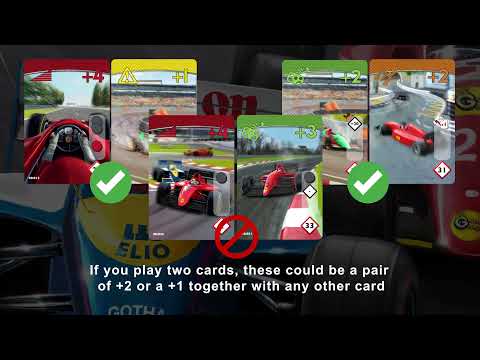
When a curve section is activated, each car in the section, starting from the last position and moving forward, announces if it wishes to initiate a duel. The first driver to declare a duel is considered the CHALLENGER. All others ahead of them must immediately announce whether or not they will participate in this challenge. Once all participants are defined, players must play 1 or 2 cards from their hand (Race Cards or Track Cards) FACE DOWN. Those who do not play these cards will not be participating in this duel.
Duel Resolution
The following rules apply:
- Any participant, with the exception of the first car in the section, receives a bonus or penalty in this sum as indicated in the table next to the curve name on the board.
- Any player using the BANGING WHEELS strategy (in any position in the section) receives a +3 modifier in this duel.
- All cards are revealed simultaneously, and each car sums the movement points of the two cards and all modifiers.
- Drivers who refused to participate are now placed behind the CHALLENGER according to their original positions.
- The remaining car positions are reorganized according to the sum of the cards played, from highest to lowest value.
More videos
More rules explanations from the community
In English
Rules manual
Official PDF file
Frequently Asked Questions
Quick answers about the rules
What is the objective of Race! Formula 90: 2nd Edition?
How do you set up Race! Formula 90: 2nd Edition?
How do you play Race! Formula 90: 2nd Edition?
Other Games You'll Like
Based on mechanics and theme