
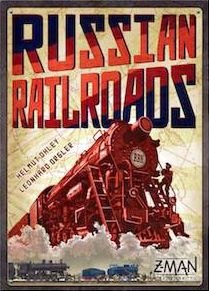
How to Play Russian Railroads
Hans im Glück, 999 Games, Asterion Press · Board game · 2013What do you want to do now
Ask anything about Russian Railroads: rules, setup, components, complexity, price, or whether it fits your group.
Video: How to Play
Start here, then follow the written guide
Step by step
Game Objective: Build the Russian Railway Empire!
Welcome, future railway tycoons! In Russian Railroads, you take on the role of visionaries tasked with a monumental undertaking: building the legendary Trans-Siberian Railway, in addition to two other important routes. But don't think it's just about laying tracks! You'll need to invest in new locomotives, boost industrialization, and hire the best engineers to ensure your railways are the most efficient and profitable. The ultimate goal? Accumulate the most victory points, the true measure of your railway mastery, by the end of the seventh round (in 4-player games). Who will be Russia's greatest builder?
Setup: Assembling Your Railway Network
Let's set up the table and prepare your stations for the journey!
- Place the game board in the center of the table. Leave the 100/200 and 300/400 point markers near the 100 space on the scoring track.
- The 5 cards are placed face up.
- Shuffle the 10 End Bonus cards, remove two without looking, and place the remaining 8 face down to form a pile.
- The 37 locomotives are organized by number into 9 distinct piles, with the locomotive side up (the purple side will come later). One of the #9 locomotives does not have a purple back and should be placed on its corresponding card.
- The 2 turquoise workers are placed in the area of the board that displays them. The black worker is placed on its corresponding card. Each player receives 7 workers of their color (1 worker of each color is returned to the box).
- Form a supply with the 20 Doubler markers.
- Form a supply with the 18 rubles (coins).
- Form a supply of tracks, separating the 48 tracks by color.
- The 15 engineers are separated into piles [A] and [B]. An engineer without a letter is placed on its corresponding [A] card with a ruble. Shuffle piles [A] and [B] separately. Place the first 4 engineers from pile [A] on the spaces marked [A] and the first 3 from pile [B] on the spaces marked [B]. The remaining engineers are removed from the game. Horizontal engineers are placed with the light side up; vertical, with the dark side up.
- The Last Round marker is placed near the board; it will be used in the last round.
Individual Player Setup
- Each player chooses a color and places their individual board in front of them.
- Each player receives a #1 locomotive from the supply and places it in the appropriate space in the upper left corner of their board.
- Each player receives 3 black tracks from the supply and places them on the first space of each of the three railways on their board.
- Each player receives 5 workers of their color and places them in front of them. The remaining 2 workers are placed near the board as a supply.
- Each player receives 1 ruble from the supply.
- Each player receives 1 Industry marker and places it on space 0 of the industry track.
- Each player receives 7 different markers, a second Industry marker, 1 Kiev Medal, and 1 Revaluation marker. Everything is placed near their individual board.
- Shuffle the 4 Turn Order cards and place one face up (with the number) in front of each player.
- Each player receives 2 pawns of their color: one for space 100 of the scoring track; another for the space on the turn order track that corresponds to their Turn Order Card.
- The Initial Bonus cards are arranged. The 4th player in turn order takes one, uses its ability, and removes it from the game. The 3rd and 2nd players do the same. The 1st player does not receive an Initial Bonus. The remaining card is returned to the box.
- Each player receives a Scoring Overview card.
The Game Turn: Building Your Empire
In Russian Railroads, players take turns, one after another, until everyone has passed. At the end of each round, points are scored. But before that, let's see how your turn works!
On each turn, a player must choose an unoccupied action space, occupy it with the required number of workers, and perform the action. Remember:
- The action space must be unoccupied.
- You must place the correct number of workers required by the action.
- You can only use workers from your personal supply.
- You must perform the action immediately and completely.
- You can only perform one action per turn (with noted exceptions).
Main Actions
Track Extension: Develop Your Railways!
Track extension actions are crucial for scoring. Your individual board has 3 railways: the Trans-Siberian, the St. Petersburg, and the Kiev. The more developed they are, the more points you'll score!
To build tracks:
- Place the required number of workers on one of the track extension action spaces.
- Advance the appropriate track(s) on your board the number of spaces indicated in the action. You can distribute the advances among multiple railways.
Important: Tracks advance in a specific and unchangeable order: first black, then gray, brown, natural, and finally, white. A track can only be moved to an empty space and can never reach or overtake the track in front of it.
You gain tracks of other colors by advancing the black track on the Trans-Siberian:
- Upon reaching or passing space 2: 3 gray tracks.
- Upon reaching or passing space 6: 3 brown tracks.
- Upon reaching or passing space 10: 2 natural tracks.
- Upon reaching or passing space 15: 1 white track.
Special Track Extension Action (Top and Bottom): This is the only action that can be used more than once per round. By placing 1 worker, you advance a black or gray track. The space is not considered occupied and can be used again by any player.
Locomotives and Factories: The Heart of Your Network
Without locomotives, even the best railway is useless! They determine how many spaces your railway can reach for scoring and for activating special spaces.
To build a locomotive:
- Place the required number of workers on one of the locomotive action spaces.
- Take 1 locomotive from the lowest numbered pile in the supply.
- Place this locomotive in front of one of the 3 railways on your board.
The Trans-Siberian can have up to 2 locomotives (one next to the board, another directly on the board), summing their values. St. Petersburg and Kiev can only have 1. You can replace a locomotive with a higher numbered one, and the "old" one can be moved to another railway (if empty or replacing a lower numbered one).
Factories: The back of each locomotive is a factory, which grants a special ability. To build a factory, use the same locomotive actions, but flip the locomotive to its purple side (factory) and place it under your board, from left to right, in the spaces reserved for factories.
Difference between locomotive actions:
- Top action (1 worker): Takes 1 locomotive (for railway or factory).
- Middle action (2 workers): Same effect, but more expensive.
- Bottom action (3 workers): Takes 1 locomotive AND 1 factory (not 2 of one type). You decide the order.
Industrialization: The Other Path to Victory
Industrialization allows you to score points in the scoring phase and access the abilities of your factories.
To industrialize:
- Place the required number of workers on one of the industrialization action spaces.
- Advance your Industry marker the number of spaces indicated.
You will notice gaps on the industry track. To advance beyond them, you need to fill them with factories. When your Industry marker moves onto a factory, you must immediately use that factory's ability.
Difference between industrialization actions:
- Top action (1 worker): 1 advance on the industry track.
- Middle action (2 workers): 2 advances on the industry track.
- Bottom action (2 workers): 1 advance on the industry track AND 1 black track advance.
Auxiliary Actions: Reinforcements and Flexibility
- 1 Doubler (1 worker): Take 1 doubler and place it on an empty dashed space above the Trans-Siberian (from left to right). A doubler multiplies the value of the space below it by 2 during scoring.
- 2 Rubles (1 worker): Take 2 rubles. Rubles can replace workers in action spaces (1 ruble = 1 worker), but workers cannot replace rubles. Spaces occupied by rubles also cannot be used again in the round.
- 2 Temporary Workers (1 worker): Take the 2 temporary turquoise workers. You must use them this round, and they act as if they were of your color. They cannot be saved for the next round.
Engineers: Special Abilities and Extra Points
Engineers offer special abilities during the game and points at the end. Each round, only one engineer can be hired: the one in the rightmost space of the engineer area on the board.
To hire an engineer:
- Place a ruble on the hiring action space.
- Take the engineer from that space and place it, light side up, near your board.
The engineers you hire (near your board) can be used as additional actions, even if you cannot complete them. The engineers on the board (light side up) are extra actions available to everyone, but can only be used once per round.
Engineers move one space to the right each round, becoming available in future rounds.
Turn Order: First Come, First Served!
Turn order is not fixed! The turn order track determines who plays first. To change your position in the next round, you can place one of your workers under the first or second position of the turn order track. You cannot occupy your current space or both turn order spaces.
When a player cannot or no longer wants to play, they pass, flipping their Turn Order Card and scoring the indicated points. The game continues until everyone has passed.
Turn Order Reorganization: After everyone has passed, players who placed a worker under the turn order track remove their pawns. The other pawns are moved to the right. Then, players who placed workers place their pawns on the turn order spaces above their workers.
Workers in the turn order spaces also grant an extra benefit: after reorganization, the player who placed a worker in the 2nd position moves their worker to a free action space (requiring exactly 1 worker) and performs the action. The player in the 1st position does the same.
End of Game and Scoring: The Grand Count
The game ends after the seventh round (in 4-player games). The scoring phase occurs at the end of each round, after all players have passed and the turn order has been reorganized.
Per-Round Scoring Phase
Two elements are scored on the individual boards:
- Your 3 Tracks:
- Only spaces reached by a locomotive are scored.
- The value of each track is determined by its color (shown in the upper right corner of the board).
- A track scores points for the space it occupies and all empty spaces behind it (count as "virtual tracks" of the same color).
- Trans-Siberian: Score the spaces reached by your locomotives. Doublers double the value of the space below them.
- St. Petersburg: Score like the Trans-Siberian. If your gray track and a locomotive reach space 7, the value of all scored spaces on this railway is doubled.
- Kiev: Score like the others. If your black track and a locomotive reach spaces 1-4 or 8, you score the additional points indicated by the stars (cumulative).
- Your Industrialization Progress:
- Score the points indicated on the industry track space occupied by your Industry marker. Spaces without points (like factories) are worth the same as the first previous space with points.
After scoring, workers are returned, rubles and turquoise workers are returned to their supplies, and engineers are moved one space to the right. Turn Order Cards are adjusted for the next round.
End of Game and Final Scoring
After the scoring phase of the 7th round, final scoring occurs, and the game ends. Final scoring consists of two parts:
- End Bonus Cards: Players reveal their End Bonus cards and score their effects. (It is possible to acquire more than one with the help of factories.)
- Engineer Majority:
- The player with the most engineers scores 40 points.
- The player with the second most engineers scores 20 points.
- In case of a tie, the tied player with the highest numbered engineer wins the tiebreaker.
- Players without engineers do not score.
The player with the most points is the winner! In case of a tie, tied players share the victory.
Tips for Winning: Strategies for Railway Success
To avoid getting lost in the vastness of Russia, here are some valuable tips for your first games:
- Don't Underestimate Track Extension: It's easy to focus on locomotives and factories, but don't forget to extend your most valuable tracks whenever possible. The tracks
More videos
More rules explanations from the community
In English
-
 Ten Minute Teach - Russian Railroads
-
 How to Play Russian Railroads - Icarus Tours
-
 How to play Russian railways
-
 Russian Railroads Gamesplained - Part 1
-
 Russian Railroads - Règles en français
-
 Play through of the Russian Railways
-
 Russian Railroads Teach and Playthrough 3 player
-
 Review of Russian railways
Rules manual
Official PDF file
Frequently Asked Questions
Quick answers about the rules
