
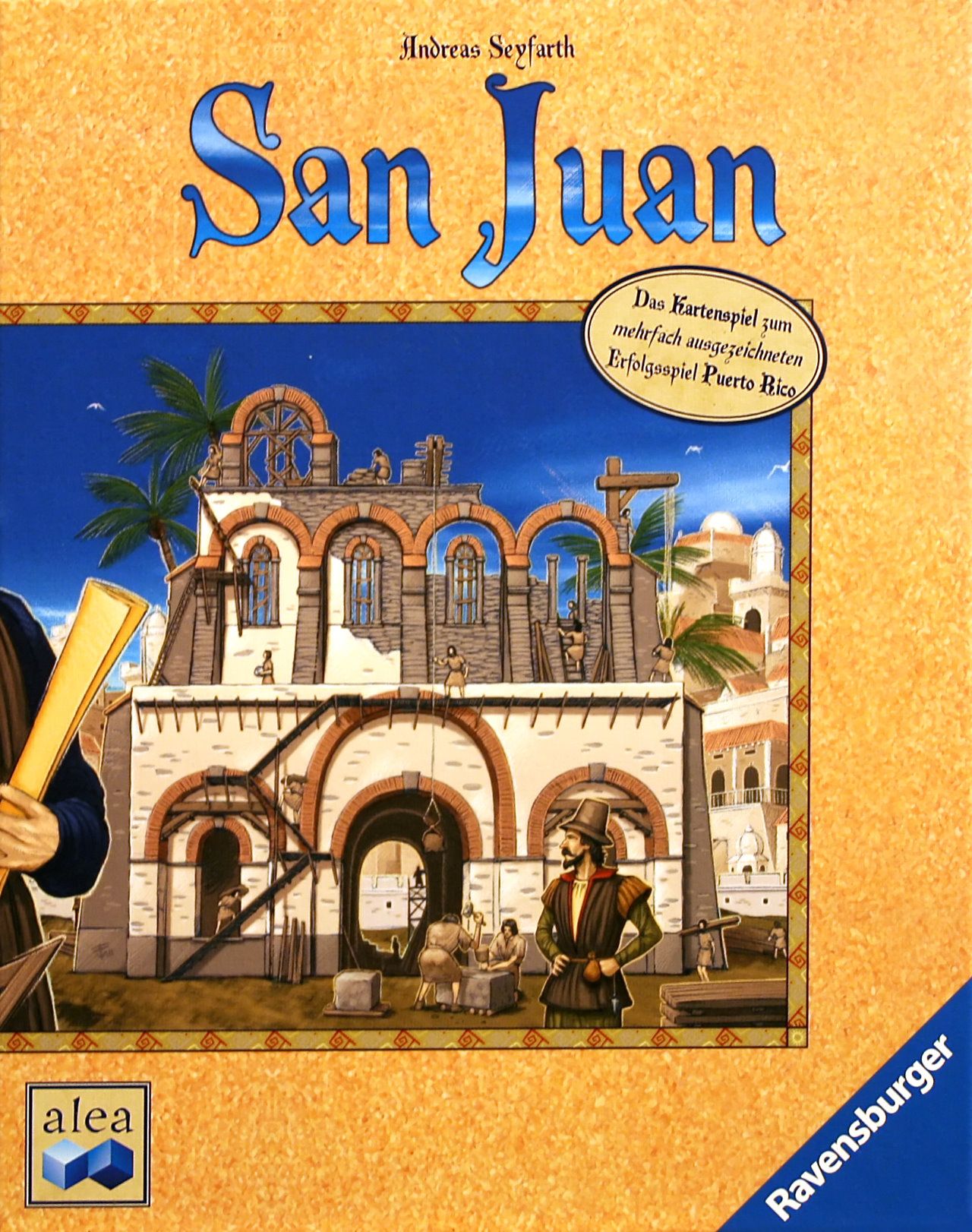
San Juan
alea, Ravensburger AG, Broadway Toys LTD · Board game · 2004Game Objective: Build Your Empire in San Juan!
Welcome to San Juan, future governors and builders! Prepare to dive into a world of trade, production, and, of course, a lot of construction. In San Juan, your objective is simple yet challenging: be the player with the most victory points (VPs) at the end of the game. How do you achieve this? By choosing the best roles, building the most valuable buildings, and managing your cards wisely. Who will have the most fruitful production facilities? Who will erect the most important buildings? The one who accumulates the most wealth and fame will be the great winner!
Setup: Set Up the Table and Start Building
Before embarking on the adventure, let's set up the table so everything is ready for action:
- Choose a starting player however you prefer. They will receive the governor's plaque.
- Place the 5 role plaques (Builder, Producer, Trader, Councilor, and Prospector) side by side in the center of the table.
- Shuffle the 5 trading house tiles face down and form a stack next to the Trader plaque.
- Shuffle all the cards (production and violet cards) to form the card supply, which will be face down. Next to it, leave a space for the discard pile, which will also be face down. It's important to keep these two piles separate!
- Each player takes:
- One Indigo Plant card (separated from the other cards) and places it face up in their play area (the table in front of them) as their first construction.
- 4 cards face down from the card supply, keeping them secret from other players.
- Keep the score pad and pencil handy. They will only be used at the end of the game to record VPs.
Ready! San Juan is set up and waiting for you!
The Game Turn: Choose Your Role and Act!
The game unfolds over several rounds (usually between 11 and 14). In each round, the dynamic is as follows:
- The governor (starting player) chooses one of the available role plaques from the center of the table, places it face up in their play area, and performs the associated action for that role.
- Then, the player to the governor's left, clockwise, performs the same action associated with the chosen role, and so on, until each player has performed the action once.
- After everyone has acted, the next player to the governor's left (the second player of the round) selects one of the remaining role plaques, places it in their play area, and performs the action. Again, all other players follow clockwise, performing the action.
- This process repeats until all players have selected a role and everyone has performed the associated actions.
End of Round:
- When all role plaques have been chosen and actions performed, the round ends.
- Players return the used role plaques to the center of the table.
- The governor's left neighbor takes the governor's plaque, becoming the new starting player.
- A new round begins with the new governor selecting a role.
Important Role Details:
Each role offers an action for all players and a special privilege only for the player who chose it (with the exception of the Prospector).
- The player who chooses the role is always the first to perform the action.
- You must select a role on your turn, but you can choose not to perform the associated action. Other players can also choose not to perform the action.
- A chosen role plaque remains in the player's play area until the end of the round. No one else can choose that role this round.
The Roles and Their Actions:
Builder (Construction Phase)
- Action: All players can build a building.
- To build, you place a card from your hand face up in your play area.
- Then, you pay the construction cost (shown in the upper left and right corners of the card) by discarding cards from your hand equal to the cost (the value of the cards doesn't matter, only the quantity).
- You can build any number of production buildings of the same type, but only one of each violet building.
- Builder's Privilege: The player who chose the Builder role pays 1 less card to build, but the cost cannot be reduced below 0.
- Tip: Buildings like the Blacksmith, Crane, Poor House, Black Market, Carpenter, Quarry, and Library can alter construction rules if you have them in play.
Producer (Production Phase)
- Action: All players can produce goods.
- You take a card from the card supply and place it face down on one of your empty production buildings (where there is no other card).
- This card represents a good that can be sold in the Trader phase.
- Producer's Privilege: The player who chose the Producer role can place a second card from the supply on another of their empty production buildings.
- Important: No production building can have more than 1 "good" card at a time.
- Tip: The Well, Aqueduct, and Library can influence your production.
Trader (Trading Phase)
- Action: All players can sell goods.
- You announce which of your goods you will sell.
- Take the good cards from the corresponding production buildings and place them face down on the discard pile.
- Then, draw cards from the card supply equal to the price of the goods sold (the price is determined by the trading house tile).
- Trader's Privilege: The player who chose the Trader role can sell an additional good.
- At the start of the phase: The Trader flips the top trading house tile from the stack to determine selling prices.
- At the end of the phase: The Trader places the trading house tile face up back at the bottom of the trading house tile stack.
- Tip: The Market Stand, Trading Post, Market Hall, and Library can improve your sales.
Councilor (Councilor Phase)
- Action: All players draw 2 cards from the supply, look at them, add 1 to their hand, and discard the other face down.
- Councilor's Privilege: The player who chose the Councilor role draws 5 cards from the supply, looks at them, adds 1 to their hand, and discards the other 4 face down.
- Tip: The Archive, City Hall, and Library can alter how you acquire cards.
Prospector (Prospector Phase)
- Action: No action for other players.
- Prospector's Privilege: The player who chose the Prospector role draws 1 card from the supply and adds it to their hand.
- Tip: The Gold Mine and Library can enhance the Prospector's privilege.
Start of Each New Round:
After the governor changes, some checks are made:
- The new governor reminds Chapel owners that they can place 1 card from their hand face down under their chapel.
- The governor checks the number of cards in each player's hand. If a player has more than 7 cards (or 12 with a Tower), they must discard the excess to the discard pile.
End of Game and Scoring: The Great Reckoning!
The game ends immediately after the Builder phase if at least one player has twelve buildings in their play area. The round is not played to the end.
Now it's time to count victory points! Use the score pad and pencil to record. Each player sums:
- The victory points from their buildings (the number at the bottom of the card).
- The victory points (number of cards) under their Chapel.
- The victory points for the Triumphal Arch, the Guild Hall, and the City Hall.
- The victory points for the Palace (this is calculated last!).
The player with the most victory points wins the game!
In Case of a Tie:
If there is a tie in total victory points, the player among the tied players with the most cards in hand and in their production buildings is the winner.
Tips for Winning: Strategies for Success in San Juan
San Juan is a game of smart choices. Here are some tips to get started on the right foot:
- Card Management is Everything: Remember that in San Juan, cards are your currency, your buildings, and your goods! Knowing when to use a card to pay for a building, when to save it for a future action, or when to turn it into a good is crucial. Don't underestimate the power of having cards in hand for options.
- Observe Opponent Roles: You don't play alone! An opponent's role choice can benefit you (or harm you). For example, if a player chooses the Producer, you can also produce. Plan your constructions and sales considering which roles your opponents are likely to choose and how you can take advantage of that.
- Prioritize Buildings with Special Functions: The violet buildings with special functions (like the Blacksmith, Trading Post, or Library) can offer significant advantages throughout the game, optimizing your actions and saving cards. Building them early can create a powerful game engine, but evaluate the cost and if they fit your overall strategy.



