

How to Play SETI: Search for Extraterrestrial Intelligence
Czech Games Edition (CGE), Broadway Toys LTD, Cranio Creations · Board game · 2024What do you want to do now
Ask anything about SETI: Search for Extraterrestrial Intelligence: rules, setup, components, complexity, price, or whether it fits your group.
Video: How to Play
Start here, then follow the written guide
Step by step
Game Objective
SETI is a game of exploration and discovery where players control space exploration agencies. Your goal is to use limited resources to launch probes, explore planets, listen to the stars, and advance the science of exobiology to find intelligent alien life. The game ends after 5 rounds, and the player with the most points wins.
Setup
- Main Board: Assemble the planetary board (A), solar system board (B), and tech board (C) and place them in the center of the table.
- Alien Species: Mix the 5 alien species boards face down and place 2 at random in the slots on the edge of the planetary board. The others are returned to the box.
- Solar System Board: Randomize the three discs and 4 sector boards so that the discs line up to form eight sectors, each with one nearby star.
- Card Row: Shuffle the main deck and deal 3 cards face up to form the card row.
- Resources: Place credit and energy tokens nearby. Fill each nearby star's data slot with data tokens.
- Technologies: On the tech board, shuffle the 4 matching tech tiles for each of the 12 technologies and place them face down. Place a 2-point tile on top of each of the 12 stacks.
- End-of-Round Cards: Prepare 4 stacks of cards. Each stack must contain 1 more card than there are players.
- Rotation Tokens: Place one solar system rotation token on the tech board and the second on the first pile of end-of-round cards.
- Milestones: Place neutral markers above the 20- and 30-point spaces on the scoring track (for 1-2 players, 2 markers each; for 3 players, 1 marker each; ignore for 4 players).
- Gold Scoring Tiles: Place the 4 double-sided gold scoring tiles beside the board with a random side up.
- Player Setup: Each player chooses a color and takes their pieces. The starting player (who last saw a UFO) receives the starting player marker. Starting scores are 1 for the first player, 2 for the second, 3 for the third, and 4 for the fourth.
- Starting Resources: Players take their starting income card and receive 4 publicity, 4 credits, 3 energy, and 5 cards. Players then turn one of their cards into income by tucking it under the starting income card.
Game Flow
The game is played over 5 rounds. In each round, players take turns in clockwise order.
Turn Structure
On your turn, you perform 1 main action. You may also perform any number of free actions before, after, or during your main action. Once the main action and free actions are finished, you resolve any milestones or discovered species before the turn ends.
Round Structure
- Players continue taking turns until everyone has passed.
- The first player to pass in a round must rotate the solar system.
- When a player passes, they discard down to 4 cards and choose one card from that round's end-of-round cards stack.
- Once all players have passed, the round ends. Players collect income (resources from the starting income card and all tucked cards).
- The starting player marker moves to the next player to the left.
Actions and How to Play
Main Actions
- Launch a probe: Pay 2 credits to place a probe figure on the Earth space. You are limited to one probe "in space" (in the rings of the solar system board).
- Orbit a planet: Pay 1 credit and 1 energy to move a probe from a planet space (other than Earth) to that planet's orbit on the planetary board. The first player to orbit a planet scores 3 points.
- Land on a planet or moon: Pay 3 energy (or 2 energy if an orbiter is already present) to move a probe from a planet space to the planetary board. This earns a life trace and points. Landing on a moon requires specific effects or tech.
- Scan nearby stars: Pay 1 credit and 2 energy. Mark 1 signal in Earth's sector and 1 signal in a sector matching a card discarded from the card row. Telescope techs can allow for additional signals.
- Analyze data: Pay 1 energy. This requires the top row of your computer to be full. Discard all data in the computer to mark a life trace for one of two alien species.
- Play a card: Pay the cost to resolve the card's effect. Missions cards (Conditional or Triggerable) are kept in front of the player. End-of-game scoring cards (gold boxes) are also kept for final scoring.
- Research a tech: Pay 6 publicity. First, rotate the solar system, then take the top tile from a chosen tech stack. If you are the first to take from that stack, score 2 points.
- Pass: End your turn for the remainder of the round.
Free Actions
- Movement: Spend 1 energy to move a probe to an adjacent space. Leaving asteroids costs 1 additional movement.
- Analyze Data (Placing): Place a data token from your data pool into your computer (from left to right).
- Resource Exchange: Exchange 2 cards, 2 credits, or 2 energy for 1 card, 1 credit, or 1 energy.
- Buying a Card: Spend 3 publicity to take a card from the card row or the top of the deck.
- Card Free Action: Discard a card to gain its free action benefit.
Special Mechanics
- Rotating the Solar System: Occurs when a player researches a tech or the first player passes. Discs rotate in order (Disc 1, then 2, then 3). Probes move with the discs unless they are in a gap; if bumped by a disc, they are pushed into the next space.
- Sectors: Marking a signal replaces a data token with a player marker. The player with the most markers when the last token is replaced "wins" the sector and gets the reward.
- Life Traces: Marking a life trace on an alien board grants 1 publicity and 5 points. If discovery spaces are full, use overflow spaces for 3 points.
End of Game and Scoring
The game ends after 5 rounds. The player with the most points wins.
Final Scoring Criteria:
- Gold Scoring Tiles: Points are awarded based on sets (e.g., sets of three different techs, completed missions, sets of three different life traces, or sets of three income cards).
- End-of-game scoring cards: Points from cards with gold boxes.
- Alien Species: Some species may add an additional scoring step.
Tips for Winning
- Strategic Movement: Use the solar system rotation to your advantage to push probes into desired spaces for free.
- Data Management: Keep your data pool (limit of 6) clear by using the free action to place data into your computer so you don't discard excess data.
- Tech Synergy: Prioritize telescope techs to increase the efficiency of your Scan actions, allowing you to mark more signals per action.
More videos
More rules explanations from the community
In English
-
 How to play SETI - Full teach + Alien Species explanation + Visuals - Peaky Boardgamer
-
 How to play the SETI Alien Life Forms #2 - Centaurians
-
 SETI: How To Play
-
 How to play the SETI Alien Life Forms #4 - Exertians
-
 SETI: Space Agencies - Tutorial & Playthrough
-
 How to play the SETI Alien Life Forms #5-Anomalies
-
 SETI - Playing With Friends
-
 How to play the SETI Alien Life Forms #3-Mascamites
-
 SETI Rules Challenge
-
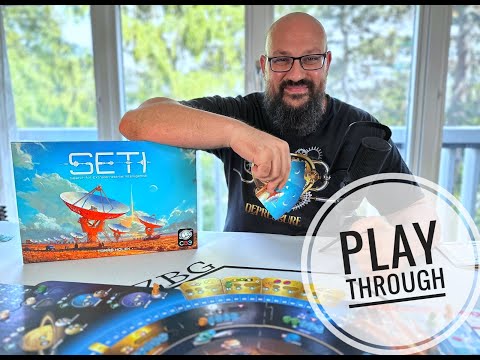 SETI playthrough/how to play
-
 SETI l A Solo Mode Tutorial
Rules manual
Official PDF file
Frequently Asked Questions
Quick answers about the rules
