
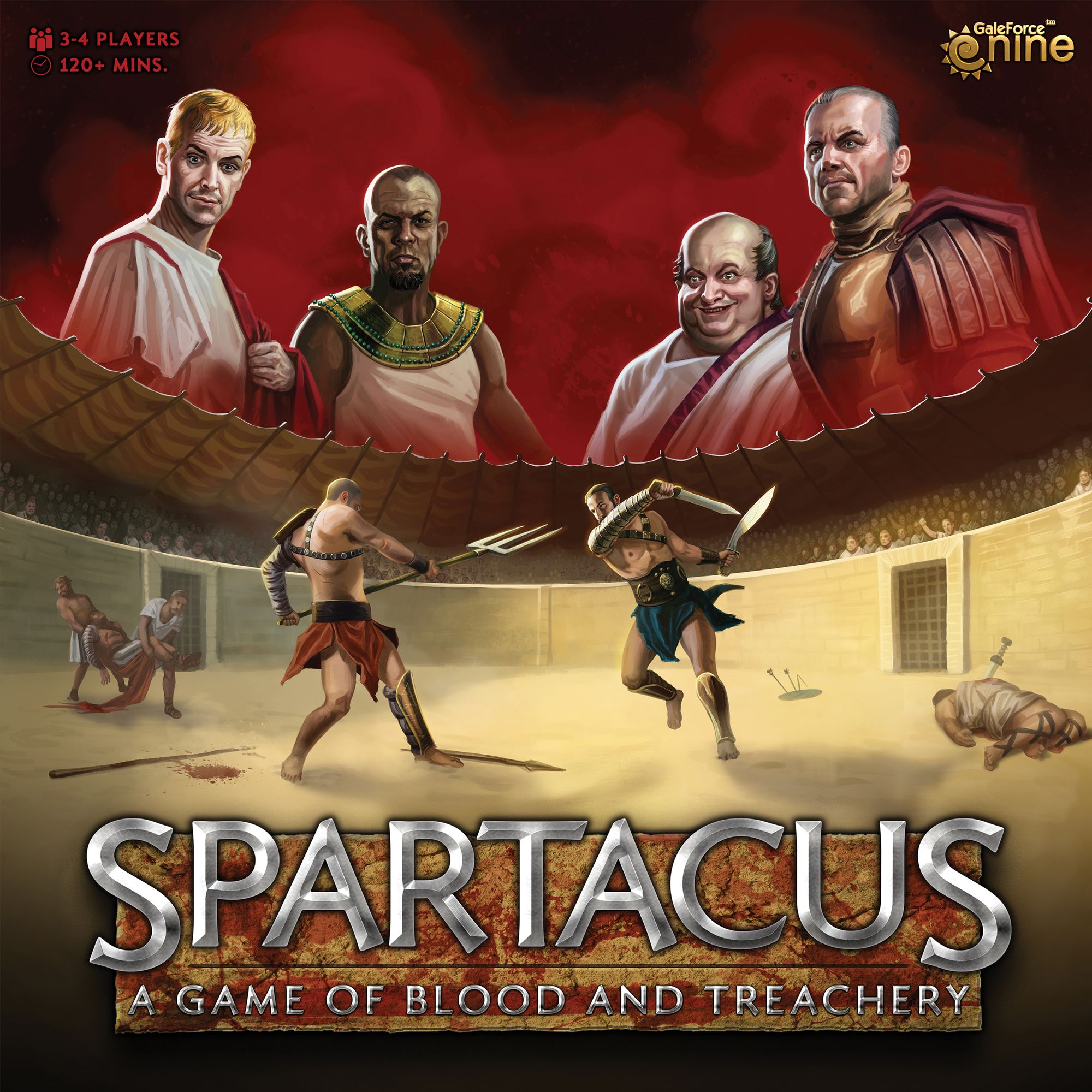
Spartacus: A Game of Blood and Treachery
Gale Force Nine, LLC, A1 Games, Battlefront Miniatures Ltd · Board game · 2012Game Objective: Conquer Capua with Blood and Treachery!
Welcome, Dominus! In Spartacus: A Game of Blood and Treachery, you will assume the role of heads of Patrician Houses in the vibrant and dangerous city of Capua. Your ultimate goal? To become the most influential House, securing your family's power for the future! How will you do this? With an explosive mix of political conspiracies behind the scenes and glorious battles in the arena sands. Prepare for bribery, poisoning, betrayal, theft, and blackmail. The first Dominus to reach **12 Influence points** and end a phase alone in that position wins the game. If more than one Dominus reaches 12 Influence in the same phase, glory will be decided in the Arena!
Setup: Building the Empire
To begin your journey to supremacy in Capua, follow these steps:
- House Selection: Each Dominus rolls a die. The highest result chooses a House Board, a Gladiator Miniature, and receives the Host Marker first. Clockwise, the other players choose their House Boards and Gladiator Miniatures, receiving the corresponding House Marker. The holder of the Host Marker starts the first Intrigue Phase.
- Starting Resources: Each Dominus receives the Starting Resources listed on their House Board.
- Starting Gladiators and Slaves: Separate the Starting Gladiators and Slaves cards (white borders) from the Market Deck. Shuffle the Starting Gladiators and deal each Dominus their starting quantity. Do the same with the Starting Slaves. The remaining cards are returned to the Market Deck.
- Starting Guards: Deal each Dominus their starting quantity of Guards from the Intrigue Deck. All starting Guard cards must be placed on the table, face up, as Resources.
- Starting Denarii: Give each Dominus their Starting Denarii. The remaining denarii form the Bank. Remember: Denarii can change hands between players at any time!
- House Preparation: Mark your starting Influence on your House Board with the House Marker. Place Gladiators to the right, Slaves to the left, and Guards below your Treasury.
- Define Game Type:
- Quick: Starting Influence 7. Duration less than two hours. Recommended for beginners.
- Standard: Starting Influence 4. Duration two to three hours.
- Advanced: Starting Influence 1. Duration more than three hours.
- Cards and Decks: Fully shuffle the Market and Intrigue Decks and place them face down on the table. The discard piles are placed next to them, face up.
Ready! Let the negotiations and machinations begin!
The Game Turn: Rise and Fall
Each turn in Spartacus is a cycle of four phases, where your House's luck and influence can change dramatically:
- Maintenance Phase
- Intrigue Phase
- Market Phase
- Arena Phase
Maintenance Phase: Preparations for Battle
This phase sets the stage for the actions to come. Players can perform their actions simultaneously.
- Card Activation: Flip face up all "Exhausted" Resource Cards (face down), except those with a Wound Marker. Exhausted cards cannot be used.
- Wound Recovery: For each Gladiator or Slave with a Wounded Marker, roll a die for a Recovery Test:
- **4-6:** Remove the Wounded Marker and activate the card.
- **2-3:** The Combatant remains wounded and Exhausted this turn.
- **1:** The Combatant dies and is discarded to the Market Deck discard pile.
- General Balance:
- Receive 1 Denarius for each Active Slave.
- Pay 1 Denarius for each Active Gladiator.
- If you cannot pay for a Gladiator, you must discard it.
Intrigue Phase: The Game of Shadows
This is where plans are laid, alliances are formed, and betrayals are executed. The game begins with the Dominus holding the Host Marker, and proceeds clockwise.
- Receive Cards: Each player receives 3 Intrigue Cards.
- Maximum Hand Size: Your Maximum Hand Size is listed below your current Influence. At the end of your Intrigue turn, you cannot have more cards than the limit, and must discard the excess.
- Your Intrigue Turn: On your turn, you can:
- Trade Cards for Denarii: Discard an Intrigue Card to receive the denarii value indicated on it.
- Use Special House Rules: Each House has unique abilities that can be used in this phase.
- Use Special Card Abilities: Many Slaves and some Gladiators have "Intrigue" abilities that can be used, often requiring the card to be Exhausted.
- Set Up Schemes:
- Each Scheme Card requires a minimum Influence level. If your Influence is equal to or greater, you can launch the Scheme, declaring a target (which can be yourself).
- Seeking Support: If you don't have enough Influence, you can ask other players for support. Their Influence adds to yours for the Scheme (without changing Influence markers). Support, once granted, is final. You don't need to show the Scheme or tell the truth about it!
- Successful Schemes: If the Scheme is not canceled, its effects occur immediately, costs are paid, and the card is discarded.
- Reactions: These are powerful countermeasures that can be played in response to other events, not just on your turn. They also have a Required Influence level, but you cannot receive support to play them.
- Canceling a Scheme: Some Reaction Cards can cancel Schemes. They are played immediately after an attempt to launch a Scheme. You can cancel any Scheme, even if you are not the target.
- Guards: These are a special type of Reaction to cancel Schemes against you. To use them, discard a Guard and roll a die:
- **4-6:** Scheme canceled.
- **1-3:** Failure! The Guard is discarded, but you can try with another.
- End of Your Turn: Discard cards down to your Maximum Hand Size. The game proceeds to the next player clockwise.
Market Phase: Trade and Auctions
In this phase, players trade Resources and bid for new items in auctions, culminating in the dispute for the honor of being Host.
- Open Market:
- Buy, sell, and trade Resource Cards (Gladiators, Slaves, Equipment, and Guards) among yourselves. This is the only time these cards can change hands between players.
- Sell Resources to the Bank for their denarii value.
- Closing the Open Market: When you finish your negotiations, take and hide your denarii. When all players have done so, the Open Market ends.
- Auction:
- Place a number of cards from the Market Deck (face down) equal to the number of players on the Arena Board.
- Reveal the first card. All players make Hidden Bids (holding the amount of denarii in a closed hand over the Arena Board and revealing simultaneously).
- The highest bid wins, pays the Bank, and receives the Resource. The others keep their denarii.
- Resolving Ties: Tied players place their bids on the table and make another round of hidden bids, adding to the previous ones, until one has the highest total.
- Canceled Auctions: If all bids are null (zero denarii), the auction is canceled, no one receives the card, and the denarii are returned.
- Contest for the Host Title:
- After all Resources are auctioned, players compete to be the Host of the next Arena Phase, using Hidden Bids.
- The winner pays the bid to the Bank and receives the Host Marker. They will be the Host of the games and the first in the next Intrigue Phase.
- Auction Canceled by Host: If the auction is canceled, all bidders roll a die. The highest result wins Host Honors.
- Ending the Market Phase: Return any remaining denarii to the Treasury and the Arena Phase begins.
Arena Phase: Blood and Glory
The moment of truth! Gladiators fight to bring glory and Influence. The Host presides over the games.
- Honor to the Host: The Host receives 1 Influence point.
- Hosting the Event (Invitations): The Host must invite two Dominus to provide combatants.
- The Host offers one invitation at a time. The player who accepts chooses a Gladiator or Slave, places their Gladiator Miniature on hex "I" or "II" of the Arena Board, and their Combatant Card with up to one Equipment Card of each type (Weapon, Armor, Special) on the edge of the Arena.
- Refusing an Invitation: If a Dominus refuses, they lose 1 Influence. The Host invites another. If no one accepts, the phase ends.
- The Host can request bribes or agreements in exchange for invitations.
- Tribute: The Bank pays 2 denarii for each Favor Marker and 6 denarii for each Champion Marker that the invited combatants possess.
- Making Bets: Players bet on the outcome of the games.
- Place 1 to 3 denarii in the desired corner of the Arena Board and cover with your House Marker. Bets must be simultaneous.
- Victory (Pays 1 to 1): Bet that a combatant will win. Players cannot bet against their own combatant.
- Wound (Pays 2 to 1): Bet that the fight will end with a wound.
- Decapitation (Pays 2 to 1): Bet that the fight will end with a decapitation.
- Winning bets recover the amount bet and the gain. Lost bets go to the Bank.
- Combat!: The fight begins! (See complete Combat rules on pages 14-16 of the manual).
- Victory and Defeat:
- The victorious Dominus gains 1 Influence. The victorious Combatant receives a Favor Marker.
- Crowning a Champion: Upon receiving the third Favor Marker, a combatant becomes a Champion (exchange the Favors for a Champion Marker). Gaining a Champion gives 1 Influence; losing one, loses 1 Influence.
- Resolving Bets: After the winner receives their Favor Marker, bets are resolved.
- The Power of Life & Death: The Host decides the fate of the defeated combatant with a "thumbs up or thumbs down" gesture.
- Thumbs Up: The combatant returns to their House.
- Thumbs Down: The combatant is executed and discarded. If the combatant has Favor Markers, the Host loses 1 Influence for each. Executing a Champion is not allowed.
- The Game Continues...: After the Host's decision, the next turn begins.
Combat Basics
The arena is the stage of glory. Understanding combat is crucial:
- Attributes: Each Combatant has Attack (ATK - red dice), Defense (DEF - black dice), and Speed (VEL - blue dice). The sum of the dice represents the Combatant's Health.
- Initiative: At the start of each round, both combatants roll their VEL dice. The highest result wins Initiative and chooses who acts first.
- Combat Round: Each player moves and attacks (or vice versa).
- Movement: A combatant can move up to the number of hexes equal to the dice in their Speed Pile.
- Attack: Combatants attack opponents in adjacent hexes. Resolved by a Roll Contest: attacker rolls ATK, defender rolls DEF. Compare dice from highest to lowest. One point of Damage is inflicted when an ATK die is higher than a DEF die (tie goes to the defender).
- Damage: The wounded combatant loses a number of dice equal to the damage suffered, choosing from which Piles (ATK, DEF, VEL).
- Rule of One: No Dice Pile can be reduced to less than 1 until all other Piles have only 1 die remaining.
- Defeat: A combatant is defeated when one or more of their Dice Piles are reduced to zero.
- Surrender: One Pile to zero.
- Wound: Two Piles to zero. The card is Exhausted and receives a Wounded Marker.
- Decapitation: All three Piles to zero. The card is discarded.
- Special Abilities: Combatant and Equipment cards may have special abilities that alter the standard rules. Rules on cards take precedence.
- Exhausting a Card: Flip the card face down to use an "Exhaust to..." ability. Exhausted cards cannot be used.
- Rerolling
In English
-
 Spartacus: A Game of Blood & Treachery Board Game Game-Play Overview
-
 Spartacus Blood & Treachery Tutorial & Review by Nerd Barrage
-
 HOW TO PLAY | Spartacus: A game of Blood and Treachery
-
 Overly Critical Gamers - Spartacus: A Game of Blood & Treachery - Instructional/Gameplay/Review
-
 How To Setup And Play Spartacus
-
 Level Up 07 : Spartacus the Boardgame played as a Campaign
-
 Fase de Mantenimiento

