
T.I.M.E Stories
Space Cowboys, ADC Blackfire Entertainment, Asterion Press · Board game · 2015Objective of the Game
You’re not just playing a game—you’re becoming a T.I.M.E. Agent! Your mission? To preserve temporal continuity across realities and eras by solving mysteries, overcoming dangers, and unraveling enigmas. You and your team will be projected—mind only—into receptacles (characters) from alternate timelines, using the safe, non-intrusive Tachyon Insertion technique.
Each deck represents a standalone mission—a self-contained story with its own setting, puzzles, and challenges. The goal is simple: complete the mission before your Temporal Units (TU) run out. If you succeed, you’ll hear the words you’ve been waiting for: “Mission Successful.” If not? You’ll be recalled to base—and given a second (or third, or fourth) chance to try again. But remember: each failed attempt costs the Agency (and the taxpayers!) big time. So stay sharp, stay together, and don’t let time slip through your fingers.
Setup (Preparation)
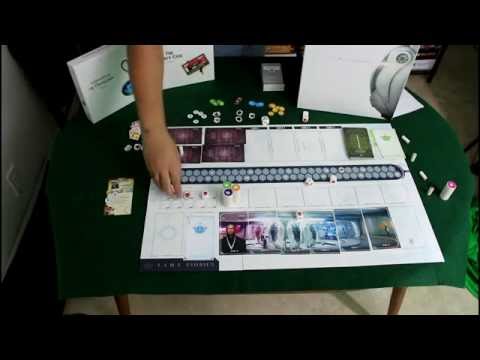
Every scenario follows the same setup—simple, clean, and designed to get you into the story fast. Here’s what you’ll need to do:
- Set up the board facing all players.
- Prepare the shields:
- Split the normal shields in half: place one half with the skull side up, the other half with the white shield side up.
- Sort the other shield types (time, heart, special) into separate piles.
- Place tokens:
- Put Life Points (LP) and resource tokens above the board.
- Sort the 24 state tokens and place them to the left of the board.
- Place dice and tokens:
- Put the 6 action dice and the Time Captain die near the players.
- Place the time token and group token nearby—your starting position for these will be given during the mission briefing.
- Distribute player components:
- Each player picks a pawn color and takes one large pawn (to move around the board) and one small pawn (as a personal reminder).
- Organize your deck:
- Remove the top and bottom flash cards (they’re just for secrecy—set them aside).
- If the scenario uses multiple packs, stack them in order (pack 1 on top, etc.) to form one unified deck.
- Locate the Base cards (always marked A–G on the back) and place them on the board in alphabetical order.
- Place the rest of the deck in the indicated space on the board.
Pro tip: Sit on the same side of the board so everyone can clearly see the panorama cards—some details in the artwork may be vital!
The Game Turn
There are no formal “turns” in T.I.M.E. Stories—just Temporal Units (TU) and shared action. Think of it as a rhythm: discuss → spend TU → act. Here’s how it flows:
The Time Captain’s Role
Each location has a Time Captain—a rotating leadership role. The Time Captain is responsible for:
- Reading Card A aloud (the narrative intro to the location).
- Tracking and spending TU for location changes and actions.
- Breaking ties in group decisions (if consensus can’t be reached, the Time Captain decides).
After each location change, the Time Captain passes to the player on their left.
Entering and Exploring a Location
Once a location is opened, you can enter it for free (no TU cost). To do so:
- Each player places their pawn on a space of their choice—you can all go to the same space or split up.
- Important: If at least one agent enters, all must enter—even if someone hesitates!
- Only agents on a space can consult the card for that space.
Sealed cards require special conditions to access—like owning a specific state token, having a key, or being a certain receptacle. Check the back of the card for the requirement.
Reading and Discussing Cards
When you consult a card, don’t show it to players not on the same space—and don’t read it word-for-word unless it contains a rule or technical instruction. Instead:
- Paraphrase what you see.
- Describe clues, people, or objects.
- Share your interpretation and hypotheses.
Remember: You’re in telepathic contact the whole time—use it! Communication is your greatest weapon.
Spending 1 TU and Taking Actions
When the group decides to act (e.g., investigate, fight, move), the Time Captain spends 1 TU, and then each player takes one action in any order they choose:
- Make a characteristic roll (combat, strength, persuasion, deftness, etc.)
- Move your pawn (if allowed by sealed card rules)
- Do nothing (sometimes the safest—or stupidest—choice!)
Note: You can look at the card of a space you just moved into—no extra TU needed.
Tests and Dice Rolls
Tests appear as shields on a card. To resolve one:
- Roll dice equal to your receptacle’s rating for that attribute (e.g., “3 dice for combat”).
- Apply hits (✅): Each hit removes one shield, from left to right (normal → skull → special/heart/time).
- Resolve riposte (if you rolled at least one skull and the test still has skull shields):
Add your rolled skulls to the shield skulls → compare to your resistance.
If resistance ≥ total skulls: you’re safe.
If resistance < total skulls: lose 1 Life Point. - Automatic penalties (if any special, heart, or time shields remain):
- Each heart shield = lose 1 LP.
- Each time shield = lose 1 TU.
- Special shields have scenario-specific effects.
Important: If you choose to do nothing during a test that has at least one skull shield, you automatically lose 1 LP—even if you don’t roll!
Location Changes
When you’re ready to move on, follow these five steps:
- Leave the current location: Each player places their pawn in front of themselves.
- Choose a new location: Pick any visible location on the PLAN card.
- The group must agree—or vote. Tie? Time Captain breaks it.
- You can revisit locations—but not immediately after leaving one. - Put away the current location: The Time Captain stacks all cards face down (Card A on top), then places them at the bottom of the deck.
- Roll the Time Captain die: Result (1–3) = TU spent. If leaving a red-named location, add +2 TU.
- Pass the Time Captain die: To the player on your left.
End of Game and Scoring
There’s no traditional “scoring”—T.I.M.E. Stories is about mission success, not points. Here’s how it ends:
Victory
The game ends with a Mission Successful card when you fulfill the objective (e.g., rescue a captive, retrieve an artifact, stop a catastrophe). Read it aloud—and celebrate!
Defeat
You fail the mission and must read the Mission Failed (TU) card if:
- The time token reaches 0, OR
- All receptacles are dead (even if TU remain), OR
- A specific scenario condition triggers failure (e.g., failing to prevent a key event).
Important: When you fail, keep item cards (especially those with the Agency logo), but reset everything else: LP, state tokens, discarded cards, etc. Then, reset the deck and try again!
Death and Reintegration
If a receptacle drops to 0 LP, it dies:
- The agent’s large pawn is removed.
- Place the small pawn 7 TU ahead of the current time marker.
- The agent can still participate in discussions—but no longer acts until reintegrated.
- When the time marker reaches the small pawn, the agent returns for free to any space with at least one living agent—and regains full LP.
- If only ≤7 TU remain when death occurs, reintegration is impossible that run.
Tips to Win
Ready to go from rookie to legend? Here are three tactical tips straight from the manual:
- Never ignore the story’s background.
Most scenarios are built around an enigma. Pay close attention to names, dates, dialogue, and visual clues. Often, the key to solving a puzzle is hidden in a seemingly offhand remark or a background detail in the art. - Coordinate your dice rolls.
If you’re facing a tough test, group agents on the same space to pool dice. But remember: each agent rolls separately, and some receptacles (like Madeleine du Tilleul or Vasil La Fouine) have special powers that activate only under certain conditions (e.g., proximity to others or resource use). Use them wisely! - Don’t rush sealed cards.
Many critical clues or items are behind sealed cards. If you know you’ll need a state token or key, plan ahead—don’t waste time exploring dead ends. Sometimes, the best move is to hold off until you’ve gathered enough information to unlock the next step.
And one golden rule to live by: Communication is non-negotiable. T.I.M.E. Stories shines when players share what they see, hear, and deduce. The more you talk, the more the story unfolds—and the more fun you’ll have.
Now grab your receptacle, check your dice, and—most importantly—watch the clock. The timeline’s counting on you.
In English
-
 T. I. M. E Stories - Part 2 - How To Play (Spoiler Free)
-
 TIME Stories - Spoiler free - how to play
-
 Top Shelf Board Games How to Play Time Stories in 11 minutes
-
 Tantrum House Quick Setup Guide
-
 Time Stories - Runthrough - part1 (NO SPOILERS)
-
 Time stories - Runthrough - part2 (SPOILERS)
-
 BGN unboxes this travel through time board game
-
 Board Game Review and Gameplay Demo - TIME Stories
-
 Let's Unbox T.I.M.E. Stories

