
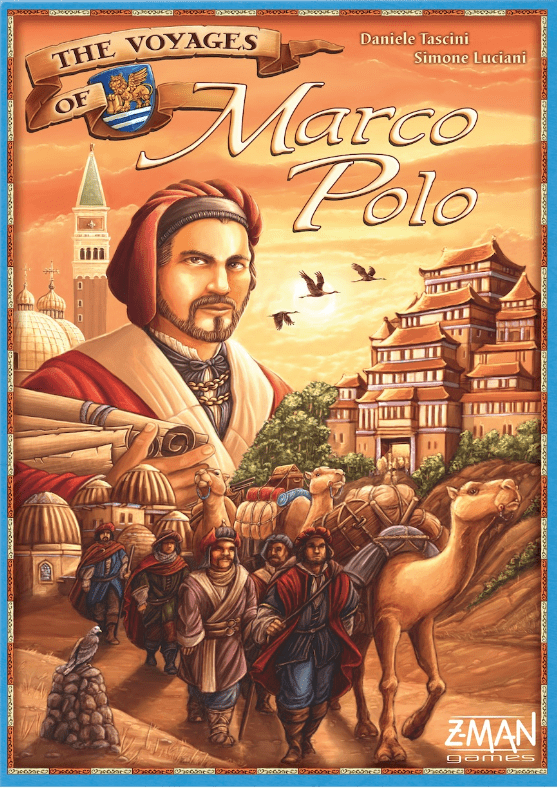
How to Play The Voyages of Marco Polo
Hans im Glück, 999 Games, Albi · Board game · 2015
2–4 · best 4
40–100 min
Weight 3.2/5
8.6
rating
Ludopedia
7.8
rating
BGG
What do you want to do now
Ask questions about the game
Ask anything about The Voyages of Marco Polo: rules, setup, components, complexity, price, or whether it fits your group.
Example questions
Continue this chat in the Assistant
Game page
Prices, ratings and our review
Rules manual
Official PDF file
Video: How to Play
Start here, then follow the written guide
Nights Around a Table - How to Play The Voyages of Marco Polo
Step by step
Objective of the Game
Welcome, intrepid traveler, to the world of *The Voyages of Marco Polo*! In this solo variant, you're not just aiming for a high score; you're going head-to-head with a cunning virtual opponent, the AI. Your goal is to outsmart and outscore this automated rival, proving your strategic prowess across the Silk Road. The AI will travel, fulfill contracts, and even score Victory Points, mimicking a human opponent's actions, but with simplified upkeep. Can you navigate the challenges and emerge as the most successful merchant?Preparation (Setup)
Getting ready for your solo journey is straightforward, with a few key differences from a regular two-player game. Here's how to set up your table:- Set up the game board as you would for a standard two-player game.
- The AI doesn't need a player board, money, resources, camels, or a character tile.
- The AI collects its 9 trading posts, 1 initial contract, and the 5 dice of its color.
- The AI receives 4 objective cards, placed face down in its play area.
- The AI takes its deck of cards:
- Separate the 24 Action cards from the 4 Travel cards.
- Randomly choose 1 of the 4 Travel cards to use in the game. The other 3 are not used.
- Place the AI's 9 trading posts on each of the Big Cities and Small Towns spaces depicted on the chosen Travel card.
- Place 2 of the AI's figures on the board: 1 on the scoring track and the other in Venice.
- Shuffle the Action cards into a face-down deck.
- The AI's player area will now consist of:
- 1 Travel card with its trading posts placed on the city/town spaces.
- 1 contract pile (initially just the AI's starting contract).
- The AI's 5 dice.
- The Action cards deck.
- 4 Objective cards.
- The AI is the 1st player in the first round.
The Game Turn
You'll play your turns as normal, but when it's the AI's turn, things are a bit different. The AI's actions are determined by a deck of cards, keeping the game flowing smoothly. The AI's turn structure is as follows:- DRAW 1 ACTION CARD: Draw the top card of the AI's Action deck.
- RESOLVE MAIN ACTION: Perform the action listed at the top of the card.
- If that action isn't possible for the AI (e.g., not enough dice, or its dice are already there and it lacks black dice), perform the action listed below it.
- If *that* action is also impossible, perform the third possible action, called "compensation."
- PERFORM ADDITIONAL ACTION: Some cards have an additional action at the bottom (e.g., "Complete 1 contract" or "Take 1 black die"). If so, perform it for the AI.
- The AI doesn't roll its dice, except for the "compensation action." The values of the dice it places are usually indifferent.
- The AI always tries to place its colored dice first. It only uses a combination of its colored dice and black dice if necessary, and only if it has collected black dice on a previous turn.
- If the AI has no dice (colored or black) on its turn, it passes, and its round is over.
- If you passed, but the AI still has dice to use, continue performing its turns as normal.
Main Actions Explained (for the AI)
Here's a breakdown of the actions the AI might take:- MARKETPLACE (Gold/Silk/Pepper/Camels): The AI places the required number of dice in that action space. The primary purpose of these actions for the AI is to block your options.
- FAVOR OF THE KHAN: The AI places 1 die on the next available space, setting its value 1 pip higher than the last placed die on the track.
- OBTAIN 2 CONTRACTS: The AI takes the highest VP contract(s) from the offer and places them at the bottom of its contract pile. Ties are broken by other rewards in this order: New contract > Black Die > other rewards.
- TRAVEL 1/2/3 SPACES: The AI travels the indicated number of spaces.
- Consult the AI's Travel card and advance its meeple on the game board following the depicted route (read left to right, top to bottom). Circles represent oasis spots.
- When the AI arrives at or passes through a Big City (brown) or a Small Town (blue), it takes the respective trading post from its Travel card and places it on the board.
- If the AI is the first to place a trading post in a Big City and collects a bonus tile, that tile is removed from the game. The AI gains the bonus if it's: "Collect 1 black die" (AI collects 1 black die), "Gain 1 contract" (AI gains 1 contract, placing it at the bottom of its pile), or "Travel 1 space" (AI travels 1 space).
- Remember: The AI doesn't have to stop when arriving at a city like a player normally would. It can place trading posts in multiple cities with a single travel action.
- If the AI places a trading post in a small town with the 3VP bonus tile, it immediately gains 3VP and 3VP at the beginning of each subsequent round.
- When the AI builds its 8th and 9th trading posts, it gains the respective 5 and 10 VPs.
- When the AI places its trading post in Beijing, it gains VPs based on whether it was the first or second to place a trading post there.
- COMPENSATION: This is the third possible action on an Action card, performed when the top two actions aren't possible.
- The AI rolls a die of its color (or a black die if it has no colored dice) and gains VPs based on the roll:
- 1 or 2: AI gains 1 VP
- 3 or 4: AI gains 2 VP
- 5 or 6: AI gains 3 VP
- Optional "Less Luck" Variant: Instead of rolling, you can award the AI a fixed number of VPs for compensation: 1 VP (easy), 2 VPs (normal), or 3 VPs (hard).
- The AI rolls a die of its color (or a black die if it has no colored dice) and gains VPs based on the roll:
Additional Actions Explained (for the AI)
Some Action cards will trigger these:- TAKE 1 BLACK DIE: The AI gains 1 black die, which can be used in future turns.
- COMPLETE 1 CONTRACT: The AI completes 1 contract. It doesn't discard goods like a normal player; it simply fulfills the contract.
- It takes the top contract from its contract pile and gains the respective rewards. The AI only collects VPs, black dice, and new contracts (which are added to the bottom of its pile).
- Each completed contract is set aside. At the end of the game, if the AI completed more contracts than you, it gains a 7 VP bonus.
End of Game and Scoring
The game concludes after a set number of rounds. Here's how to determine the winner:- At the end of round 4, just before the final round, shuffle all discarded Action cards back into the deck to form a new Action cards deck. This adds a bit of uncertainty to the final stretch!
- At the end of the game, reveal the AI's 4 objective cards. Determine which combination of 2 objective cards would give the AI the most points, and score those for the AI.
- If the AI was the last player to travel in a round, it will be the first player in the next round.
- Compare your final score to the AI's. The player with the most Victory Points wins!
Tips for Winning
Even against an automated opponent, strategy is key! Here are a couple of tips to help you on your solo journey:- Watch the AI's Travel Card Closely: The AI's travel route is predetermined by its Travel card. Pay attention to which cities it's likely to visit next and where it will place trading posts. This can help you plan your own travel to claim valuable city bonuses before the AI does, or to block its preferred routes.
- Prioritize Contract Completion (and Blocking): The AI gains a significant 7 VP bonus for completing more contracts than you. While the AI doesn't need goods to fulfill contracts, it will still try to obtain them. Focus on efficiently completing your own contracts to deny the AI this bonus, and consider taking high-VP contracts from the offer that the AI might otherwise grab.
More videos
More rules explanations from the community
In English
-
 How to play The Voyages of Marco Polo
-
 A Dicey "Walkthrough Review" of: The Voyages of Marco Polo
-
 Pit Stop: The Voyages of Marco Polo
-
 How to play The Voyages of Marco Polo
-
 Dara Teaches How To Play: The Voyages of Marco Polo
-
 How to PLay The Voyages of Marco Polo
-
 How to play The Voyages of Marco Polo board game - Full teach + Visuals - Peaky Boardgamer
-
 Play through of The Voyages of Marco Polo part 1
-
 How to Play Voyages of Marco Polo
-
 Play through of The Voyages of Marco Polo part 2
-
 The Game Explainer: The Voyages of Marco Polo
Rules manual
Official PDF file
Prefer the Official PDF?
Download the official The Voyages of Marco Polo rulebook or browse it online with our AI rules assistant.
View Rulebook PDF
Frequently Asked Questions
Quick answers about the rules
What is the objective of The Voyages of Marco Polo?
Welcome, intrepid traveler, to the world of *The Voyages of Marco Polo*! In this solo variant, you're not just aiming for a high score; you're going head-to-head with a cunning virtual opponent, the AI. Your goal is to outsmart and outscore this automated rival, proving your strategic prowess across the Silk Road. The AI will travel, fulfill contracts, and even score Victory Points, mimicking a human opponent's actions, but with simplified upkeep. Can you navigate the challenges and emerge as…
How do you set up The Voyages of Marco Polo?
Getting ready for your solo journey is straightforward, with a few key differences from a regular two-player game. Here's how to set up your table: Set up the game board as you would for a standard two-player game. The AI doesn't need a player board, money, resources, camels, or a character tile. The AI collects its 9 trading posts, 1 initial contract, and the 5 dice of its color. The AI receives 4 objective cards, placed face down in its play area. The AI takes its deck of cards: Separate the…
How does The Voyages of Marco Polo end, and how do you score?
The game concludes after a set number of rounds. Here's how to determine the winner: At the end of round 4, just before the final round, shuffle all discarded Action cards back into the deck to form a new Action cards deck. This adds a bit of uncertainty to the final stretch! At the end of the game, reveal the AI's 4 objective cards. Determine which combination of 2 objective cards would give the AI the most points, and score those for the AI. If the AI was the last player to travel in a…
What are some tips for winning The Voyages of Marco Polo?
Even against an automated opponent, strategy is key! Here are a couple of tips to help you on your solo journey: Watch the AI's Travel Card Closely: The AI's travel route is predetermined by its Travel card. Pay attention to which cities it's likely to visit next and where it will place trading posts. This can help you plan your own travel to claim valuable city bonuses before the AI does, or to block its preferred routes. Prioritize Contract Completion (and Blocking): The AI gains a…
Want to compare prices and check reviews?
Find where to buy at the lowest price, price history, and our full game review.
View The Voyages of Marco Polo
