
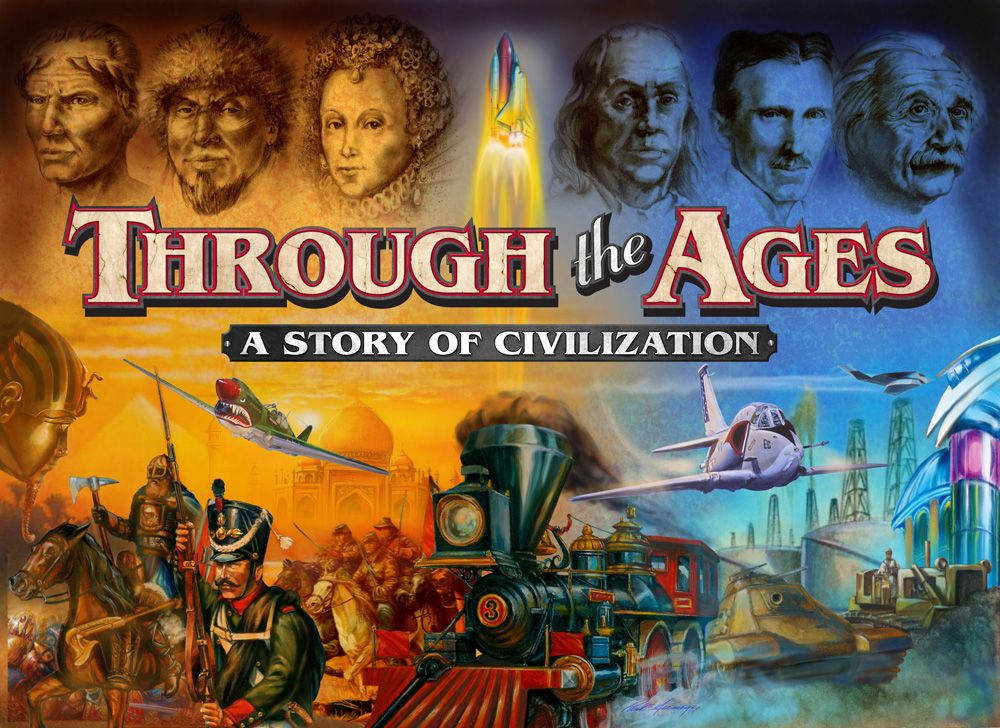
Through the Ages: A Story of Civilization — How to Play
Czech Board Games, Czech Games Edition (CGE), DiceTree Games · Board game · 2006Video: How to Play
Start here, then follow the written guide
Step by step
Game Objective: Make Your Mark on History!
In Through the Ages: A Story of Civilization, you take on the role of a visionary leader, guiding your civilization from Antiquity to Modern Times. Your main goal is to build the most impressive and lasting legacy, accumulating as many Culture Points as possible!
Imagine your civilization as a blank canvas, where every decision, every technological advance, every great leader, and every wonder built paints a unique picture in history. You can spread your influence through art, religion, great constructions, or even international treaties. The choice is yours: will your civilization be remembered for its wisdom, its military conquests, or its innovations?
The game is a race to see who leaves the biggest "impression" on the world, and in the end, the player with the most Culture Points will be the grand winner!
Setup: Building Your Empire from Scratch
Let's set up the table and prepare your civilization for greatness! For the Simple Game, which is perfect for beginners, follow these steps:
Essential Components:
- 1 Main Board
- 4 Player Boards (one for each player)
- 4 Overview Cards
- Wooden Tokens: 120 yellow (Population), 90 blue (Food/Resources), 35 white (Civil Actions), 30 red (Military Actions)
- 40 Player Cubes (10 of each color)
- 341 Cards (185 civil, 155 military, 1 starting player)
Step-by-Step Setup:
- Main Board and Cards:
- Place the Main Board in the center of the table. It has the Card Row (where you will choose your cards) and the Score Track.
- For the Simple Game, separate the Civil Cards from Eras II and III and the Military Cards from Eras I, II, and III. They will not be used.
- Take the Development of Politics card from Military Deck A and set it aside.
- Shuffle the remaining 9 Military Cards (Era A) and place them face down in the CURRENT EVENTS space on the Main Board.
- Shuffle Civil Deck A. Place 13 of these cards in the Card Row: 5 in the first section (lighter), 4 in the second, and 4 in the third. The rest of the deck goes next to the Card Row.
- If there are 2 players, separate the cards marked with or . If there are 3 players, separate the cards marked with . For 4 players, don't worry about this.
- Shuffle Civil Deck I and place it in the clear square on the Main Board.
- Choose the Starting Player and give them the Starting Player card.
- Your Player Board and Components:
- Each player chooses a color and takes their Player Board and the 10 corresponding cubes.
- Each player receives: 25 yellow tokens (population), 18 blue tokens (food/resources), 4 white tokens (civil actions), and 2 red tokens (military actions).
- Take your Overview Card.
- Organizing Your Player Board:
- Population (Yellow Tokens): Of your 25 yellow tokens, place 18 on your yellow strip (yellow bank). Of these, 6 are placed on your Starting Technologies (2 on Bronze Working, 2 on Agriculture, 1 on Philosophy, and 1 on Warriors). The remaining 7 yellow tokens go into the orange square, your Unused Workers Pool.
- Food and Resources (Blue Tokens): All 18 of your blue tokens go into the blue strip (Blue Bank) on your Player Board. In the Simple Game, ignore the divisions and numbers on the Blue Bank.
- Actions (White and Red Tokens): Place the 4 white tokens and 2 red tokens on your Despotism Government card.
- Indicators: Place one of your cubes on position 0 of the Culture, Science, and Happiness indicators on your Player Board. Place another cube on position 0 of the Culture Points and Science Points counters on the Main Board. Your Strength indicator starts at position 1 (due to the worker on Warriors).
- Starting Technologies: The 6 cards on your Player Board (Bronze Working, Agriculture, Religion, Philosophy, Warriors, and Despotism) are your Starting Technologies. They represent what your civilization already knows.
- Extra Cards and Tokens: Place all unused cards and tokens in the game box, out of reach of the players.
The Game Turn: Building Your Civilization
The game proceeds clockwise, starting with the Starting Player. Each round is divided into three main phases for each player:
Game Turn Phases:
- Add Cards to the Card Row (Starting from Round 2):
- Remove Cards: At the beginning of your turn (except in the 1st round), remove the first cards from the Card Row. For 2 players, remove the first 3. For 3 players, remove the first 2. For 4 players, remove only the first. If any position is empty, do not remove cards from other positions. Removed cards are out of the game.
- Move Cards: All remaining cards in the Card Row move to the left, filling empty spaces and making the cards cheaper.
- Add New Cards: Place one civil card from the civil deck into each empty position on the right. In the 2nd round, the Starting Player adds cards from Civil Deck A, and the other players add from Civil Deck I, marking the beginning of Era I (Medieval).
- Play Your Civil and Military Actions:
This is the main part of your turn, where you make crucial decisions for your civilization. Your Government (initially Despotism) determines how many Civil Actions (white tokens) and Military Actions (red tokens) you can perform. Under Despotism, you have 4 Civil Actions and 2 Military Actions.
You can use your actions in any order, alternating between civil and military, and you can repeat the same action multiple times, as long as you pay the cost. Used action tokens are removed from your Government card and return at the beginning of your next turn.
Potential Civil Actions:
- Take a Civil Card from the Card Row:
- The cost varies by section: 1 Civil Action for the first section, 2 for the second, 3 for the third.
- In the 1st Round: The Starting Player can only use 1 Civil Action, the second player 2, the third 3, and the fourth all 4.
- Leaders (Green Cards): You can only take one Leader per Era. You keep it to play later.
- Wonders (Purple Cards): The cost to take a Wonder increases by 1 Civil Action for each Wonder you have already built. You can only have 1 Wonder "under construction" at a time. When taking a Wonder, it is immediately placed on your board, not in your hand.
- Action Cards (Yellow Cards): Have an immediate effect when played. You cannot play an Action Card in the same round you took it.
- Technologies (Orange, Red, Blue, Brown, or Gray): You cannot take a new Technology if you already have one with the same name. They cost Science Points to play.
- Hand Limit: You cannot take a new Civil Card if you already have a number of cards equal to or greater than your total number of white tokens (civil actions).
- Increase Population: Costs 1 Civil Action and the amount of Food indicated on your yellow bank. Move a yellow token from your yellow bank to the Unused Workers Pool.
- Build a Mine or a Farm: Costs 1 Civil Action and the amount of Resources specified on the Technology card. Move a worker from the Unused Workers Pool to the Technology card.
- Build an Urban Building (Temple, Laboratory, etc.): Costs 1 Civil Action and Resources. Move a worker from the Unused Workers Pool to the Urban Technology card. You are limited to the maximum number of Urban Buildings allowed by your Government (2 for Despotism). Adjust your Culture, Science, and/or Happiness indicators.
- Destroy a Mine, Farm, or Urban Building: Costs 1 Civil Action. Move a yellow token from the technology card back to the Unused Workers Pool. Adjust your indicators, if it's an Urban Building.
- Build a Stage of a Wonder: Costs 1 Civil Action and the amount of Resources specified for the stage. Cover the stage number with a blue token from your bank. Upon completing the Wonder, return the blue tokens to the bank, place the card above your Government, and apply its effects.
- Put Your Leader into Play: Costs 1 Civil Action. Place the Leader card near your Government. If you already have a Leader, the old one is discarded. Adjust your indicators for the new Leader's bonuses.
- Play an Action Card: Costs 1 Civil Action. Follow what the card says and discard it. You cannot play an Action Card you took in the same round.
- Discover a New Technology and Put It into Play: Costs 1 Civil Action and Science Points. Move your Science Points marker back. Place the card on your Player Board. Special Technologies (blue) give immediate bonuses.
- Play a Government Card (Revolution or Peaceful Change):
- Revolution: Must be your first and only Civil Action. You spend all your Civil Actions and pay the lowest amount of Science Points specified on the card. You replace your old Government with the new one, adjust your actions, and apply the new effects.
- Peaceful Change: Costs 1 Civil Action. (The manual does not detail peaceful change further in the Simple Game, but Revolution is the most common option for beginners).
Potential Military Actions:
- Build a Military Unit: Costs 1 Military Action and the amount of Resources specified on the Military Technology card. Move a worker from the Unused Workers Pool to the Military Technology card. Adjust your Strength indicator.
- Dismantle a Military Unit: Costs 1 Military Action. Move a yellow token from the Military Technology card to the Unused Workers Pool. Adjust your Strength indicator.
- Take a Civil Card from the Card Row:
- Production and Maintenance:
At the end of your turn, your civilization automatically produces and consumes:
- Food Production: For each worker on a Farm Technology card, place 1 blue token from your blue bank on the card. The Food value per token is indicated on the card.
- Food Consumption: Your civilization consumes the amount of Food indicated in the rightmost non-empty section of your yellow bank. Move the corresponding blue tokens from your Agriculture card to your blue bank.
- Resource Production: For each worker on a Mine Technology card, place 1 blue token from your blue bank on the card. The Resource value per token is indicated on the card.
- Science and Culture Production: Advance your cubes on the Culture Points and Science Points counters on the Main Board according to the values shown on your Culture and Science indicators.
- Unused Resources and Food: Remaining blue tokens on Farm and Mine cards stay there for future rounds.
Events (Starting from Round 3):
At the beginning of the 3rd round, the Starting Player must reveal the top card from the CURRENT EVENTS section. The described Event affects all players. Era A Events are positive, such as "Each civilization produces 2 Food."
End of Game and Scoring: The Final Legacy
The game is almost over when the last Civil Card is placed in the Card Row. Players who have not yet played in the round complete their turns, and the game ends when the player to the right of the Starting Player finishes their turn.
Final Scoring:
After the last round ends, players score bonus points they may have obtained (such as bonus Culture points for their civilization's Happiness in the Simple Game). The player with the highest total number of Culture Points on the Main Board is declared the winner!
Remember: The Culture Points counter can mark a maximum of 190 points, but there is no real limit. If you exceed it, make a note and keep counting!
Tips for Winning: Be a Legendary Leader!
- Focus on Initial Production: In the second round, a classic tactic is to increase your population and build 1 Farm or Mine. This ensures a solid foundation for your economy, allowing you to produce more Food and Resources for future constructions and advancements.
More videos
More rules explanations from the community


Rules manual
Official PDF file
