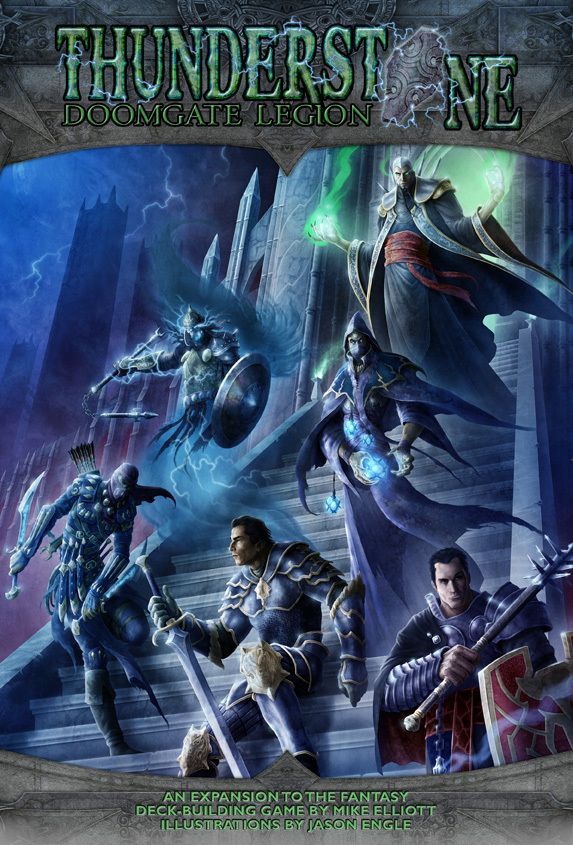
How to Play Thunderstone: Doomgate Legion
Alderac Entertainment Group, Arclight Games, Edge Entertainment · Board game · 2010What do you want to do now
Ask anything about Thunderstone: Doomgate Legion: rules, setup, components, complexity, price, or whether it fits your group.
Step by step
Object of the Game
The object of your quest in Thunderstone: Doomgate Legion is to find the ancient Thunderstone, hidden deep behind the Doomgate. To do this, you must gather mighty Heroes, powerful weapons, mystic spells, and mercenaries from Everwatch Village. Each player constructs their own deck of cards during the game, representing the members, abilities, and gear of their party. How you build your deck determines whether victory and glory will be yours!
Preparation (Setup)
Doomgate Legion is an expansion to the base Thunderstone game and can be played with or independent of it. The setup procedure follows the same steps as the base game, with a few small changes to building the Dungeon Deck.
- First Game Recommendation: If this is your first time using Doomgate Legion, it is recommended to use the specific cards listed in the manual: Unholy Guardian (Guardian Card), Abyssal • Thunderspawn, Cultists • Humanoid, Evil Druids • Humanoid (Monster Cards), Amulets (Treasure Cards), the Special Disease Deck, Drunari, Elf, Slynn, Thyrian (Hero Cards), Bodyguard, Glow Berries, Greed Blade, Divine Staff, Short Sword, Spirit Blast, Squire, Pawnbroker (Village Cards), and Dagger, Iron Rations, Militia, Torch (Basic Cards).
- Random Setup: If it's not your first game, use the Randomizer cards to determine your setup.
- Sort Randomizer Cards: Sort all Randomizer cards (from base set, Doomgate Legion, and Wrath of the Elements if owned) into Village, Monster, and Hero piles.
- Identify Dungeon Feature Randomizers: Some Randomizer cards show a large question mark and say “Dungeon Feature” at the top; these are mixed with the Monster Randomizers.
- Shuffle Randomizer Decks: Shuffle all three Randomizer decks (Village, Monster, Hero) separately. Use them to select which cards are included in the game, then return the Randomizers to the box.
- Build the Dungeon Deck:
- Turn over cards from the stack of Monster Randomizers one at a time until you turn over a total of three different Monster cards, plus any number of Dungeon Feature Randomizers.
- If you draw any Dungeon Feature Randomizers, shuffle the “Dungeon Feature” cards together. Take one card from this Dungeon Feature pile for each special Randomizer you drew. This may add extra cards like Treasures and Guardians to the dungeon.
- If the Swarm Monster Randomizer card is flipped, a separate Swarm Deck needs to be built.
- Take all the Monster, Treasure, and Trap (if using Wrath) cards that match the revealed cards. There are ten cards for each class of Monster, but only six Treasures of each type.
- If the Swarm Randomizer was flipped, add the Swarm placeholder cards to this stack. Set aside any Guardian card for now.
- Shuffle the Monster, Treasure, and Trap cards together to form the Dungeon Deck. The Dungeon will include at least 31 cards.
- Add Guardians: If any Guardian Dungeon Feature cards were turned over, add the same number of Guardians to the Dungeon. For each Guardian, count off ten cards from the deck (without revealing them). Take the Guardian card (there is only one Guardian of each type) and shuffle it together with these ten cards. Place these eleven cards at the bottom of the Dungeon Deck. Repeat if multiple Guardian cards are present.
- Add Thunderstone: Count off ten cards from the top of the deck (without revealing them) and shuffle them together with one of the Thunderstone cards. Place these eleven cards at the bottom of the previously constructed Dungeon Deck.
- Form the Dungeon Hall: Turn over the top three cards from the Dungeon Deck to form the Dungeon Hall. Leave extra space for a Rank 0 if there are any Guardians in the Dungeon Deck. If any Treasures or Traps are turned up, place them on the bottom of the Dungeon Deck and refill the hall until only monsters are visible.
- Populate the Village: Follow the steps listed in the base set rules to populate the Village.
- Starting Party Deck: Give each player the cards they need for their starting Party Deck.
- Draw Starting Hand: Each player shuffles their own deck and draws six cards to form their starting hand.
- Special Disease Deck (Optional): If all players agree, the Special Disease Deck (25 cards, 15 new) may be used in place of the normal disease deck. Certain randomizers may also require its use. Alternatively, shuffle the special disease deck and draw one card. If it's "Disease", use the normal deck; if it's a new disease, use the Special Disease Deck. If using the special disease deck, shuffle it and place it face down during setup.
Fluxo do Jogo
The game progresses through player turns. Each turn, a player chooses one of three main actions:
- Visit the Village
- Enter the Dungeon
- Rest
After performing one of these actions, the player ends their turn by discarding all cards and drawing a new hand.
Ações e Como Jogar
Visit the Village
- Reveal your hand.
- Use Village Effects: You may use any Village Effects on your revealed cards. You can use some, none, or all of the Effects on a card in any order, making sure not to use Effects from destroyed cards. Unless an Effect is mandatory (like Disease), you are not required to use all Effects. No single Effect on a card can be used more than once. Effects and gold production are cumulative.
- Produce Gold: Add the gold value of all revealed cards still in play to any gold you produced in Step 2.
- Purchase Cards: You may purchase one card from the Village (Basic, Hero, or Village cards) from the top of any stack. The Purchase Cost must be less than or equal to your total gold value. Purchased cards are always placed on your discard pile. Any unused gold is lost. If an Effect allows you to purchase more cards, the total Purchase Cost must be less than or equal to your gold. Note: Actions must be taken in order, so a card may be discarded or destroyed before producing gold. For instance, if the Pawnbroker destroys a card with a gold value, you do not gain the gold value of the destroyed card.
- Level Up Heroes: Level up any or all of the Hero cards in your hand, using Experience Points you have collected.
- End Turn: Discard all cards (whether used or not) face up on your discard pile, and draw six new cards to form a new hand.
Enter the Dungeon
- Reveal your hand.
- Use Dungeon Effects and Equip Weapons: You may use some, none, or all of the Dungeon Effects from your cards. Unless the card has a mandatory Effect (like Disease), you are not required to use all Spells or Effects. You may equip one Weapon to each Hero, if the Strength requirements are met.
- Declare Attack: Declare which Monster and rank you are attacking.
- Resolve the Battle:
- Calculate Attack Value: Calculate your total Attack Value, including all Light Penalties.
- Resolve Battle Effects: Resolve Battle Effects (adjust Attack Value as necessary).
- Undefeated Monster: Place an undefeated Monster on the bottom of the Dungeon Deck.
- Defeated Monster/Disease: Place defeated Monster and Disease cards on your discard pile.
- Receive Spoils: Receive Spoils (if any).
- Shift and Refill: Shift Monster cards to fill empty ranks, and refill the Dungeon Hall.
- Resolve Trap Effects: Resolve Trap Effects (if any).
- Resolve Breach Effects: Resolve Breach Effects (if any).
- End Turn: Discard all cards (whether used or not) face up on your discard pile, and draw six new cards to form a new hand.
Rest
- Destroy a Card: You may destroy one card from your hand.
- End Turn: Discard all cards face up on your discard pile, and draw six new cards to form a new hand.
Special Card Types and Rules
- Treasure Cards: These are added to the Dungeon Deck like Monster cards. When a Treasure appears in the Dungeon Hall, the active player takes it and places it in front of them (not in their discard pile). During any later turn, the player may destroy this card to activate its special effect. The Dungeon Hall is then refilled until only Monsters (and/or Thunderstones) remain.
- Guardian Cards: These are powerful Monsters shuffled into the Dungeon Deck. When a Guardian card is turned over, it is added to the Dungeon Hall and behaves like a regular Monster.
- Breach Effect: If a Guardian reaches Rank 1 of the Dungeon Hall, it emerges to attack the Village. Move the Guardian away from the Dungeon Hall, creating a new “Rank 0” space. The Dungeon Hall is then refilled.
- Rank 0: Only a Guardian can enter Rank 0. If the Guardian is defeated, the Rank 0 space ceases to exist. Any player can attack a Guardian in Rank 0 with no Light Penalty.
- Continuous Breach Effect: A Guardian in Rank 0 has a continuous Effect that persists as long as it remains there, affecting all players. Each player must resolve this special Breach Effect during their turn.
- Thunderstone Restriction: No player can claim the Thunderstone as long as a Guardian remains in Rank 0.
- Immunity: Guardians are immune to any Effect or action that would cause them to leave the Dungeon Hall (including Rank 0) or change their position within it, until they are defeated in combat. They will not retreat to the bottom of the Dungeon Deck if attacked and not defeated.
- Multiple Guardians: If one Guardian is already in Rank 0 and another enters Rank 1, both Guardians share the Rank. There is no limit to the number of Guardians that can occupy Rank 0. However, a player choosing to Enter the Dungeon still selects only one Monster to attack, regardless of how many are in the Rank.
- The Swarm: A special breed of Monster card that grows stronger.
- Placeholder Cards: Swarm placeholder cards have “0” for all game stats and no card text. They are shuffled into the Dungeon Deck like normal Monster cards.
- Swarm Deck: The other Swarm cards create a separate Swarm Deck, arranged face up in order of Health (4 on top, 13 on bottom), not shuffled. Place it next to the Dungeon Hall.
- Replacement: Whenever a Swarm placeholder card appears in the Dungeon Hall, it is immediately replaced with the top card from the Swarm Deck. The placeholder card is destroyed and removed from the game.
- Victory Points: Swarm cards are not worth Victory Points during the game. At the end of the game, the Victory Point value of each Swarm card in your Party Deck is equal to the total number of Swarm cards in your deck (maximum value = 5 VP each). Any card effect that targets a Monster’s printed Victory Points (e.g., “less than 4 VP”) does not affect the Swarm.
- Thunderstone Cards: Doomgate Legion introduces the Stone of Avarice, which is worth 1 VP at the end of the game and has a Gold value of 2 (only usable in the Village and only if playing Campaign Variants from Wrath of the Elements). You can use any Thunderstone from any expansion, decide which to use before play, alternate, or shuffle them together.
- Disease Deck: If using the special disease deck, shuffle it and place it face down. When a game effect forces you to take a disease card, draw the top card and put it in your discard pile face up.
- Dungeon Effect: If a disease card shows up in your hand on a turn you Enter the Dungeon, you must reveal it and play its special effects.
- Village Effect: If a Disease card shows a Village effect, it must be revealed and its special effects taken when you Visit the Village.
- Destroying Disease Cards: If a player uses an effect (like resting or a cleric ability) to destroy a disease card, the card goes to the bottom of the disease deck face down.
- Running Out of Disease Cards: If the disease deck runs out of cards, any player who would normally take a disease card does not have to. If cards are returned to the deck later, players will once again draw disease cards.
- Multiple Disease Cards: If multiple disease cards are given out at once, start to the left of the active player and go clockwise.
- Traits: Constant powers that benefit the Monster.
- Cannot be Attacked if [Something] is Activated/Equipped: You cannot declare an attack on this Monster if you use any prohibited benefit of the [Something] (e.g., Attack, Magic Attack, Light, Dungeon Effects). You can forgo the benefits to attack.
- Half-Magic Attack: Reduce your Magic Attack Bonus by half (rounded down) after calculation.
- Half-Attack Without [Something] Present: Your total Attack Value is reduced by half (rounded down) if you don't have the required [Something].
- Heroes with Strength less than X Cannot Attack: Heroes with Strength less than X do not contribute Attack, Magic Attack, or other benefits (like Light) to the battle. They can still be targets of Battle Effects.
- Immune to Edged Weapons: Any Attack or Magic Attack bonus from Edged Weapons is reduced to zero. Other Effects (like Light) are not affected.
- Immune to Spells: Attack or
Rules manual
Official PDF file
Frequently Asked Questions
Quick answers about the rules