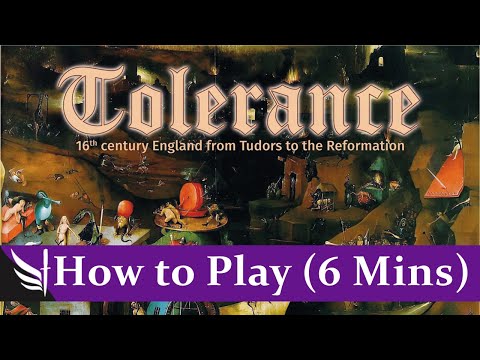
Tolerance
Dragon Dawn Productions · Board game · 2023
3–5 · best 5
60–90 min
Weight 3.0/5
Buy · from US$ 16.89
6.9
rating
Ludopedia
6.0
rating
BGG
Our Verdict
RECOMMENDED
Love cards, politics, and deduction? Tolerance blends intrigue and strategy in a medieval setting that keeps you on edge.
Highlights
- Tricks that shift the game
- Secret objectives
- Strong historical theme
Keep in mind
- Unpredictable dynamics
- Can be slow for beginners
Rules manual not indexed yet
Upload the PDF rulebook to ask questions about this game with AI.
About the game
What you do in a play session
Picture 16th‑century England, where Catholics and Protestants clash over ideas and influence. In *Tolerance*, you’re not just a soldier—you’re a minister with a secret, personal goal. The game runs over three rounds, each representing a different monarch’s reign—Mary I, Elizabeth I, and James I—bringing cards that depict events, people, and tactics. You play cards in tricks; the trick winner gets to execute the actions of all cards played, whether they help or hurt you. This creates tension: you might inadvertently aid a rival. The goal is to rack up points at the end of each round, but the trick lies in timing your plays to maximize power without giving too much away. The game lasts about 45‑60 minutes, so you can play multiple times in one night. If you enjoy card games with asymmetric information, deduction, and a well‑built historical theme, *Tolerance* will make you feel like a diplomat surviving in a maze of intrigue and faith battles.
The game is well balanced, but the trick‑taking dynamic can be a bit unpredictable, and the need to deduce each player’s goal can slow the pace for newcomers. Still, the medieval political setting combined with solid card mechanics makes this a fun, educational experience, ideal for history buffs who love strategic debate.
In short, *Tolerance* blends political intrigue, deduction, and trick‑taking in a rich historical setting. If you like games that challenge perception and strategy, you’ll have a blast with this title.
The game is well balanced, but the trick‑taking dynamic can be a bit unpredictable, and the need to deduce each player’s goal can slow the pace for newcomers. Still, the medieval political setting combined with solid card mechanics makes this a fun, educational experience, ideal for history buffs who love strategic debate.
In short, *Tolerance* blends political intrigue, deduction, and trick‑taking in a rich historical setting. If you like games that challenge perception and strategy, you’ll have a blast with this title.
Gallery
Box and component photos
Tap any photo to open fullscreen. Photos submitted by the community or publisher.
Rules videos
Learn by watching before you open the box



Best player count
BGG community vote
3
OK
4
OK
5
BEST
Soundtrack
Ambience suggested by Melodice
Loading playlist...
Where to Buy
Prices monitored daily
Finding best prices...
Prices unavailable at this time.
Price history — last 6 months (lowest new offer)
As an Amazon Associate I earn from qualifying purchases. Prices and availability subject to change.
Alert enabled!
Join the BoardGamesBot deals group
Get the best board game deals every day — without message spam.
Join the WhatsApp groupGame details
Mechanics, categories, families and credits
Mechanics
Categories
Families
Publisher
Dragon Dawn Productions
Designer
Ren Multamäki, Tony Cotterill
Artist
Lars Munck
Community
Data from BoardGameGeek
219owners
52wishlist
3want to play
Frequently Asked Questions
Quick answers before you buy
How long does a game of Tolerance last?
A typical session runs between 45 and 60 minutes, depending on player experience.
How many players is it designed for?
It supports 3 to 5 players, and more players increase the deduction dynamic.
What’s the game’s complexity?
Medium to high: it involves trick‑taking, deduction, and asymmetric information, so it’s best for those with some card‑game experience.
What are the main components?
The core components are a themed card deck, score markers, secret objective tokens, and a rulebook.
Is there a digital version?
Yes, there’s a Tabletopia implementation for online play.
What’s the game’s theme?
It’s set in 16th‑century England, focusing on Catholic and Protestant conflicts.
Is it beginner‑friendly?
It can be a bit challenging for those new to trick‑taking or deduction, but the learning curve is reasonable with practice.
Other Games You'll Like
Based on mechanics and theme