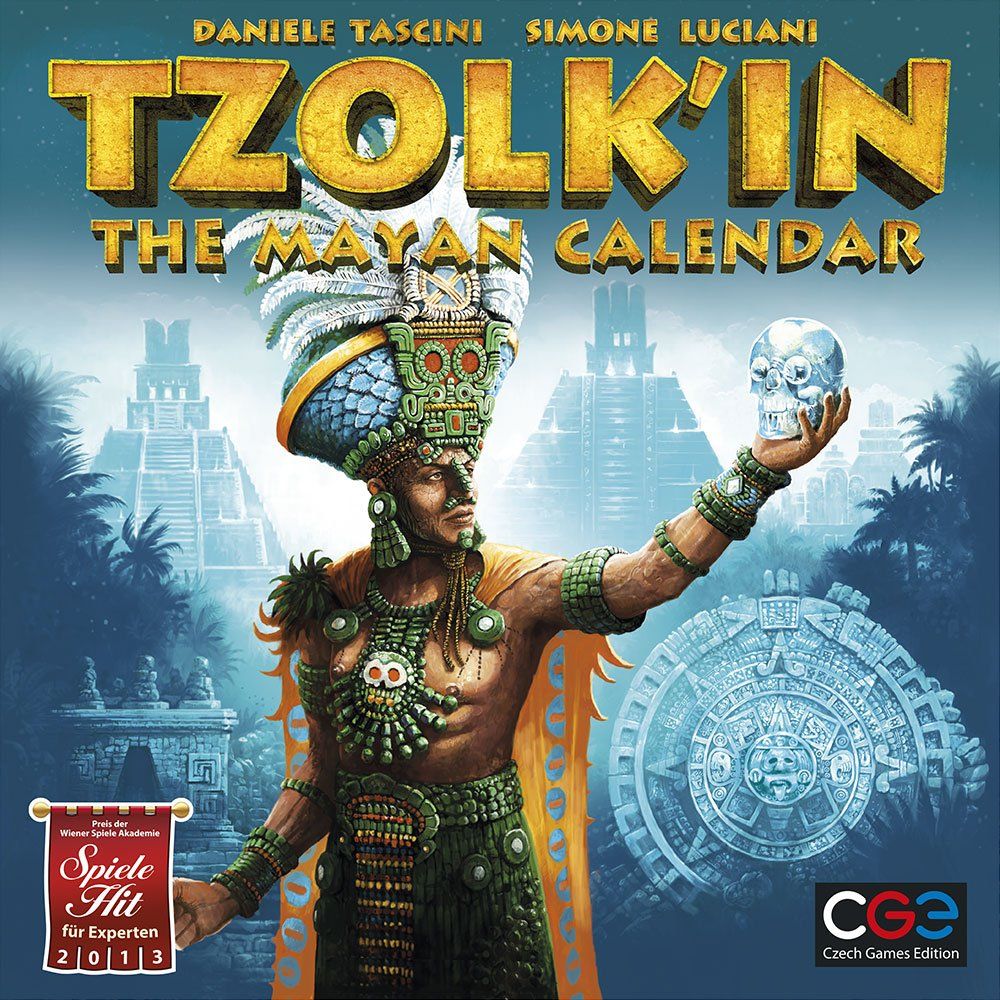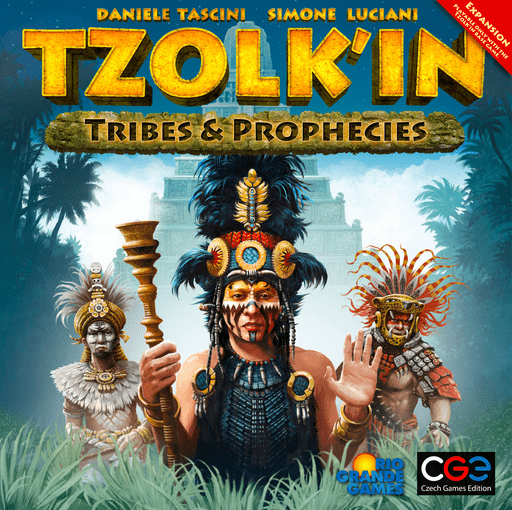
How to Play Tzolk'in: The Mayan Calendar – Tribes & Prophecies
Czech Games Edition (CGE), Cranio Creations, GaGa Games · Board game · 2013What do you want to do now
Ask anything about Tzolk'in: The Mayan Calendar – Tribes & Prophecies: rules, setup, components, complexity, price, or whether it fits your group.
Video: How to Play
Start here, then follow the written guide
Step by step
Objective of the Game
This expansion enhances the basic game of Tzolk'in: The Mayan Calendar by introducing unique special abilities for players, challenging prophecies, new buildings, and the option to play with a fifth player. Players are trying to lead their group of people with a unique gift, overcome calamities, and strategically construct buildings to earn the most victory points. The game's core objective remains to accumulate the most victory points by the end of the game.
Preparation (Setup)
Extra Resource Blocks
- Add the 30+ Resource Blocks (wood, stone, and gold) to your basic set. Resources should be unlimited.
Tribes
- After setting up the game (including revealing buildings and monuments and placing dummy workers, if any), mix up the Tribe Tiles and deal 2 to each player at random.
- Starting Wealth Tiles should also be dealt at this time.
- While choosing Starting Wealth Tiles, each player also chooses 1 Tribe Tile to keep and returns the other one.
Prophecies
- While setting up the game (along with revealing buildings and monuments and before players choose Starting Wealth Tiles), mix up the Prophecy Tiles and draw 3 at random.
- Place them in a random order on the Prophecy Board.
New Buildings
- Add the 8 New Buildings (four for each age) to the building deck.
Fifth Player
- Add the wooden components for a fifth player.
- Use the new two-sided player board for a fifth player.
- Use the 7 New Harvest Tiles (4 Corn Harvest Tiles and 3 Wood Harvest Tiles) to set up a fifth field for each of the Palenque harvesting actions (2, 3, 4, and 5).
Quick Actions
- Place the Quick Action Board on the main board so that it covers up the Starting Player Space.
- Divide the Quick Action Tiles according to their backs and mix up each group separately, face down.
- Set the Age 2 Quick Action Tiles aside.
- Take all Age 1 Quick Action Tiles and place them face up on the Tzolk'in gear (in a random order) so that each tile corresponds to 2 days in Age 1. They will span the upper half of the gear, from the starting turquoise tooth to the opposite turquoise tooth.
- The Quick Action Tile corresponding to the starting tooth is the first available quick action. Put it on the Quick Action Board.
Quick Actions for Fewer Players
- To use quick actions in a game with fewer than five players, add dummy workers:
- In a two-player game, use 18 dummy workers and place the first 2 on Quick Action Spaces.
- In a three-player game, use 12 dummy workers and place the first 1 on a Quick Action Space.
- In a four-player game, use 6 dummy workers and place the first 1 on a Quick Action Space.
- Use the Starting Wealth Tiles to place the dummy workers as explained in the original game rules, using marker disks in non-player colors.
- If you don't have enough leftover Starting Wealth Tiles, place as many as you can, then use discarded tiles to place the remaining dummy workers after players have chosen their Starting Wealth Tiles.
- A dummy worker on a Quick Action Space will block that space for the entire game.
Fluxo do Jogo
Consulte o manual para detalhes sobre esta seção.
Ações e Como Jogar
Tribe Special Abilities
Each player's chosen Tribe Tile grants a unique special ability that can be used during the game, altering specific rules or providing advantages. These abilities are described on the tile, with detailed descriptions in the Appendix of the rulebook.
- AH CHUY KAK: The 2 (or more) workers must be placed on gears. The Starting Player Space and the Quick Action Spaces are not on gears and do not count. When you pick up the 1 worker, you have the same choices as you would on a pick up turn: use the corresponding action, use a lower-numbered action by paying corn, or do nothing.
- AHAU CHAMAHEZ: This can be used cumulatively with the level-1 theology technology to place a crystal skull 2 spaces ahead in Chichen Itza (for 1 corn). You can use this ability even if the action ahead is "perform any action". For example, on Tikal 5, you can pay 1 corn to use action space 6, which lets you choose any Tikal action for no additional cost.
- AHMAKIQ: This ability breaks the rule that requires you to either place or pick up workers every turn.
- BACAB: Your ability to begin each turn with at least 2 corn is not begging. It does not make you move down 1 step in a temple. Begging so that you can start with 4 corn is begging and does cause you to move down 1 step in a temple.
- BALAM: You gain 1 corn total, not 1 corn for each step back. You may use the 1 corn you gained to pay costs associated with the action. You can even use this ability on a "perform any one action on this gear" space. For example, on Yaxchilan 6 or 7, you can perform a lower-numbered action and gain 1 corn instead of performing the lower-numbered action for free.
- CIT-BOLON-TUM: For example, to place 1 worker on action space 5, you pay 3 corn. To place 2 workers on two action spaces with a cost of 5, you could pay 3 for the first and 5+1 for the second or 5 for the first and 3+1 for the second – either way, it is 9 corn. When your worker is pushed onto this extra action space (8 on most gears, 11 on Chichen Itza) it is not yet pushed off the gears. For example, if you have a worker on Palenque 6, a player may use the time-speeding privilege and move your worker up to Palenque 8. If your worker is on Palenque 8, the next turn of the gears will push your worker off.
- HURACAN: You can also pay to use lower-numbered action spaces on either gear. For example, on Palenque 4, you can pay 1 corn to perform action 3 on Yaxchilan or Palenque.
- ITZAMNÀ: It costs you 1 block to go from first to second level and 2 blocks to go from second to third. When you advance above third level in any technology you can take the level-4 bonus of any one of the four technologies. So if you were at level 3 in agriculture, you could pay 1 block to get a crystal skull, even if you had advanced 0 levels in theology.
- IXTAB: Take your starting wealth bonuses first, then move down 1 step in one temple.
- VACUB-CAQUIX: You choose 1 space on 1 gear to treat as "occupied" and all pieces you place on that gear this turn may skip over that space.
- XAMAN EK: You can use this ability any time during your turn. So you can use it before you pay costs associated with actions or before you pay for putting workers on the gears. You cannot use this ability when you feed workers at the end of a Food Day because that happens after your turn (and after everyone else's).
- YALUK: The cost is always 1 extra corn. If you are under the effect of the Hunger prophecy, your workers require 4 corn instead of 3. See the Farms section for details on how these effects interact with farms.
- YUMKAAX: To calculate costs for placing multiple workers, you use the table on your Tribe Tile instead the table on your player board. The costs of the action spaces on the game board remain the same.
Prophecies
Each prophecy lasts for one quarter of the game, making one aspect of play more difficult. The effect of the first prophecy begins the day after the first Food Day and lasts until the end of the second Food Day. The second prophecy takes effect on the next day and lasts until the end of the third Food Day. The third prophecy then takes effect and lasts until the end of the game. No prophecy will be in effect for the first quarter of the game.
Calamities
The upper half of the Prophecy Tile depicts a calamity. This calamity makes some aspect of the game more difficult while the prophecy is in effect. It lasts until the END of a Food Day and applies even when collecting rewards on that Food Day. If a calamity requires you to pay for a reward or benefit, you may choose not to pay and not receive that specific reward/benefit, while still receiving others.
- WRATHFUL GODS: Whenever you go up one step in any temple, you must pay 1 corn.
- ANGRY GOD: Whenever you go up one step in the indicated temple, you must pay 1 resource block.
- FOREST FIRES: Whenever you harvest wood from Palenque, you get 1 less block than normal.
- DROUGHT: Whenever you harvest corn from Palenque, you get 1 less corn than normal. (This does not apply to Palenque action 1, fishing.)
- GOLD SHORTAGE: Whenever you receive a block of gold, you must pay 1 corn. (If you gain corn and gold at the same time, you may use the corn to pay for the gold.)
- DESECRATION: Whenever you receive a crystal skull, you must pay for it by moving down one step in the temple of your choice.
- TEACHER SHORTAGE: Whenever you advance one level in a technology (even from level 3) you must pay 1 extra resource.
- FORGOTTEN LORE: You cannot use the level 2 effect of any technology. (But you must still advance to level 2 before you can advance to level 3.)
- CROWDED CITIES: Whenever you construct a building (but not a monument) you must pay 1 extra resource block (of any type). If you construct a building using corn, you must pay 2 extra corn (instead of 1 extra block).
- HUNGER: On this quarter's Food Day, each worker requires 1 extra corn. So you must feed each worker 3 corn instead of 2.
- HIGH FLOODWATERS: Whenever you place a worker on Chichen Itza, you must pay 2 corn.
New Building Effects
- Renovation: All four of the Age 1 buildings in this expansion can be renovated. This effect can be used on a monument or building that you construct later in the game. Renovation allows you to tear down the older building and use the resources to build the newer one. Discard the building with the renovation icon. This counts as paying for each resource block that the two cards have in common. You only have to pay for the blocks that were not required by the older building. (Any blocks required by the older building and not the newer building are lost; you don't get "change.") If you construct a building using Uxmal action 4, you must first compute the discount before converting the price to corn. You may not renovate more than one building to construct a single building or monument. If a building is discarded for renovation, it is no longer counted among your buildings and you may no longer get any benefits or rewards from it.
- Food Day Reward (Corn): From now on, at the end of each Food Day (after everyone's turn, but before you feed your workers) you receive the indicated corn reward. Any corn you receive can be used to feed your workers.
- Food Day Reward (Wood/Skull): From now on, at the end of each Food Day (after everyone's turn, but before you feed your workers) you receive either 1 block of wood or 1 crystal skull. The reward is wood on the first two Food Days and crystal skulls on the last two Food Days.
- Crystal Skull Placement Reward: When you construct this building, you immediately place a crystal skull on it (the one indicated in its cost). When you place the skull here, you gain the indicated reward. If you have the level-2 theology technology, you may use it at this time. A skull placed here counts as a skull placed in Chichen Itza. You have to have the crystal skull to be able to construct this building. To construct it using Uxmal action 4, you pay 2 corn and 1 skull. The third level of architecture applies only to resources not crystal skulls.
- Technology Level Reduction/Advance: Choose one technology in which your marker is at least at first level. Reduce your level in that technology by 1 and advance 1 level in each of the other three without paying any resources. (If you advance in a technology that is already at level 3, you gain the usual bonus.)
- Construct a Monument: You may construct a monument (as though you were performing the monument option of Tikal action 4).
Quick Actions
A quick action is a special action available for only a short time. The available quick action changes frequently. A player choosing the quick action gets to perform the action on the same turn.
Choosing the Quick Action
On a turn in which you place workers, one of your options is to place one of your workers on a Quick Action Space. Each Quick Action Space has a cost of 1. You may not place workers on more than one Quick Action Space per turn (but you are allowed to place one worker on a Quick Action Space and another on the Starting Player Space). If all Quick Action Spaces are occupied, then you cannot choose the quick action this turn.
Performing the Quick Action
The available quick action is the one depicted on the tile currently sitting on the Quick Action Board. As soon as you are done placing workers, you must perform the quick action. (If you also placed a worker on the Starting Player Space, you may take the accumulated corn before performing the quick action.) You do not wait for a pick up turn to get this worker back; the worker on a Quick Action Space returns to you automatically at the end of the round. You are not allowed to place a worker on a Quick Action Space if the quick action is one you cannot perform. Once you have chosen the quick action, you must perform the action at the end of your turn. None of your technologies applies to a quick action, but quick actions can be affected by other things, such as prophecies and special abilities of tribes.
Types of Quick Actions
- Gain 3 corn.
- Gain 1 wood and 1 corn.
- Gain 1 stone.
- Gain 1 gold.
- Advance 1 level in the technology of your choice, paying the usual cost.
- Exchange corn and resources as many times as you want (as you would at Uxmal action 2).
- Pay 1 corn and construct one building.
Changing the Quick Action
When the arrow points to a tooth corresponding to a new Quick Action Tile, remove the old Quick Action Tile from the Quick Action Board and replace it with the new one. The available quick action will change every other round (or sooner, if someone uses the time-speeding privilege).
Age 2 Quick Actions
You reveal the Age 2 quick actions on the first Food Day after feeding workers. By this time, 4 or 5 Age 1 quick actions have been removed from the Tzolk'in gear. Place the Age 2 Quick Action Tiles randomly on the Tzolk'in gear as you did with the Age 1 tiles, except that this time you will place only 6, starting on the tooth after the turquoise tooth. The last quick action will become available 2 days before the final round, which means (unless days are skipped) that it will be available for 3 rounds.
Farms
In this expansion, the Hunger prophecy and the Yaluk tribe can require more than 2 corn on Food Days. The symbol meaning "one of your workers requires 2 less corn" is now precise. No worker can benefit from more than one of these effects. The symbol meaning "all your workers require 1 less corn
More videos
More rules explanations from the community
Rules manual
Official PDF file
Frequently Asked Questions
Quick answers about the rules
What is the objective of Tzolk'in: The Mayan Calendar – Tribes & Prophecies?
How do you set up Tzolk'in: The Mayan Calendar – Tribes & Prophecies?
How do you play Tzolk'in: The Mayan Calendar – Tribes & Prophecies?
Expansion for
Published additional content