How to Play Village
eggertspiele, 999 Games, Albi · Board game · 2011
2–4 · best 4
60–90 min
Weight 3.1/5
8.4
rating
Ludopedia
7.5
rating
BGG
What do you want to do now
Ask questions about the game
Ask anything about Village: rules, setup, components, complexity, price, or whether it fits your group.
Example questions
Continue this chat in the Assistant
Game page
Prices, ratings and our review
Rules manual
Official PDF file
Video: How to Play
Start here, then follow the written guide
10 Rules You Might Have Missed : Village
Step by step
Objective of the Game
Welcome to the village, where life is tough but full of opportunities! In Village, you're not just playing a game; you're guiding the destiny of an entire family through generations. Your main goal is to make your family famous by having its members immortalized in the **village chronicle**. But remember, time stops for no one, and your family members will eventually pass away. The player who best manages their family's time, careers, and legacy, accumulating the most **prestige points**, will win the game!Setup
Let's get this village ready for some family drama and strategic decisions!- Place the **game board** in the middle of the table. This is your bustling village, complete with areas like the **grain harvest**, **family**, **crafts**, **market**, **travel**, **council chamber**, **church**, **well**, **village chronicle**, and **anonymous graves**.
- Each player chooses a color and takes their matching **farmyard**. Place it in front of you. Your farmyard is where your family members reside and where you'll track your family's **life time**.
- Take the 11 **family members** and 8 **markers** of your chosen color. Place your 4 family members with a "1" on your farmyard – these are your first generation! Set the remaining family members aside in a general supply for future generations.
- Place one of your **markers** on the cloud on the right side of the bridge on your farmyard. Place another marker on the book (space "0" of the **prestige track**) in the upper left corner of the game board.
- Each player receives 1 **coin**, placed next to their farmyard. The rest of the coins go into a general supply.
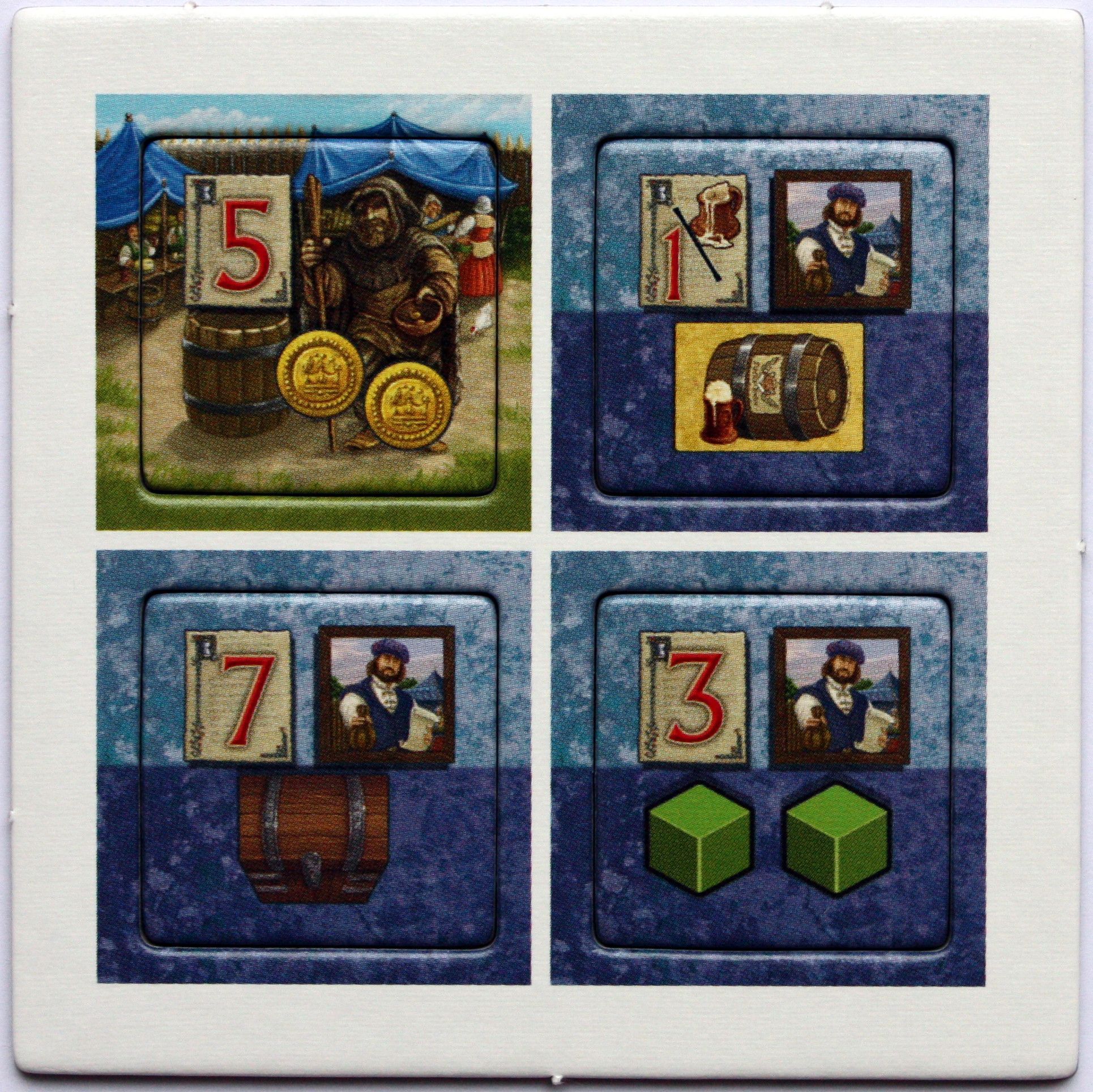
- Shuffle the **customer tiles** face down and place them next to the **market**. Then, depending on the number of players, reveal a certain number of tiles face up and add them to the market:
- **4-player-game**: Place a tile on each of the 10 spaces.
- **3-player-game**: The space labeled "4" remains empty.
- **2-player-game**: The spaces labeled "3" and "4" remain empty.
- If playing with fewer than 4 players, use **family members** of an unclaimed color to block spaces in the **chronicle** and **anonymous graves**:
- **3-player-game**: Place an unused family member on each space and grave labeled "4".
- **2-player-game**: Place an unused family member on each space and grave labeled "3" or "4".
- Place the **next starting player marker** on its designated space in the **council chamber**.
- Place the **goods tiles** (horses, oxen, wagons, plows, and scrolls) next to the game board as a general supply.
- Place the **bags of grain**, **influence cubes**, and **plague cubes** next to the game board as general supplies. Keep the **green bag** nearby.
- Put the 4 **black monks** into the **black bag** and place it below the **church**.
- Take the **setup card** that matches your player count and place it nearby. Also, place the "**mass**" overview card near the game board.
- The oldest player becomes the **starting player** and receives the **starting player marker**.
The Turn of Play
Alright, let's get down to business! Village is played over several rounds, with players taking turns performing actions.Beginning a Round
Each round kicks off with a crucial step: **seeding the action spaces**.- Consult the **setup card** to see how many **influence cubes** of each color (brown, pink, orange, green) you need to take from the supply and add to the **green bag**.
- Don't forget to add all available **plague cubes** to the green bag as well!
- Mix the cubes thoroughly.
- Then, distribute a specific number of randomly drawn cubes onto each **action space** on the game board, as indicated on the setup card.
Taking Your Turn
On your turn, you *must* take one **cube** (either an **influence cube** or a **plague cube**) from an **action space** of your choice.- If you take an **influence cube**, place it on your farmyard. You can store any number of influence cubes here.
- If you take a **plague cube**, immediately return it to the supply and lose 2 **time**. This means you move your **life time track marker** 2 spaces forward clockwise.
The "Currency" Time
Time is a precious resource in Village!- Whenever you perform an action that costs **time** (indicated by hourglass symbols), move your **life time track marker** forward (clockwise) the appropriate number of spaces.
- You also lose 2 time when you take a **plague cube**.
- As soon as your marker passes the bridge on your farmyard, one of your oldest **family members** passes away. (More on this later!)
The Actions
Here's a rundown of the actions you can take in the village:Grain Harvest
If you have one or more **family members** on your farmyard, you can perform a harvest action.- Immediately take 2 **bags of grain** from the supply and place them on your farmyard.
- If you own a **horse** and a **plow**, take 3 bags of grain instead.
- If you own an **ox** and a **plow**, take 4 bags of grain instead.
- Your goods are not used up during the harvest.
- *Note*: Your farmyard can only hold a maximum of 5 bags of grain!
Family
This action represents a new family member being born or an existing one returning home.- Take one **family member** of your color from the general supply and add it to your farmyard. You *must* always take the family member with the lowest available number from the supply (e.g., a "2" before a "3").
- *Alternatively*: You may use this action to return one of your employed family members (not yet deceased) from the game board to your farmyard.
Crafts
This action allows you to produce one **good** in one of the 5 craft buildings (Wainwright, Stables, Office, Smithy, Mill). There are two ways to produce a good:- Acquire good by losing time:
- Place a **family member** from your farmyard onto the desired craft building. This costs you time (shown on the building's roof).
- Then, immediately produce the corresponding good by paying additional time (shown by the production arrow).
- Your family member remains on that building, allowing you to produce that good again in the future by only paying the production time.
- *Exception*: You cannot place family members on the Mill.
- Acquire goods by paying with influence cubes (or bags of grain):
- Regardless of whether you have a family member on a craft building, you can purchase the good by returning the specified amount of **influence cubes** (or **bags of grain** for the Stables) to the supply.
Market
This action triggers a **market day** in which all players can participate. This action *must* be carried out.- If you triggered the action, you are the first player to serve an available **customer**. Available customers are those directly in front of the stalls on blue-bordered spaces.
- To serve a customer, return the required **goods** and/or **bags of grain** to the supply, take the **customer tile**, and place it face down next to your farmyard. These tiles are worth **prestige points** at the end of the game.
- Then, in clockwise order, other players may serve remaining customers. However, they must also pay 1 **green influence cube** and 1 **time** in addition to the required goods/grain. (Only your first sale is free.)
- Players who cannot or do not want to sell anything must pass and cannot re-enter the current market day.
- The market day continues until all customers have been served or all players have passed.
- After the market day, customers in the waiting line move up, and new customers are drawn from the pile to fill empty spaces.
Council Chamber
This action allows you to exert influence in the **council chamber**. You can use it in three ways:- Place a family member: Take a **family member** from your farmyard and place him on the 1st stage of the council chamber. This costs 1 **time** and 2 **green influence cubes** OR 1 time and 1 **scroll**. You may then perform the privilege action of this stage.
- Move a family member forward: Move one of your **family members** already in the council chamber one stage forward. This costs either 1 **scroll** OR 2 **green influence cubes**, plus 2 or 3 **time** depending on the stage. You may perform the privilege action shown below either the current or a previous stage.
- Perform a privilege action for free: If you already have at least one **family member** in the council chamber, you may perform a privilege action without moving a family member. Perform the privilege action shown below either its current or a previous stage for free.
- 1st stage: Take the **next starting player marker**. If already taken, you get nothing.
- 2nd stage: Take 2 **influence cubes** of your choice from the supply.
- 3rd stage: Take 1 **goods tile** of your choice from the supply.
- 4th stage: Pay exactly 1 **coin** to the supply for 3 **prestige points** on the prestige track.
Travel
This action allows you to send a **family member** out into the world.- If you don't have any family members on the travel map, take one from your farmyard and place him on one of the two neighboring cities reachable from the village. You must pay the cost of the trip (2 **time**, 1 **wagon**, and either 2 **brown** or 2 **pink influence cubes**). Place one of your **markers** on the city and receive its reward (3 **prestige points**).
- If you already have a family member on the travel map, you can either send another family member from your farmyard to a neighboring city OR move an existing family member to an adjacent city. Pay the cost, place a marker (if it's a new city for you), and receive the city's reward (2 influence cubes, 1 coin, or 3 prestige points).
- *Note*: You can only place a marker and receive a city's reward once per city.
Church
You may add one **family member** from your farmyard to the **black bag**.- This costs either 1 **brown influence cube** (returned to the supply) OR 3 **time**.
- Family members in the black bag may be drawn and placed onto the church during a **mass**.
Well (Substitute Action)
Instead of taking a cube from an action space, you may return 3 same-colored **influence cubes** (not plague cubes) to the supply. For this, you may carry out *any one* of the listed actions.- This action is only possible as long as there is at least one cube left on any action space.
- This is the only way to perform an action when there is no cube left on its corresponding action space.
A Family Member Passes Away
When your **life time track marker** passes the bridge, one of your oldest **family members** passes away.- You finish your current action first, then decide which of your oldest family members dies.
- It's always the family member with the lowest number that has to die. If you have several with the lowest number, you choose one.
- A dying family member must be visible (on the game board or your farmyard).
- For a dying family member, there are two possibilities:
- Free space in the village chronicle: If there's an open space in the **village chronicle** for their profession (Council chamber, Crafts, Travel, Church, Farmyard), they are immortalized there. These count for **prestige points** at the end of the game.
- No proper grave: If there's no suitable space in the village chronicle, the family member is placed on one of the **anonymous graves** next to the church. They rest in peace but are not worth prestige points.
End of a Round and Mass
When the last cube is taken from the board, the current round is finished, and a **mass** is said. A mass consists of 3 phases:- Draw 4 pieces from the black bag:
- Shuffle the **family members** and **black monks** in the black bag.
- Beginning with the **starting player**, each player may pay 1 **coin** per family member to pick their own family members from the bag.
- Once 4 family members have been bought, no more can be drawn. If fewer than 4 were bought, draw randomly to reach 4 pieces.
- Place any drawn family members on the large rightmost glass window of the **church**. Return all black monks to the bag.
- Move family members up in the church hierarchy:
- Beginning with the **starting player**, each player may move one or more of their family members up in the church hierarchy (leftward on the windows).
- To move a family member to the next window, you must return **bags of grain** to the supply as shown between the windows.
- Award 2 prestige points for the church majority:
- The player with the most family members in the **church** immediately gains 2 **prestige points**.
- In case of a tie, the player whose family member is furthest to the left wins. If still tied, all tied players gain 2 prestige points.
End of Game and Scoring
The game is a race against time and other families!Ending the Game
The game ends immediately when a **family member** is placed onto either:- The last empty space in the **village chronicle**.
- The last empty **anonymous grave** next to the church.
Final Scoring
Move your **prestige track marker** forward for each point gained.- Travel: Count the number of cities your family visited (number of your markers) and gain points:
- 1 city = 1 point
- 2 cities = 3 points
- 3 cities = 6 points
- 4 cities = 10 points
- 5 cities = 14 points
- 6 cities = 18 points
- Council Chamber: Each family member in the council chamber is worth points based on their stage:
- 4th stage = 6 points
- 3rd stage = 4 points
- 2nd stage = 2 points
- 1st stage = 0 points
- Church: Each family member in the church is worth points based on their window position:
- Rightmost window = 2 points
- Second window = 3 points
- Third window = 4 points
- Leftmost window = 6 points
- Family members still in the black bag are worth 0 points.
- Village Chronicle: Gain prestige points based on how many of your family members are immortalized:
- 1 or 2 family members = 0 points
- 3 family members = 4 points
- 4 family members = 7 points
- 5 or more family members = 12 points
- Customer Tiles: Reveal your concealed **customer tiles** and receive the prestige points printed on them.
- Coins: Each unspent **
More videos
More rules explanations from the community
In English
-
 The Dragon Table Episode 1: How to Play "Village"
-
 Nights Around a Table - How to Play Village
-
 Village - How to Play
-
 Village Quick Overview
-
 Village Gamesplained - Part 1
-
 Hans Solo: Village
-
 Village - In Focus
-
 The Unboxings of a 4-year-old: #5 Village
-
 Village: Inn & Port - Playthrough With Friends!
-
 Village ... Setup and Rules by the Crabby Dice
-
 Village ◊ Solo variant runthrough【ツ】The Mountain Gamer
Rules manual
Official PDF file
Prefer the Official PDF?
Download the official Village rulebook or browse it online with our AI rules assistant.
View Rulebook PDF
Frequently Asked Questions
Quick answers about the rules
What is the objective of Village?
Welcome to the village, where life is tough but full of opportunities! In Village, you're not just playing a game; you're guiding the destiny of an entire family through generations. Your main goal is to make your family famous by having its members immortalized in the **village chronicle**. But remember, time stops for no one, and your family members will eventually pass away. The player who best manages their family's time, careers, and legacy, accumulating the most **prestige points**, will…
How do you set up Village?
Let's get this village ready for some family drama and strategic decisions! Place the **game board** in the middle of the table. This is your bustling village, complete with areas like the **grain harvest**, **family**, **crafts**, **market**, **travel**, **council chamber**, **church**, **well**, **village chronicle**, and **anonymous graves**. Each player chooses a color and takes their matching **farmyard**. Place it in front of you. Your farmyard is where your family members reside and…
How do you play Village?
Alright, let's get down to business! Village is played over several rounds, with players taking turns performing actions. Beginning a Round Each round kicks off with a crucial step: **seeding the action spaces**. Consult the **setup card** to see how many **influence cubes** of each color (brown, pink, orange, green) you need to take from the supply and add to the **green bag**. Don't forget to add all available **plague cubes** to the green bag as well! Mix the cubes thoroughly. Then…
How does Village end, and how do you score?
The game is a race against time and other families! Ending the Game The game ends immediately when a **family member** is placed onto either: The last empty space in the **village chronicle**. The last empty **anonymous grave** next to the church. The player who triggered the end of the game does not get another turn. All other players may perform one last action in clockwise order. If the final cube is taken from the board during these last actions, the action spaces are *not* reseeded…
Want to compare prices and check reviews?
Find where to buy at the lowest price, price history, and our full game review.
View Village
Expansions
Published additional content



Other Games You'll Like
Based on mechanics and theme