
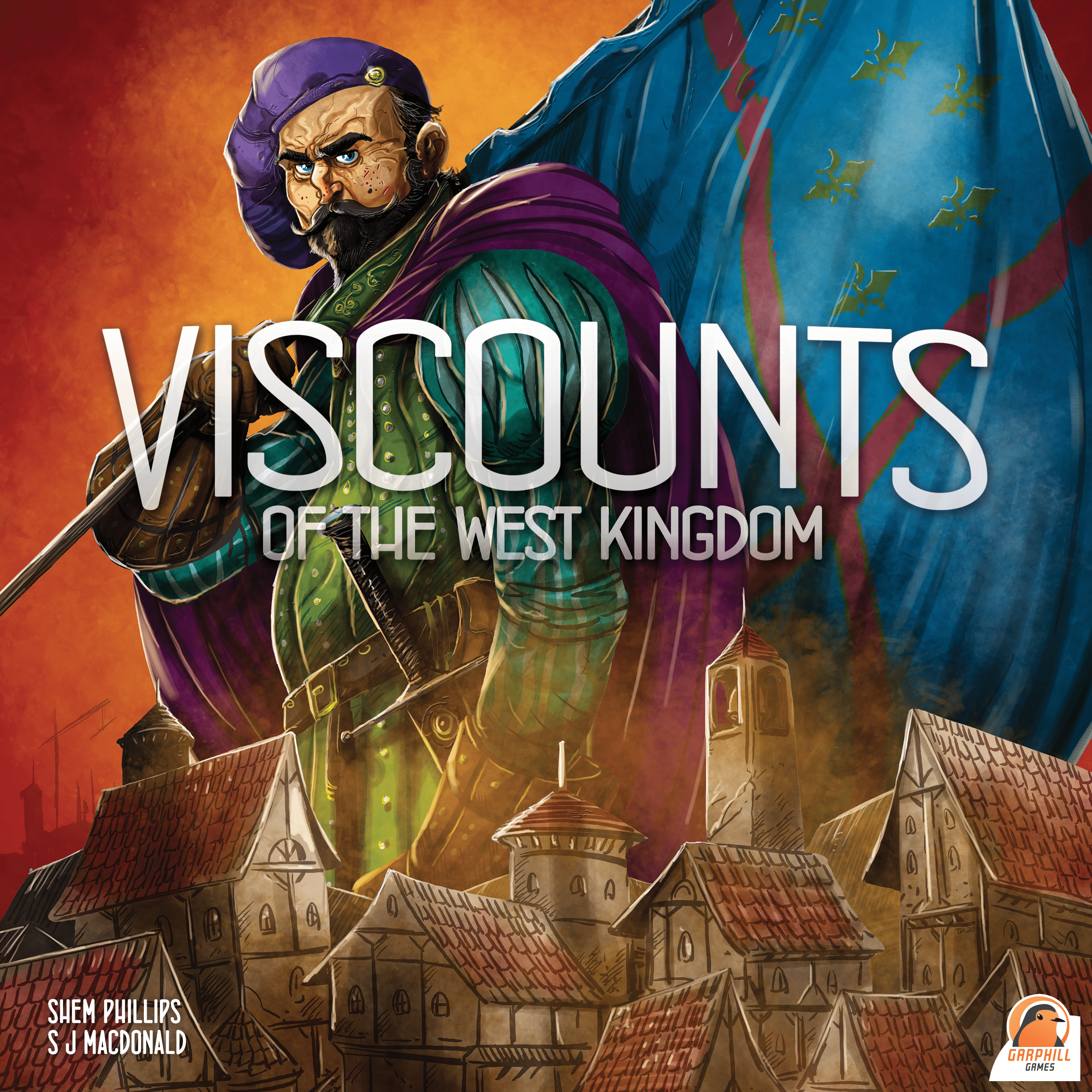
Viscounts of the West Kingdom
Garphill Games, Banana Games, CMON Global Limited · Board game · 2020Aim of the Game
Welcome, Viscounts! In the captivating world of Viscounts of the West Kingdom, the King's power is waning, and it's up to you to secure your place in a shifting political landscape. Your ultimate goal is to become the player with the most Victory Points (VP) by the game's end. How do you achieve this? By building grand structures, transcribing ancient manuscripts, working diligently in the castle, and acquiring deeds to new lands. You'll start with a humble group of townsfolk, but wisely recruiting new talents will be key to advancing your ambitions. Each turn, you'll journey across the kingdom, striving to increase your influence among its various factions. The game concludes when the kingdom reaches either poverty or prosperity – or perhaps even both!
Preparation (Setup)
Let's get your kingdom ready! Here's a step-by-step guide to setting up Viscounts of the West Kingdom:
- Main Board Assembly: Take the 5 Main Board Segments and flip them to the side corresponding to your player count (check the numbers on the inside edge). Mix them up and arrange them in a random order to form a circle. Don't worry about the red numbers for now.
- Castle Placement: Place the Castle in the center of the Main Board. It should click into place, locking all the segments together. The orientation of the Castle should be random.
- Townsfolk Cards: Shuffle all the Neutral Townsfolk Cards (black titles) and divide them into 5 roughly equal piles. Place one pile faceup onto each of the indicated spaces on the Main Board.
- Manuscript Piles: Find the 5 grey-backed Manuscripts and place them facedown in 5 separate piles. Then, shuffle all the black-backed Manuscripts and place 6 facedown on top of each grey-backed pile, creating 7 Manuscripts per pile. Place one of these piles faceup onto each of the indicated spaces on the Main Board. The grey-backed Manuscripts should now be visible on top.
- Main Supply: Create a central supply near the Main Board with all the Silver, Ink Wells, Gold, Stone, and Multiplier Cards. Also, keep the 4 Cleric Bonus Cards and the Castle Leader Card nearby. Remember, Debts, Deeds, Ink Wells, Stone, Gold, and Silver are considered unlimited, so use Multiplier Cards if you run out of physical components.
- Player Components: Each player receives 1 Player Board (faceup to the side shown in the manual) and the following components in their chosen color:
- 1 Corruption Marker
- 20 Workers
- 1 Viscount
- 3 Trading Posts
- 3 Guildhalls
- 3 Workshops
- 8 Starting Townsfolk Cards
- 1 Virtue Marker
- Start Player: Randomly determine the Start Player and give them the Start Player Marker. They'll keep it for the entire game.
- Player & Hero Card Setup: Shuffle the Player Cards and lay out a number of cards equal to the number of players plus one. Then, shuffle the Hero Townsfolk Cards and place one below each Player Card, forming pairs.
- Player Selection & Initial Placement (Reverse Turn Order): Starting with the player to the right of the Start Player and moving counter-clockwise, each player selects one pair of cards and performs these actions:
- Place their Viscount on the matching numbered space of the Main Board (based on the number at the top of their chosen Player Card).
- Gain all resources, Silver, Debts, and Deeds listed on their Player Card.
- Take any additional steps indicated at the bottom of their Player Card (like flipping Deeds or gaining Virtue).
- Flip over their Player Card and place it alongside the top-left of their Player Board as a reference.
- Shuffle their chosen Hero Townsfolk Card with their 8 Starting Townsfolk Cards and any other Neutral Townsfolk Cards gained during Setup to form a facedown Draw Pile to the left of their Player Board. Finally, draw a starting hand of 3 cards from the top of their Draw Piles.
- Poverty & Prosperity Cards: Place a number of Debt Cards (unpaid-side faceup) on top of the Poverty Card, based on your player count (refer to the Poverty Card for this). Place the remaining Debt Cards below the Poverty Card. Similarly, place a number of Deed Cards (acquired-side faceup) on top of the Prosperity Card, based on your player count. Place the remaining Deed Cards below the Prosperity Card.
The Turn of Play
Viscounts of the West Kingdom is played over an undetermined series of rounds. Each round consists of every player taking one turn, starting with the player holding the Start Player Marker and proceeding clockwise. Your turn is divided into six distinct phases, laid out from left to right on your Player Board. The main goal is to move your Viscount clockwise around the Main Board, take a primary action, and potentially recruit new townsfolk.
Phase 1: Card Management
This phase is all about managing the shifting line of Townsfolk Cards on your Player Board. These cards provide you with crucial Icons for your primary actions and determine your movement for the turn. Cards can have immediate, ongoing, or drop-off effects.
- Shift Cards: Move all Townsfolk Cards currently on your Player Board one space to the right. If a card drops off the right side, place it faceup into your discard pile. If this card has a drop-off effect, resolve it now.
- Play New Card: Place one Townsfolk Card from your hand into the leftmost space of your Player Board. If this was a Criminal, you immediately gain 1 Corruption for each Criminal icon on your Player Board. If the card has an immediate effect, resolve it now.
Important Note: You must always have at least 3 cards. If you start your turn with only 3 cards, the rightmost card drops off, then gets "shuffled" to form a new Draw Pile before being placed into the left space. If you have no cards in hand, you must blindly play the top card from your Draw Pile.
Phase 2: Movement
Time to move your Viscount! You'll move your Viscount clockwise around the Main Board a number of spaces equal to the Silver value in the top-left of the Townsfolk Card you just played. You can never move fewer spaces, but you can pay 1 Silver per additional space to move further.
- If your Viscount lands on the same space as an opposing Viscount, that player may immediately rearrange the Townsfolk Cards on their own Player Board.
- You must follow the arrows leaving your current space and can never move backward.
Phase 3: Primary Action
Now for the core of your turn! You'll choose and take just one of the four possible primary actions. To fund your chosen action, you'll use a combination of Icons on your Player Boards (excluding discard piles), spend resources, or use Icons from a dismissed Townsfolk.
The 4 primary actions are:
- Trade
- Construct a Building
- Place Workers
- Transcribe a Manuscript
As part of your primary action, you may dismiss the face-up Townsfolk Card adjacent to your Viscount to gain more Icons. This is only possible if the Townsfolk Card has Icons matching your chosen primary action (remember, Criminal Icons are wilds!). The cost to dismiss is the Silver value on the card. You can only dismiss one Townsfolk Card per turn. When dismissing, pay the Silver, remove the card from the game, temporarily gain all Icons printed on its left side for your primary action, and resolve any immediate effects on its top-right. Abilities at the bottom of dismissed cards have no effect.
Trade
This action can only be taken on the outside path of the Main Board. To fund it, count Merchant Icons and Criminal Icons on your Player Board, spend Silver (1 per extra Merchant Icon), or dismiss the adjacent Townsfolk Card. What you gain depends on your Viscount's location. Each space on the outside path has an exchange you can use as many times as you can afford:
- Gain 1 Silver per Merchant Icon.
- Gain 1 Ink Well, 1 Gold, or 1 Stone per 2 Merchant Icons.
- Destroy 1 Townsfolk Card per 3 Merchant Icons. Destroying cards refines your deck. You gain Silver equal to the destroyed card's value. You can destroy from your hand or blindly from your Draw Pile.
- Flip 1 Debt or 1 Deed per 4 Merchant Icons. You can mix and match when flipping multiple cards.
Construct a Building
This action also takes place on the outside path. Fund it by counting Builder Icons and Criminal Icons, spending Stone (1 per extra Builder Icon), or dismissing the adjacent Townsfolk Card.
- There must be an available (empty) Building Spot at your Viscount's location. The River divides Building Spots; only those on the left are accessible from the left space, and vice-versa.
- Choose one of the 9 available Buildings on your Player Board. Costs are shown along the top of your Player Board. If you've built all your Buildings, you can't take this action.
- Workshops require 3 Builder Icons, Trading Posts require 5, and Guildhalls require 7.
- You'll score VPs for constructed Buildings as indicated on your Player Board (e.g., 4, 9, or 15 VP for 1, 2, or 3 Trading Posts).
- After funding and choosing, place the Building onto the chosen Building Spot. Immediately gain the effect shown on that spot. If your Building links to a previously constructed Building, both players on either end of that link gain the printed effect. If you have Buildings on both ends, you only gain the effect once.
- Once placed, each Building reveals an ongoing ability for the rest of the game.
Place Workers
This action is exclusive to the inside path of the Main Board. Fund it by counting Noble Icons and Criminal Icons, spending Gold (1 per extra Noble Icon), or dismissing the adjacent Townsfolk Card.
- You can use 1, 3, 5, or 8 Noble Icons to place 1, 2, 3, or 4 Workers, respectively. A reminder is on your Player Board.
- Workers are always placed into the first tier of the Castle, adjacent to your Viscount. You must have at least 1 Worker in your supply to take this action.
- After placing Workers, check if you now have 3 or more of your own Workers in that first-tier section. If so:
- Move 1 Worker clockwise and 1 Worker counter-clockwise to adjacent sections.
- Move 1 Worker inwards from the first tier to the second tier.
- Immediately resolve the effect printed on the second tier where you moved your Worker.
- Continue checking for 3 or more Workers in other first-tier sections (due to movement) and resolve them similarly.
- Then, check the second tier. If 3 or more of your Workers are in a section, move 1 Worker inwards to the third tier, immediately gaining 1 resource (as printed on the Castle). Second-tier Workers do not move clockwise or counter-clockwise.
- Finally, check if any first or second-tier sections have more than 3 Workers (any color). If so, bump off Workers until only 3 remain. You decide which Workers are bumped. Bumped Workers return to their owner's supply, and that player gains 2 Silver (from first tier) or 1 Virtue and 1 resource of their choice (from second tier). Workers can never be bumped from the third tier.
- The first player to move a Worker into the third tier gains the Castle Leader Card, worth 5 VP at game's end and an increased hand limit of 1. If another player ever has more Workers in the third tier, they take the card.
Transcribe a Manuscript
This action is also done on the inside path. Fund it by counting Cleric Icons and Criminal Icons, spending Ink Wells (1 per extra Cleric Icon), or dismissing the adjacent Townsfolk Card.
- You need a certain number of Cleric Icons, as shown on the Manuscript adjacent to your Viscount.
- Once funded, add the Manuscript alongside your Player Board and resolve any immediate effects. You can only transcribe 1 Manuscript per turn.
- The first player to transcribe 3 Manuscripts of the same ribbon color immediately collects the corresponding Cleric Bonus Card (worth 3 VP at game's end).
- You score VPs printed on certain Manuscripts, plus VPs for sets of different-colored ribbons (e.g., 9 VP for a set of 3 different ribbons).
- If a pile of Manuscripts runs out, do not refill it. Pre-printed Manuscripts on the Main Board cannot be collected but can be transcribed for their immediate effects.
Phase 4: Recruit
After your primary action, you may hire the faceup Townsfolk Card adjacent to your Viscount on the Main Board. The cost is the Silver value on the card. You can only hire 1 Townsfolk Card during this phase. Pay the Silver, place the card into your discard pile, and immediately resolve its top-right effects. If a pile of Townsfolk Cards runs out, do not refill it. Pre-printed cards cannot be hired but can be used for their immediate effects when dismissing.
Phase 5: Resolve Collision
If, and only if, your Virtue and Corruption Markers are on the same space of your Player Board at this point, you must resolve the collision effects in this order:
- All players who have constructed their second Workshop and have no Criminals on their Player Boards gain 1 Virtue.
- All Townsfolk Cards on Player Boards with effects during collisions are resolved.
- You gain the items printed directly above where your Virtue and Corruption Markers sit.
- All opposing players gain the items printed directly below where your Markers sit, if applicable.
Once all effects are resolved, reset your Corruption and Virtue Markers to the far ends of your Player Board.
Phase 6: Draw Cards
Draw cards from your Draw Pile until you reach your hand limit (which starts at 3 but can increase). If your Draw Pile is empty, shuffle your discards to form a new Draw Pile. At this point, if you have 1 or more Criminal Icons on your Player Board, you gain 1 Corruption. If you have no Criminal Icons, you gain 1 Virtue. (Note: A collision from this shuffle won't be resolved until Phase 5 of your *next* turn.)
Once you've refilled your hand, the next player in clockwise order begins their turn.
End of Game and Scoring
The game ends once either the Poverty Card or Prosperity Card is revealed. The current round finishes, and then one final round takes place so all players have had an equal number of turns. The player to the right of the Start Player will always take the last turn.
It's possible for both Poverty and Prosperity Cards to be revealed, creating a "Divided Kingdom" where both are active during final scoring.
Once the game has ended, tally up your score from these areas:
- Constructed Buildings: VPs as printed across the tops of your Player Boards.
- Workers in the Castle: VPs for each Worker, equal to the tier they are on in the Castle.
- Transcribed Manuscripts: VPs for sets of different ribbon colors and from specific Manuscripts.
- Castle Leader Card and Cleric Bonus Cards: VPs as printed on each card.
- Unpaid Debts: -2 VP each.
- Acquired Deeds: 1 VP each.
- Approved Deeds: 3 VP each.
- Poverty Card (if revealed): The players with the most, second-most, and third-most flipped Deeds gain 12, 8, and 4 VP respectively. You must have at least 1 flipped Deed to qualify. Ties split VPs as equally as possible. (In games with less than 3 players, the 8 VP reward is ignored.)
In English
-
 Game in a Nutshell - Viscounts of the West Kingdom (how to play)
-
 Viscounts of the West Kingdom - Tutorial Playthrough - JonGetsGames
-
 Viscounts of the West Kingdom Board Game - How to Play. A Kickstarter preview by Stella & Tarrant
-
 How to Play Viscounts of the West Kingdom (Rules School) with the Game Boy Geek
-
 Peaky Boardgamer Episode #61 - Viscounts of the West Kingdom - Full rules explanation (English)
-
 One Minute Overview of Viscounts of the West Kingdom
-
 Everything Organized in the Collectors Box!
-
 How to Play Viscounts of the West Kingdom
-
 Viscounts of the West Kingdom: Complete 2-Player Playthru and Tutorial
-
 Viscounts of the West Kingdom - A Quick Tutorial
-
 A - Z of Board Games - V - Viscounts of the West Kingdom - Ludus Vulpes
-
 Hoe speel je... Burggraven van het Westelijk Koninkrijk

