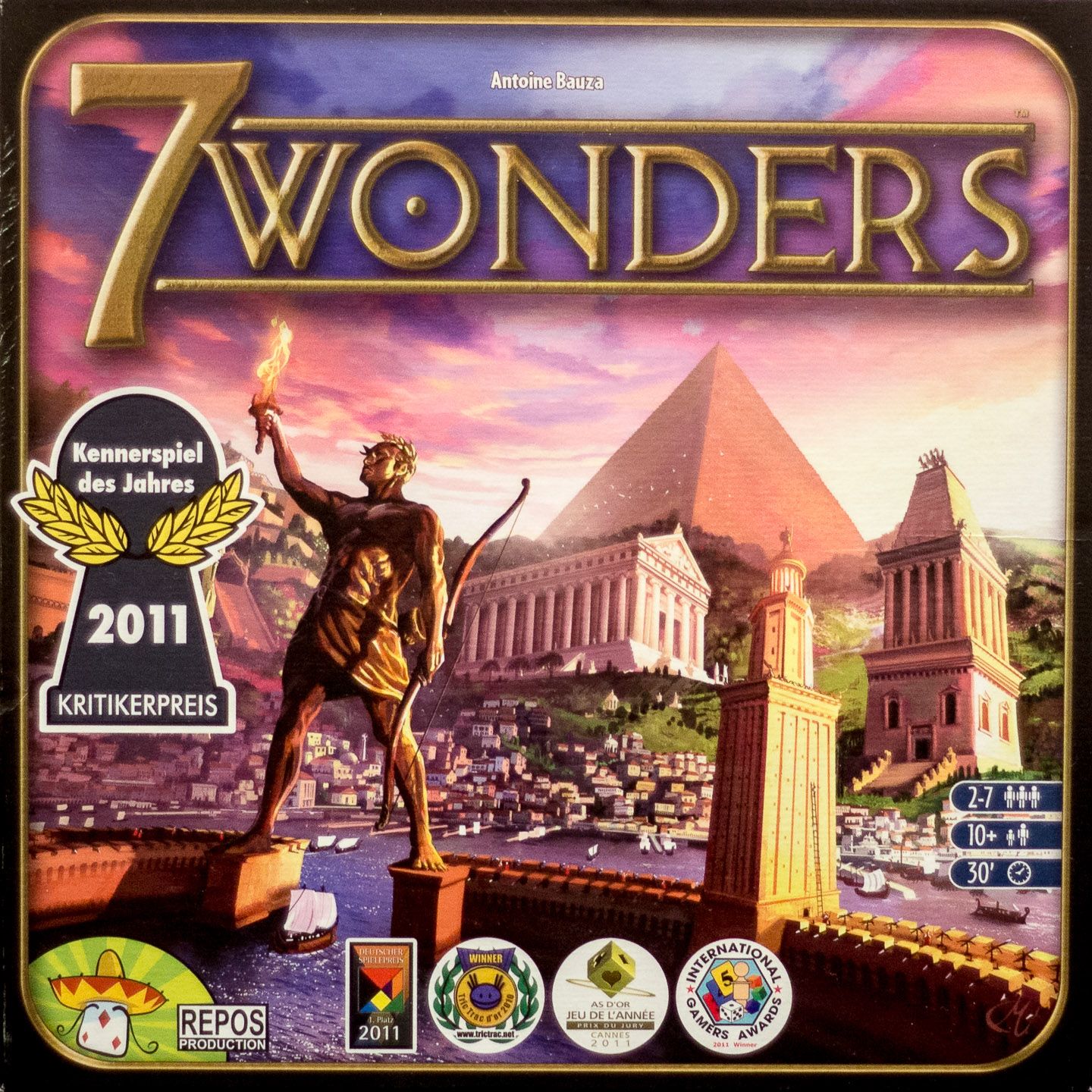
How to Play 7 Wonders: Leaders
Repos Production, Asterion Press, Galápagos Jogos · Board game · 2011What do you want to do now
Ask anything about 7 Wonders: Leaders: rules, setup, components, complexity, price, or whether it fits your group.
Video: How to Play
Start here, then follow the written guide
Step by step
Game Objective
The 7 Wonders: Leaders expansion allows players to place Leaders in command of their civilizations. These Leaders, represented by 36 cards, will influence the growth of each player's city in unique ways. The game objective and victory conditions remain the same as the 7 Wonders base game: the player with the highest total of Victory Points at the end of the game is declared the winner.
Setup
- Add the new Rome and its Colosseum Wonder Board to the game. This board can only be used with the Leaders expansion.
- The 36 Leader cards (white cards with a different back) are separated from the Age cards.
- The 4 new Guild cards (purple cards) are added to the base game's Guilds. Some of them can only be used with the Leaders expansion and are identified by a symbol in the bottom center of the card.
- The 17 6-value Coins should be added to the base game's Coins.
- The Courtesan token is used in conjunction with the Courtesans' Guild.
- The score pad is included to tally the Victory Points awarded by some of the Leaders.
- The blank Leader card (Semiramis) allows for creating a custom personality.
- The purple cards from Age III are added to those from the base game. The rules for the Age III deck remain unchanged (the number of Guilds remains the same).
- Each player starts with 6 Coins (instead of the 3 from the base game).
Game Flow
The game begins with a Leadership Phase. Additionally, at the start of each Age, a new phase occurs: the Recruitment Phase.
Leadership Phase
Each player receives a hand of 4 random Leader cards (which must be kept secret). Undistributed Leaders return to the game box.
- Choose 1 of the 4 cards and place it face down in front of you. Then, the 3 remaining cards are passed to the player on the right.
- The remaining cards are then passed to the player on the right.
- The remaining card is passed to the player on the right.
- Each player holds the received card and adds it to the other 3 they had previously chosen.
At the end of this phase, each player has created a hand of 4 Leaders. It is now possible to start Age I.
Age Summary
Each Age now begins with a Recruitment Phase. The summary of an Age is:
- Recruitment Phase
- Play the Age (normally, following the rules of 7 Wonders)
- Conflict Resolution
Recruitment Phase
In this phase, each player plays one of their Leader cards. These cards are secretly chosen by the players and revealed simultaneously. Leader cards can be played in 3 ways:
- Recruit the Leader
- Build a stage of a Wonder
- Discard the card to receive 3 Coins
Special case: in the Recruitment Phase of Age III, each player has 2 Leader cards. The first is played following one of the 3 ways described previously (a, b, or c), and the second returns to the box without being revealed.
"Advanced" Variant for 2 Players
The 2-player game follows the same adjustments made to the rules of the normal 7 Wonders game. The Recruitment Phase follows the normal rules, only the Leadership Phase is slightly modified:
- Each player receives 4 face-down Leader cards. No Leader is distributed to the Free City.
- The Free City starts with 3 Coins.
- Players choose the first of their 4 cards and pass the other 3 to their opponent.
- They choose a second card from the 3, and exchange the "remaining" ones between them, and so on. At the end of this phase, each player has created a hand of 4 Leaders.
The game is played according to the 2-player variant described in the base game, following the Recruitment Phases described in this rulebook.
Actions and How to Play
During the Recruitment Phase, players can perform one of three actions with a Leader card:
a. Recruit the Leader
The player pays the Coin cost (the Coins return to the bank) and places the Leader card face up, next to their Wonder board.
b. Build a stage of a Wonder
To build a stage of a Wonder, the player uses the chosen Leader card as a construction marker (card face down). To do so, the cost indicated on the Wonder board must be paid, not the cost of the Leader card. This action will rarely be possible in the first Recruitment Phase, as cities will hardly have the necessary resources to build the first stage of their Wonder.
c. Discard the card to receive 3 Coins
The player can choose to discard the card to receive 3 Coins from the bank and add them to their city's treasury. Leader cards discarded in this way return to the box (without being revealed).
The remaining Leader cards in each player's hand will be used later in the game. They are placed face down, under the recruited Leader (if any).
Description of Leaders (Examples)
- Bilkis: Upon entering play, allows the player to buy, once per turn, any resource by paying 1 Coin to the bank.
- Midas: At the end of the game, is worth 1 Victory Point (VP) for every 3 Coins in the player's treasury (totaling 2 VP for every 3 Coins).
- Maecenas: As soon as he enters play, the player who controls him can recruit all their next Leaders for free (in the Recruitment Phase).
- Ramses: As soon as he enters play, the player can build all their Guilds for free (without having to pay their resource cost).
- Alexander: At the end of the game, adds 1 Victory Point (VP) for each Victory token (the value of the Victory tokens therefore changes from 1, 3, and 5 VP to 2, 4, and 6 VP).
- Aristotle: At the end of the game, adds 3 Victory Points (VP) for each set of different scientific symbols (the bonus changes from 7 VP to 10 VP per set).
- Amitis: At the end of the game, is worth 2 Victory Points (VP) for each stage of the Wonder built by the player.
- Plato: At the end of the game, is worth 7 Victory Points (VP) for each set of 7 cards of the same Age (one of each color: brown, gray, blue, yellow, green, red, purple) in the player's city.
- Justinian: At the end of the game, is worth 3 Victory Points (VP) for each set of 3 cards of the same Age (red, blue, and green) in the player's city.
- Hannibal and Caesar: As soon as they enter play, they grant the number of shields printed on their respective cards.
- Vitruvius: As soon as he enters play, grants 2 Coins whenever the player builds a structure for free, through chaining. Has no effect on constructions made before he entered play.
- Nero: After entering play, grants 2 Coins for each Victory token received by the player. Has no effect on Victory tokens acquired before he entered play.
- Tomyris: As soon as she enters play, Defeat tokens received by the player during Conflict resolution are given to the victorious city. Has no effect if the city itself is victorious in Conflicts or on Conflicts prior to her entering play.
- Xenophon: Grants 2 Coins for each commercial structure (yellow card) the player builds after he enters play. Has no effect on commercial structures built before he entered play.
- Solomon: As soon as he enters play, the player can choose an Age card from the discard pile and put it into play for free.
- Hatshepsut: As soon as she enters play, each purchase of one or more resources from a neighbor grants 1 Coin from the bank (limited to 1 Coin per turn per neighboring city, after payment of the purchase).
- Croesus: When he enters play, immediately grants 6 Coins from the bank.
- Pericles, Praxiteles, Hiram: At the end of the game, are worth 2 Victory Points (VP) for each card of the corresponding color present in the player's city.
- Euclid, Ptolemy, Pythagoras: Grant the scientific symbols printed on their respective cards, added to those of scientific structures (green cards).
- Hypatia, Varro, Nebuchadnezzar, Phidias: At the end of the game, are worth 1 Victory Point (VP) for each card of the corresponding color present in the player's city.
- Sappho, Zenobia, Nefertiti, Cleopatra: At the end of the game, are worth the number of Victory Points (VP) printed on their cards.
- Archimedes, Leonidas, Hammurabi, Imhotep: As soon as they enter play, allow the player to build structures of the corresponding color (or Wonder stages, in the case of Imhotep) for one less resource than their printed cost. The resource removed from the cost is chosen by the player (brown Raw Material or gray Manufactured Product).
Description of Guilds (New)
- Diplomats' Guild: 1 Victory Point (VP) for each Leader (white card) present in neighboring cities (only recruited Leaders are considered).
- Architects' Guild: 3 Victory Points (VP) for each purple card present in neighboring cities.
- Gamblers' Guild: 1 Victory Point (VP) for each complete set of 3 Coins present in the player's treasury (added to the normal reward for Coins).
- Courtesans' Guild: When built, the player must immediately place the "Courtesan" Token on one of the Leaders present in a neighboring city. The player receives the benefits and effect of that Leader. This Guild has no consequences for the player whose Leader received the "Courtesan" Token.
Wonder Board: Rome - Colosseum
- Rome - Colosseum - A: Does not produce an initial resource, but its player recruits their Leaders for free (cost = 0 Coins).
- The first stage is worth 4 Victory Points.
- The second stage is worth 6 Victory Points.
- Rome - Colosseum - B: Does not produce an initial resource, but the player benefits from a 2 Coin reduction in Leader recruitment (some Leaders are free). Neighboring cities benefit from a 1 Coin reduction in recruiting their Leaders.
- The first Leader, from those in the box, and adds them to their hand of Leader cards.
- The second extra Leader (paying 2 Coins less than its printed cost).
- The third extra Leader (paying 2 Coins less than its printed cost).
Note: Rome B provides the player with the opportunity to put up to 5 Leaders into play instead of the usual 3.
End of Game and Scoring
As in the base game, the game ends at the end of Age III, after the distribution of Conflict tokens. Each player tallies their city's Victory Points, and the player with the highest total is declared the winner.
The score pad allows for tallying the Victory Points awarded by some of the Leaders.
The scientific symbols of all cards (green, Guilds, Wonders, or Leaders) count for scoring sets (both for identical symbols and for sets of 3 different symbols).
Tips for Winning
- To facilitate the game, it is recommended that Hannibal and Caesar be placed next to their red cards, so their shield symbols are all together.
- Similarly, place Euclid, Ptolemy, and Pythagoras next to the green cards of the corresponding symbol.
Rules manual
Official PDF file
Frequently Asked Questions
Quick answers about the rules
What is the objective of 7 Wonders: Leaders?
How do you set up 7 Wonders: Leaders?
How do you play 7 Wonders: Leaders?
How does 7 Wonders: Leaders end, and how do you score?
What are some tips for winning 7 Wonders: Leaders?
Expansion for
Published additional content