Antiquity — Prices
Splotter Spellen · Board game · 2004
2–4 · best 3
120–180 min
Weight 4.3/5
Buy · from US$ 85.27
8.7
rating
Ludopedia
7.8
rating
BGG
Our Verdict
FOR GENRE FANS
Perfect for those who love heavy Eurogames focused on civilization and resource management. The land degradation system is brilliant and creates constant tension.
Highlights
- Deep and varied victory strategies
- Innovative resource depletion mechanic
- High replayability due to distinct paths
- Components that provide a sense of progression
Keep in mind
- Very steep learning curve
- Quite long play sessions
- Requires translations for better flow
Rules manual not indexed yet
Upload the PDF rulebook to ask questions about this game with AI.
About the game
What you do in a play session
Imagine Italy in the late Middle Ages, where ambition and scarcity walk hand in hand. In Antiquity, you take control of a growing civilization, but you face a serious problem: the land wears out. What starts as lush forests and fertile fields quickly becomes depleted and polluted soil, forcing you to expand your domains further and further to gather the raw materials needed to survive. It is a race against time and nature.
The game's great charm lies in its strategic freedom. You aren't locked into a single path to victory. By choosing your patron saint, you define your focus: do you want to focus on population growth, dominate trade routes, conquer neighboring territories, or erect the most imposing cities in the region? Each choice completely changes how you play and how you interact with your opponents. There's even the challenge of Santa Maria: she is the most powerful, but she requires you to build something twice as impressive as any other player to win. It's for those who enjoy playing on 'hard mode'.
While your economy evolves and new options emerge each turn, the pressure mounts. Space management and transport logistics become crucial, as journeys grow longer and resources become rarer. Can you balance technological progress with environmental degradation, or will your civilization collapse before achieving glory? With considerable strategic weight, Antiquity is a game of endurance, where efficiency in tile placement and negotiation skills can be the difference between hegemony and historical irrelevance.
The game's great charm lies in its strategic freedom. You aren't locked into a single path to victory. By choosing your patron saint, you define your focus: do you want to focus on population growth, dominate trade routes, conquer neighboring territories, or erect the most imposing cities in the region? Each choice completely changes how you play and how you interact with your opponents. There's even the challenge of Santa Maria: she is the most powerful, but she requires you to build something twice as impressive as any other player to win. It's for those who enjoy playing on 'hard mode'.
While your economy evolves and new options emerge each turn, the pressure mounts. Space management and transport logistics become crucial, as journeys grow longer and resources become rarer. Can you balance technological progress with environmental degradation, or will your civilization collapse before achieving glory? With considerable strategic weight, Antiquity is a game of endurance, where efficiency in tile placement and negotiation skills can be the difference between hegemony and historical irrelevance.
Gallery
Box and component photos
Tap any photo to open fullscreen. Photos submitted by the community or publisher.
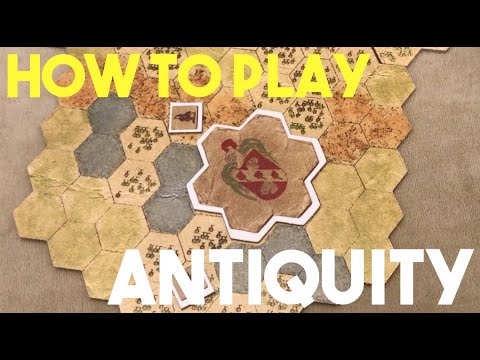
Rules videos
Learn by watching before you open the box




Best player count
BGG community vote
2
BEST
3
BEST
4
REC
Soundtrack
Ambience suggested by Melodice
Loading playlist...
Where to Buy
Prices monitored daily
Finding best prices...
Prices unavailable at this time.
Price history — last 6 months (lowest new offer)
Alert enabled!
Join the BoardGamesBot deals group
Get the best board game deals every day — without message spam.
Join the WhatsApp groupGame details
Mechanics, categories, families and credits
Mechanics
Categories
Families
Publisher
Splotter Spellen
Designer
Jeroen Doumen, Joris Wiersinga
Artist
Ynze Moedt
Community
Data from BoardGameGeek
6,123owners
2,853wishlist
826want to play
Frequently Asked Questions
Quick answers before you buy
Is the game very complex?
Yes, it's an 'Expert' game. With a BGG weight of 4.32, it requires significant planning and a careful reading of the rules.
How long does a game take?
Be prepared to spend between 2 and 3 hours. It's an endurance game, especially with 4 players.
Do I need translations to play?
Yes, there is moderate language dependence. Having translated cards or a spreadsheet helps a lot with the flow.
What is the main difference between the saints?
Each saint changes your victory condition and playstyle, allowing you to focus on trade, war, population, or building.
Who do you recommend this game for?
For groups that enjoy dense strategy games, resource management, and don't mind long play sessions.
Other Games You'll Like
Based on mechanics and theme