
/pic2911858.jpg)
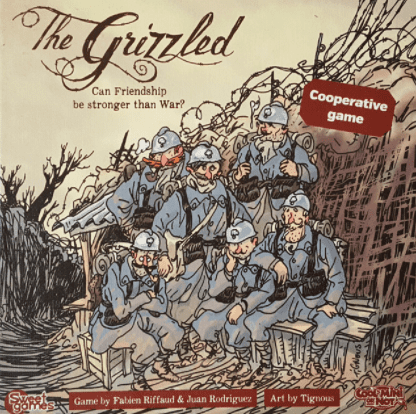
What is your question about The Grizzled: At Your Orders!?
Ask before downloading the manual: the assistant was trained on this file and answers instantly, citing the exact page.
Ask questions about the game
Ask anything about The Grizzled: At Your Orders!: rules, setup, components, complexity, price, or whether it fits your group.
Write your question first. You will create your free account to see the answer — it takes 20 seconds.
Full rulebook
Browse the manual or download the original PDFFull manual text available to read Open text
English translation of the Rules for Les Poilus
and Les Poilus - At Orders
By Esben Meulengracht Flachs (Esbenmf)
April 20, 2015
Aligns with Version 1.1 of the French rules and version 1.0 of the French rules for At Orders
Thanks to: Steve Blackwell (mudshark_baby) and Seb J (Grumbaki) for translations.
No rights claimed or infringement intended.
Les Poilus
2nd August 1914 - In the main square of the village, a group of inseparable friends contemplate,
incredulously, about the General Mobilisation order, posted at the town hall. In the last weeks, reading the
news had become increasingly worrying, but the brutality of the announcement surprised everyone. Without
having the slightest idea of the hell which they were about to be put in, they promised to stay together, to
return whatever happened. Unfortunately, the reality that they were about to face would be completely
beyond their worst fears.
Like literature and film, gaming is a cultural medium, and is undeniably participative. There is no subject
that can't be covered. Some subjects are more difficult to cope with than others, and in particular the life of
the French infantrymen of the Great War – Les Poilus. Guided by the deepest respect we hold for the
suffering endured by these men, we have worked hard to design and set a game with this in mind. In this
collective madness, we have chosen to put them in front of their concerns, their daily fears.
The only way out for these men was their solidarity, their brotherhood and their ability to help themselves to
rescue one and all. Without ever addressing fighting, Les Poilus offers each player the chance to experience
some of the difficulties experienced by the soldiers in the trenches. The atmosphere around the table will
often not only be intense but also emotional as well. The path to victory may seem difficult, but do not be
discouraged. Press forward and get through the Great War!
---
Contents
6 Poilus cards (Lucky charm on face up side)
59 Threat cards (divided into 20 Hardship cards and 39 ordinary Threat cards, some Threat cards also have a Trap symbol)
16 Support tiles (6 left, 6 right, 2 double left, 2 double right – this is an errata)
5 Speech tokens
1 Mission leader token
1 Gaming aid
1 Peace card
1 Monument card
There are six different kinds of threats depicted on the ordinary Threat cards (some cards may depict more than one type):
Night Snow
Rain Gas (mask)
Artillery (shell) Whistle (The signal to attack – to go over the top)
---
Set up
Each player chooses a Poilu/Soldier, places the Poilu card in front with the Lucky charm side face up, and receives 3 random Support tiles.
- In a 2 or 3 player game the Support tiles with double arrows are not used.
Shuffle all the Threat cards.
- Place 25 Threat cards on top of the Peace card, to form the Trials deck.
- The rest (34 cards) goes on top of the Monument card and forms the Morale deck. Once the last card from Morale deck is drawn and the Monument card is revealed, the players immediately lose the game.
The Speech tokens are placed in a common pile between the Trials deck and the Morale deck.
- In a two or three player game use five Speech tokens.
- In a four player game use four Speech tokens.
- In a five player game use three Speech tokens.
The Mission Leader token is given to the player with the bushiest beard.
The goal of the game is to reveal the Peace card by emptying the Trials deck before the Morale deck runs out and reveals the Monument card.
Phases of the game
Each round is called a mission and is divided into four phases:
1. Preparation: In turn order players draw cards from the Trials deck to exhaust it.
2. Actions: In turn order players chooses and carries out an action
3. Support: Players attempt to support one of their companions
4. Moral drop: If the war isn't over, the Morale drops
Victory condition:
The players are victorious if:
Example of playing area:
The four players has a Poilu card each (one used a Lucky charm), a couple of Support tiles, and two players received Hardship cards.
The area in the grey box denotes the No man’s land where ordinary Threat cards are placed when played.
---
At the beginning of the Morale Drop phase, the Peace card is revealed and no players have cards in their hand.
Defeat conditions:
The players are defeated if either of two conditions are fulfilled:
After the Support phase, the Monument card is revealed.
One or more players have four Hardship cards in front of him.
Missions Proceedings
Phase 1: Preparation
Mission Intensity: The Mission leader chooses a number of Threat cards that each player will have to draw from the Trials deck. Players add those cards to their hands. The Mission leader must choose at least one card, and usually 2 to 3 are recommended.
La Fleur au fusil: The intensity of the first mission of the game must always be at least three cards.
Phase 2: Actions
In this phase players will try to play as many cards as possible from their hand to the No man’s land in the mission tableau. The mission immediately stops if there are three Threat cards with an identical kind of Threat in No man’s land.
Starting with the Mission leader, in turn order players will take turns choosing one action among the following four:
1. Play a Threat card. The player plays a Threat card from his hand. If the card is a Hardship card, it must be placed next to the player’s Poilu card. Otherwise, it is added to No man’s land.
2. Fall back and support: The player won't play anymore during this mission. He chooses one of his Support tiles (if he has any left) and places it face down on his Poilu card, without showing it to the other players. He keeps any cards in his hand.
3. Make a speech: If the player has a Speech token, he discards it and chooses one kind of Threat. Each of the other players still in the mission can discard one Threat card of the same kind from their hand. The Speech token is removed from the game when used. The Speech action even allows a player to discard a Trauma or Phobia kind of Hardship card with the associated kind of Threat on it from their hand.
4. Use his Lucky charm. Each Poilu, with his Poilu card still face up, has a Lucky charm that allows him to discard one Threat card from No man’s land with the same kind of Threat as depicted on his Poilu card. Turn over the Poilu card.
The mission only stops if all players fall back or if it fails. The mission fails if there are three identical threats in the No man’s land.
Trap card
When a player plays a card with the Trap symbol, he must draw a card from the Trials deck and play it immediately. If it has another Trap symbol, ignore the symbol. If it is a Hardship card, he puts it next to his Poilu.
End of Mission
Once every player has taken the Fall back and support action, any cards in No Man’s Land is put aside. Players keep their cards in their hand (these are carried over to the next mission).
Mission Failure
As soon as three identical Threat type icons are played into the No man’s land or as Phobias and Traumas
---
from the Hardship cards, the mission is a failure and players move to the next phase.
Threat cards in No man’s land are shuffled back among the Trial deck. Hardship cards remain assigned to
players.
Phase 3: Support
Once the mission is over, players reveal the Support tile they might have played on their Poilu. They then
give it to the player designated by the arrow. The supported player keeps the Support tile. The player who
gets the majority of Support tiles can choose one of two options:
- get rid of up to two Hardship cards previously received (on his Poilu, not from his hand)
- get his Lucky charm back
If there is a tie for most Support tiles received, no one get this support bonus.
If the mission fails, players tally the supports already played. The player with the majority can only get rid
of one Hardship card.
After the Support phase, if at least one player has 4 Hardship cards in front of him, the group
immediately loses the game.
If not, and the Peace card is revealed while players do not have any Threat cards in their hands, the
group wins.
Phase 4: Morale Drop
Transfer, from the Morale deck to the Trial deck, as many Threat cards as the total number of cards in all
player hands, though always a minimum of three Threat cards.
If the Monument card is revealed, the group loses the game. If not, the current Mission leader gets a Speech
token from the common pile, and then passes the Mission Leader token clockwise and a new mission starts.
Variants for new or experienced players:
Discovery Play: Ignore the Trap card.
Veteran Play: Start with 30 Threat cards in the Trials deck.
FAQ:
- If a player takes a Falls back and Support action, his Trauma, Phobia and Hardship cards don't influence
the current mission anymore.
- If a player has no cards in hand, he can always take the Fall back and Support action, even if a Hardship
card would prevent him from doing so.
- The Merry Christmas card can be played to remove a Hardship card from any player.
- If there are conflicting effects between two or more Hardship cards from the same player, the oldest one
applies.
- If there are conflicting effects between two or more Hardship cards from different players, the one from
the active player applies.
- Hardship card Clumsy: If a trap is drawn, it is not activated.
- Hardship card Fragile: Doesn't apply anymore once the player has taken the Fall back and Support action.
- Hardship card Mute: The player can't play the Speech action but can take Fall back and Support action.
- The effect of Hardship cards can force a player to take the Fall back and Support action, preventing him
from taking any further actions in this mission.
- Once the Trials deck is empty, ignore all effects that would make you draw cards (i.e. Traps).
- Players need to keep their hand secret!
FAQ II:
- Cards on the table next to a Poilu (e.g. Hardship cards) are not "in your hand", and are thus not necessary
to get rid of in order to win.
- Lucky Charm: Discard a played Threat card from No man’s land (that matches the kind of Threat on the
Poilu card). Phobia and Traumas that are attached to a Poilu cannot be discarded.
---
- If a player with the Orgeilleux Hardship card has no cards left in his hand, he may/must take the Fall back and Support action as usual. So he can only not withdraw as not-last player when he still has cards in his hand.
- All players draw an equal number of Threat cards (as chosen by the Mission leader) in the Mission intensity step.
---
Hardship cards summary
Summary of the Hardship cards and their effects:
Egoïste (Selfish): Always keep the Support tile you played.
Mutisme (Mute): May not take the Speech action nor communicate with others.
Démoralisé (Demoralised): In the Morale phase, draw one extra Threat card (thus a minimum of 4 cards).
Peureux (Afraid): On your turn, you must take the Fall back and Support action if there are at least two Threat cards of the same kind in No man’s land.
Entêté (Stubborn): May not take the Fall back and Support action with 2 cards or more in hand.
Maladroit (Clumsy): When taking the Fall back and Support action, you must draw and play one random card.
Orgeilleux (Proud): You cannot choose to take the Fall back and Support action, if you are the only player remaining in the mission.
Fragile (Fragile): Other players may not take the Fall back and Support action as long as they still have cards in their hands.
Tyrannique (Tyrannical): Immediately take the Mission leader token, and keep it.
Frénétique (Frenetic): At the start of a Mission, you must draw two extra Threat cards.
Etourdi (Stunned): When taking the Fall back and Support action, you must remove one Support tile permanently from the game.
Paniqué (Panic): When taking the Fall back and Support action, the Support tile, if any available, is drawn at random.
Blessé (Wound): Counts as two Hardship cards. Thus the game ends if a player has the Blessé card and just two further Hardship cards beside his Poilu card.
Jouyeux Noël (Merry Christmas): Remove one Hardship card from any player.
---
Les Poilus – At Orders!
Is friendship stronger than the war?
April 4, 1916 – The war bogged down. The trenches have become our new home. Each day brings bad news. Our group remains together despite everything, together to the end! But in recent weeks, moving aside of Staff and mission orders keep coming, just as absurd as this war. Only rumours of armistice bring us some hope, in the hope that we will still be standing on that day.
Contents:
13 "Easy Mission" cards
13 "Normal Mission" cards
13 "Hard mission" cards
1 Final Assault / Last Stand card
1 card "Le Bleu" for the "Duo" version of the game
4 Tiles Support for the "Solo!" version of the game
6 Silhouettes of our Poilus
The Rules of this expansion "At orders!"
Les Poilus – At Orders!
The expansion "At Orders!" imposes Mission cards that add new set of constraints and sometimes give a little help to the players.
This extension not only offers the most varied challenges for experienced players but also allows for choosing a difficulty level of easy, leaving more opportunity for beginner players.
Good luck!
Description of Mission cards
Difficulty name and mission
Advantage or Constraint
Resolution condition
Minimum Mission intensity (minimum number of Trials cards to distribute to each player at the start of the Mission)
2 or 3 players, same number regardless of the number of players, 4 or 5 players
Difficulty level
Before you begin a game of “Les Poilus – At Orders”, choose the difficulty level of your game and prepare the Mission deck that must be composed of 12 Mission cards. The following table shows the number of Mission cards of each type (Easy, Normal or Hard). These 12 cards are shuffled and form the Missions deck.
Easy Missions
(facile)
Normal Missions
(normal)
Hard Missions
(dificile)
Classes (for learning to play) 8 4 0
Poilus (the recommended level) 4 4 4
Veterans (for trunk-death) 2 4 6
---
Silhouettes of Poilus
At the beginning of a Mission, each player places the silhouette of his Poilu near the "No Man's Land" to
indicate that he participates in the mission. Once a player takes the Fall back and support action, his
silhouette is withdrawn from "No Man's Land" and placed on any played Hardship cards to remind other
players that these Hardship cards no longer have any effect on either the group of Poilus or the current
Mission.
The traps
It is recommended to use the Traps, but you can disable them for an easier game which, of course, draws
some lustre from your eventual victory. If you decide not to play with Traps, the action "Strategic
Withdrawal" (see below) will not be available.
Set up
The Trials deck always starts at 25 cards and 5 Speech tokens are used. The card "Final Assault / Last
Stand" is placed next to the Mission deck.
Example of game in action: "Assault Final / Last Stand", the Mission deck of 12 Mission cards, Morale
deck, Speech tokens, Trials deck, ongoing Mission cards, and Trial cards played in "No Man's Land"
Course of a Mission in "At Orders!"
The mission is played as in the base game. Changes to each step are detailed below.
1/4 Preparation
Select Mission card
Instead of choosing the Mission intensity and thus the number of Trials cards distributed for the Mission, the
Mission leader draws 2 Mission cards. He chooses one to reveal to the other players, and the other card is
placed back on top of the Mission Deck (this Mission card will be one of the 2 Mission cards drawn by the
next Mission leader).
Intensity of the Mission
The chosen Mission card is posed at the beginning of the "No Man's Land". It indicates the minimum
number of Trials cards to distribute to each player (see basic rules). This number may vary depending on the
number of players and is a constraint that will be applied during this Mission. The Mission leader may, if he
wishes, increase the Mission intensity to distribute more cards.
A minimum of 3 cards each with 2 or 3 players. A minimum of 2 cards each with 4 or 5 players.
Resolution of the Mission
Most Mission cards last only during a single Mission and are discarded after the Support phase, but some
difficult Mission cards remain in play as long as the conditions for discarding them are not realized. These
conditions are specified in a frame like this:
In this example, a player who folds can choose to take 2 Threat cards from the Trials deck to discard the
Mission card.
If this frame is not present, the Mission card is automatically discarded after the Support phase.
At the end of this booklet you will find details of some more delicate Mission cards.
Assault Final / Last Stand
After having drawn and looked at the two Mission cards, the Mission leader, may choose not to play any,
and prefer to launch a Final Assault or Last Stand. He then places the card with the corresponding face up,
and this will be the last Mission of the game.
---
The specifics of the Final Assault and Last Stand and the way of playing these are printed on the side selected.
During the last round, there will be no Morale loss, whether as the result of a Hardship card or a Mission card still in play.
2/4 Actions
Strategic withdrawal
Note! : The Strategic withdrawal action is applicable only for games with rules for Traps included.
The first player who takes the Fall back and support action during a Mission, and he alone, can decide to make a Strategic withdrawal: He then places one Threat card from his hand back on top of the Trials deck. The Strategic withdrawal is done first, before any effects from Mission cards or Hardship cards are applied.
Endless Speech tokens
Speech tokens are no longer returned to the box after use, but remain in play.
3/4 Support
Note: With this expansion, the Support may always reactivate a Lucky charm.
On a Managed support, the player may discard 2 Hardship cards and reactivate his Lucky charm. On a Reduced support, the player may discard one Hardship card and reactivate his Lucky charm.
4/4 Morale loss
The Morale loss, which is always a minimum of 3 cards, is henceforth limited to 6 cards, even if the total number of cards in the hands of players exceeds that figure. Warning: the Morale loss caused by a Hardship card may exceed this limit of 6 cards.
---
Mission Cards Summary
Assault final The final assault: All the cards in the trials pile are distributed. There is neither Morale Loss nor Strategic withdrawal. Players must play all cards or game is lost.
Baroud d'Honneur To the last man: The mission is only lost after four similar threats are played. In case of Victory the soldiers are posthumously declared winners.
Le Bleu (Hardship card) The rookie: The rookie can never become Chef de Mission. Speeches have no effect on the rookie.
Acharnement (difficile) Obstinate (hard): Each time a hardship card is played; one threat card is moved from the morale pile to the trials pile. Put five "Night" and / or "Whistle" cards of successful standard missions on this card to make it disappear.
Blindé (difficile) Tank (hard): Each time a hardship card is played; one threat card is moved from the morale pile to the trials pile. Put five "Snow" and / or "Shell" cards from successful missions on this card to make it disappear.
Bonnes nouvelles(facile) Good news (easy): Put a card from the trials deck back on the morale deck.
Camarades (normal) Comrades (normal): After the players have seen their cards these are collected again, shuffled, and redistributed. Including any cards already held by players.
Consigné (normal) Command (normal): The Mission leader names a player, who must use fall back and support as his first action, regardless of any Hardship cards played.
Coulée de boue (normal) Mudslide (normal): Counts as one additional "Rain" card in this mission.
Coup de froid (normal) Cold Wave (normal): Counts as one additional "Snow" card in this mission.
Coup double (normal) Double Impact: if players want to play a card, they are required to immediately play one additional card. Players with only one card cannot play cards at all.
Déprime (normal) Depressed (normal): Immediately move two threat cards from the morale deck to the trials deck.
Empathie (facile) Empathy (easy): If the mission is successful, the supported player must support share support with another player, thus a supported player and another player may both discard one Hardship card. However, only the supported player may additionally reactivate his lucky charm.
Englué (difficile) Bonding (hard): Place first played threat card as sticky. It continues as active during this and the next mission and is then discarded. Discard both this mission card and the sticky card at the end of the following mission.
Enlisement (difficile) Stranded (hard): Shuffle the discard pile and put three threat cards back on top of the trials deck.
Epuisés (normal) Exhausted (normal): The support tiles are not passed and take no effect. Nobody receives support.
Fatalité (difficile) Destiny (hard): All players lose their still active lucky charms.
Fer à cheval (facile) Horseshoe (easy): Players can with their particular lucky charm remove two threat cards featuring a similar threat.
Galvanisé (facile) Stalwart (easy): A player who makes a speech may name two kinds of threat, but the other players are still only allowed to discard one card from their hand.
Gastro (difficile) Gastroenteritis (hard): The Mission leader gets Gastroenteritis. This is contagious. The player with Gastroenteritis draws one additional trials card and gives it to another player at the beginning of the mission. A player can only discard the "Gastro" card if he receives the most support tiles after a mission.
---
Gaz moutarde (difficile) Mustard gas (hard): Each time a hardship card is played; one threat card is moved from the morale pile to the trials pile. Put 5 "Rain" and / or "Gas mask" cards of successful standard missions on this card to make it disappear.
Gros Fortin (difficile) Large fort (hard): Counts as one additional "Whistle", "Gas Mask" or "Shell" card in "No man's land". This mission card remains until a player chooses fall back and supports and chooses to draw three threat cards from the trials deck.
Infirmier (facile) Nurse (easy): The Mission leader chooses a Hardship card already played at a player. That hardship card has no effect during this mission.
Immunisé (facile) Immune (easy): The threat depicted on the mission card cannot make the mission fail.
Lacrymal (normal) Tear gas (normal): Counts as one additional "Gas mask" card in this mission.
La Poisse (normal) Bad luck (normal): Lucky charms cannot be used during this mission.
Nuit noire (normal) Darkest night (normal): Counts as one additional "Night" card in this mission.
Offensive (normal) Offensive (normal): Counts as one additional "Whistle" card in this mission.
Petit Fortin (difficile) Small fort (hard): Counts as one additional "Night", "Rain" or "Snow" card in "No man's land". This mission card remains until a player chooses fall back and support and chooses to draw two threat cards from the trials deck.
Propagande (facile) Propaganda (easy): As the first action the Mission leader may give a free speech without spending a speech token.
Réorganisation (facile) Reorganisation (easy): During the first turn of a mission, players may pass one or two threat cards to another player.
Sursis (normal) Reprieve (normal): Shuffle the discard pile and put three threat cards back on top of the Morale deck.
Tous aux abris (normal) Take cover (normal): Counts as one additional "Shell" card in this mission.
---
Why ask BoardGamesBot
Instead of flipping through the whole manual- Accurate answers Based exactly on this manual, with the source page.
- Save time Find the rule in seconds, without flipping 12 pages.
- Anytime Settle rules mid-game, straight from your phone.
- 100% free Create your free account and start using it now.
How it works
Three steps to the answer- 1 Ask your question Type your question about this game's rules.
- 2 Create your free account Takes 20 seconds — it only saves your history.
- 3 Get the answer The AI finds the exact rule and cites the manual page.
Expansion for
Published additional content
Manual published by the publisher · for rules reference only. More about the game on BoardGameGeek and Ludopedia .
