
/pic6910360.jpg)
What is your question about The Quest for El Dorado: Dangers & Muisca?
Ask before downloading the manual: the assistant was trained on this file and answers instantly, citing the exact page.
Ask questions about the game
Ask anything about The Quest for El Dorado: Dangers & Muisca: rules, setup, components, complexity, price, or whether it fits your group.
Write your question first. You will create your free account to see the answer — it takes 20 seconds.
Full rulebook
Browse the manual or download the original PDFFull manual text available to read Open text
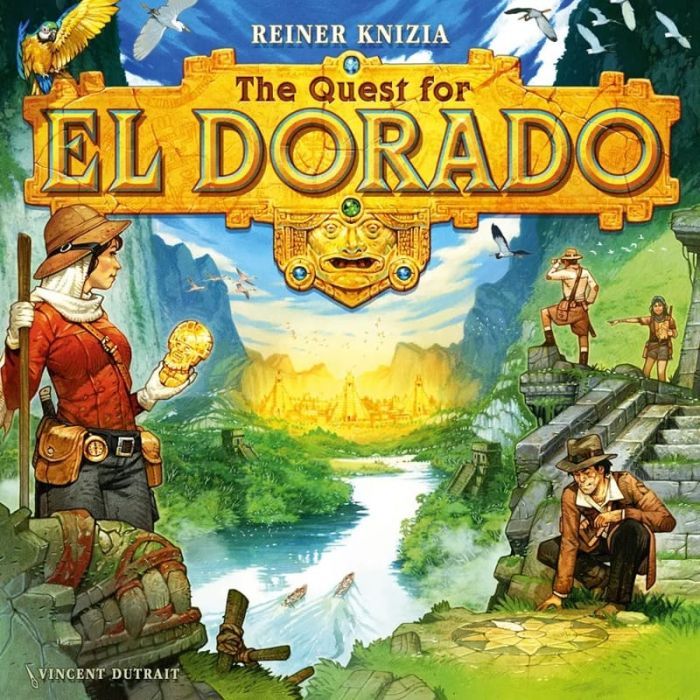
Game Design: Reiner Knizia
Artwork, DTP & Graphic Design: Vincent Duitrait
Reiner Knizia thanks all the playtesters who contributed to the development of the QUEST FOR EL DORADO family.
© 2022 Dr. Reiner Knizia. All rights reserved.
---
Deep in the dense jungles of South America lies EL DORADO, the city of gold.
Unlimited treasure waits in this lost kingdom - gold, jewels, and precious artifacts.
You are a group of daring adventurers who embark on a search for the lost city. As you advance deeper
into the unknown, you encounter new rivers and coastlines, high mountains and dangerous passes, and
treacherous swamps full of hungry crocodiles. But you also discover various shrines with precious artifacts
that will enable you to successfully enter the gate to the lost city. You also meet the Muisca, a friendly local
tribe, who help you find your way to the legendary gold.
Whoever reaches the golden city first wins the game and claims all the treasure.
This box contains two modules, which can be played separately or together.
Dangers adds a variety of new features which can be used individually or collectively to add more variety
and further challenges to the routes of the base game.
Muisca adds cards and cave tokens to the game to help the players on their quest.
The expansion can only be played in combination with the base game QUEST FOR EL DORADO.
You can play these modules together with the expansion Heroes & Hexes.
COMPONENTS
1 dangerous terrain strip
2 swamp tiles
1 swamp strip
6 cave tokens
cave variant only
2 mountains
16 artifacts
4 shrines
3 lakes
1 water vortex
3 rivers
8 Muisca cards
3
---
MODULE 1: DANGERS
The players choose which of the following features they like to use in the game.
They can be used separately or together in any combination of their choice.
All rules of the base game are valid, except for the following:
GENERAL RULE
GAMEPLAY
Some of the spaces now show a skull head. These are called "dangerous spaces".
You may only move your playing piece onto a dangerous space if you move on in the same turn.
You cannot end your turn with your playing piece on a space showing a skull head.
DANGEROUS SPACES
PREPARATION
When constructing the route, also use the dangerous terrain strip, which is full of dangerous spaces.
GAMEPLAY
The dangerous spaces show a skull head. You may only move your playing piece onto a dangerous space if you move on in the same turn.
MOUNTAINS
PREPARATION
When constructing the route, place the new mountains on top of the spaces of
the terrain tiles and/or terrain strips to modify the terrain.
GAMEPLAY
The mountains show a dangerous pass. As usual for spaces showing a skull head,
you may only move your playing piece onto the mountain pass if you move on in
the same turn.
RIVERS, LAKES AND WATER VORTEX
PREPARATION
When constructing the route, align the new rivers, lakes and
water vortex along the edges of the route to create coastlines
to travel along.
Alternatively, place the features on top of the spaces of the
terrain tiles and/or terrain strips to modify the terrain.
GAMEPLAY
Many of the new water spaces show flowing water
indicated by a white arrow. If your playing piece
comes to a stop on a space with a white arrow
after you have completed the movement for a
card, you must immediately move your playing
piece to the next space in the direction of the white arrow
- provided the white arrow points to an adjacent space, and
this space is not a mountain and not occupied by another
playing piece (as usual). If the next space also shows a white
arrow, this has no effect.
Example:
Yellow plays a blue card with value 1 and moves to a water
space with a white arrow. Due to the white arrow on this field,
he immediately moves another space following the arrow.
Since he now lands on a water space with a skull head,
he needs to play another card to move on. He is not allowed to
stay on the space with a skull head.
The white arrow on this space has no effect as yellow didn't
land on it as a result of a card. If yellow is not able to move on
(for example, if he hasn't got the right card(s)),
he is not allowed to make the move to this water space.
---
SWAMPS (CROCODILES)
PREPARATION
When constructing the route, use the new terrain strip showing swamp spaces.
Also align the new swamp tiles along the edges of the route to create challenging shortcuts.
Alternatively, place the swamp tiles on top of the spaces of the terrain tiles and/or terrain
strips to modify the terrain.
GAMEPLAY
Swamp spaces show one or more crocodiles. When you play a card to move onto a swamp space,
the power value of the card must be exactly equal to the number of crocodiles there.
However, it does not matter which of the three symbols (machete, paddle, or coin) is shown on the card.
(Note that you will never have any left-over power after moving onto a swamp space.)
Build on your experience to create exciting new routes with all these additional features.
Make sure to avoid bottlenecks where some players can seriously block the advancement of others.
To move to this space,
the player needs a card
of exactly value 2.
To move to this space,
the player needs a card
of exactly value 4.
SHRINES AND ARTIFACTS
PREPARATION
When constructing the route, align the four new shrines along the edges of the route.
Alternatively, place the shrines on top of the spaces of the terrain tiles and/or terrain strips.
Keep the color artifacts close by their shrines.
GAMEPLAY
Each shrine relates to one of the four basic card colors (green machetes, blue paddles, yellow coins,
and purple action cards). White joker cards allow you to choose any one of the three colors, green,
blue or yellow, however, not purple.
If your playing piece comes to a stop on a shrine after you have completed the movement for a card,
then you may make a sacrifice:
Take one card of the required color from your hand, remove it from the game and put it back into the box.
For this, you take the corresponding color artifact and place it in front of you. You can only collect one artifact of each color.
After you have made your sacrifice, continue your turn.
You must collect all four artefacts before you can enter the gate to El Dorado and win the game.
Make sure to place the shrines conveniently along the route to give all players easy access to the artifacts.
Example:
Yellow plays a card to move to a space on the green shrine.
He removes a green card from his hand (out of the game) and places the green artifact in front of him.
JACK-OF-ALL-TRADES
1
2
EXPLORER
1
+
5
---
MODULE 2: MUISCA
All rules of the base game are valid, except for the following:
PREPARATION
After setting up the base game, shuffle the 8 Muisca cards and place them as a face down deck close to the left side of the market board.
Reveal two single cards from the Muisca deck and display them face up next to the left side of the market board.
These two cards are now part of the market. Hence, the market board now offers 8 cards instead of 6 cards.
GAMEPLAY
BUYING MUISCA CARDS
Muisca cards can be bought from the market board as usual. Put the purchased Muisca card face up on your discard pile as usual.
When a Muisca card is bought, immediately reveal a new Muisca card from the Muisca deck so that there are always 2 Muisca cards face
up - until the Muisca deck runs out.
PLAYING MUISCA CARDS
When you play a Muisca card from your hand, you have two options:
* You can play the card as normal face up above your expedition board and
use it immediately as usual.
* You can play the card face up on your expedition board, between your draw pile and
your discard pile. At any time during your current turn or any of your later turns,
you can then use this card as if you played it from your hand.
At any time, you can only have a maximum
of two face up Muisca cards displayed on
your expedition board, one next to the other.
When buying a card, a Muisca card without a
coin symbol is worth 1/2 a coin like any other
card.
Normal play.
Max. 2 Muisca cards.
Stored for later use.
---
MUISCA WITH CAVE VARIANT
Add the following 6 cave tokens to the 36 cave tokens of the base game:
3x
Play this token as if it were one of the Muisca cards
currently displayed face up on one of your opponent's
expedition boards.
The opponent's Muisca card remains unaffected.
3x
Play this token as if it were one of your Muisca cards
currently displayed face up on your expedition board.
Your Muisca card remains unaffected.
---
Why ask BoardGamesBot
Instead of flipping through the whole manual- Accurate answers Based exactly on this manual, with the source page.
- Save time Find the rule in seconds, without flipping 7 pages.
- Anytime Settle rules mid-game, straight from your phone.
- 100% free Create your free account and start using it now.
How it works
Three steps to the answer- 1 Ask your question Type your question about this game's rules.
- 2 Create your free account Takes 20 seconds — it only saves your history.
- 3 Get the answer The AI finds the exact rule and cites the manual page.
Expansion for
Published additional content
Manual published by the publisher · for rules reference only. More about the game on BoardGameGeek and Ludopedia .
