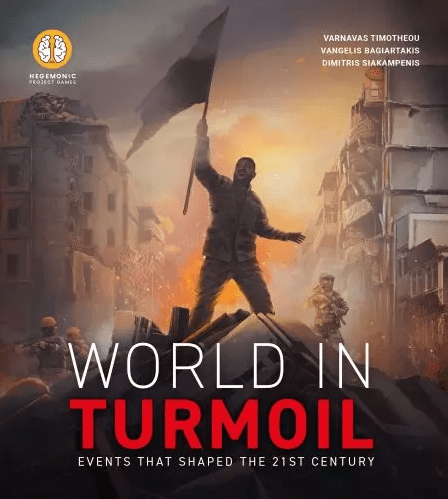
What is your question about World Order: World in Turmoil?
Ask before downloading the manual: the assistant was trained on this file and answers instantly, citing the exact page.
Ask questions about the game
Ask anything about World Order: World in Turmoil: rules, setup, components, complexity, price, or whether it fits your group.
Write your question first. You will create your free account to see the answer — it takes 20 seconds.
Full rulebook
Browse the manual or download the original PDFFull manual text available to read Open text
The world is in turmoil. Regional conflicts, shifting alliances, and new economic agreements challenge the world’s leading powers like never before. During these uncertain times, will you manage to lead your power to global hegemony? World in Turmoil brings 60 Event cards to World Order, drawn from real-world developments that have reshaped the global geopolitical landscape since 2010. Confront the aftermath of the Arab Spring, navigate the consequences of Brexit and the US–China Trade War, and respond to challenges like the rise of the Islamic State, the COVID-19 pandemic, or Russia’s invasion of Ukraine. With this expansion, you will have to respond to threats, identify opportunities, and simulate real-world scenarios with calculated decision-making in order to guide your power through the shifting currents of the emerging world order.
---
Rulebook
Effect Cards
Country Cards
Bid Cards
Era I Event Cards
Player Aid Cards
Era II Event Cards
Chain Event Cards
Events Board
Influence Cubes
(10 Blue, 10 Red, 10 Yellow,
10 White, 10 Black)
GAME COMPONENTS
---
4WORLD IN TURMOIL • COMPONENT ANATOMY
Space for
Chained Events
Event Spaces
Smart Power Areas. The players’
is stored in these spaces.
Space for
Player-Specific Events
Region(s) and Year
or Period in which
the Event takes place.
Auto-Bid: Instructions on
how this Event is handled
when a player is missing.
Event Era:
Era I corresponds to
rounds 1—3 while
Era II corresponds to
rounds 4—6.
indicates Events
caused by other Events.
Participating Players: If players’ flags are shown
separated by vertical lines then they participate in the
resolution of this Event as separate parties. If they are
shown next to each other, without a line between them,
the players participate in the resolution of the Event as a
single side and should discuss their intentions with each
other before making any decisions.
Event Name
Card’s Effects
Event Type: There are
5 different types of
Events, each resolved
in a different way.
Event Cards
Events Board
COMPONENT ANATOMY
---
GAME SETUP • WORLD IN TURMOIL
1
3
3
4
4
4
5
2
2
2
GAME SETUP
After you finish the 8th step of the main game’s setup, perform the following:
1. Place the Events board next to the Main board. Leave space below each
player’s Smart Power area for cards to be placed there if needed.
2. Separate the Event cards by their Era (Era-I, Era-II, and Chain) and form 3
decks. Shuffle the 2 Era decks separately and place all 3 decks near the Events
board. (There’s no need to shuffle the Chain deck.) Also separate the small
cards (Effect cards, Bid cards, and Country cards) by their type and keep them
nearby as well.
3. Each player places 2 of their cubes on their corresponding Smart Power area
on the Events board. These represent their starting Smart Power ( ). Give
each player a Player Aid card to remind them of the ways they can use that .
4. Draw the first 2 Event cards from the Era-I deck and place them on the board.
If any of them only affect a single player, move them below the board, in the
space corresponding to that player (below their Smart Power area), and draw
a new Event card. If you draw more than one Event that only affects the same
individual player, discard it and draw a new one. At the end, there should be 2
Event cards on the board and 0–4 player-specific Events below it, up to 1 for
each player.
5. Give each player their extra cubes included in the expansion, and place the
black cubes in a pile near the Events board. These black cubes are meant to be
used whenever an Event adds a Neutral Influence to a Region.
---
6WORLD IN TURMOIL • GAMEPLAY
World in Turmoil adds 2 new things to the game: Smart Power and Events.
SMART POWER
Smart Power ( ) is a new type of resource you can collect. You keep track of it
using cubes of your color, placed on your Smart Power area on the Events board.
You gain by participating in Events. You can then spend when performing an
action to improve it in some way or gain some kind of bonus. On top of that, during
each Scoring step, players get bonus VPs based on who has the most .
Here is how each action can be improved by using Smart Power:
Improve Relations
When you Improve Relations with a Country, you can spend any number of . For
each you spend, reduce the amount of required by 1. Effectively, you can
spend instead of when performing this action.
Engage
When you Engage in a Region on the board, you can spend 1 (and no more than 1)
to reduce the amount of required by an amount equal to the number of allied
Countries you have from that Region.
Trade
While Trading, you can spend any number of . For each you spend, you can
choose a different Region and consider that Region’s available Countries on the
board as allied Countries, including their Trade symbols in your calculations
(except for Countries with which you cannot become allies).
Invest
When you Invest in an allied Country, you can spend 1 (and no more than 1), either
before or after the action, to Ready that allied Country. In other words, you can spend
1 and Ready an exhausted card in order to Invest in it, or you can Invest in an allied
Country and spend 1 to Ready it and have it available for other uses again.
GAMEPLAY
---
7 GAMEPLAY • WORLD IN TURMOIL
Move
When you Move an Unit, you can spend 1 Action to be able to Move it to any Region,
even if it’s outside your zone of interest and you don’t have a Base there. If you
want to Move multiple Units to that Region, you need to pay 1 Action for each.
Build a Base
After you Build a Base in a Country, you can spend 1 Action (and no more than 1) to
Move an additional Unit to that Country’s Region (either from your Player board
or another Region), without paying the cost.
During the Scoring step, count how many Units each player has and award bonus
points to the players accordingly, as seen on the Events board. Treat it the same
way you would treat a Majority token: The player with the most gains 5 VPs, the
next player 3 VPs, and the third player 1 VP. In case of a tie, all tied players gain the
VPs corresponding to the lowest position among them.
Similarly, in a 2-player game, only the player with the most gains the 3 VPs.
If both players are tied, no points are given.
EVENTS
When playing with World in Turmoil, there is a new phase added to the game,
called the Event Phase. This phase is resolved right after the Action Phase and
before the Aftermath.
In the Event Phase, starting with the Event card on the right-most space on the
board, resolve each Event, one by one, going from right to left. Then, resolve the
player-specific Events below the board, using the current round’s turn order. Note
that when resolving an Event, only the player(s) depicted are affected and, unless
stated otherwise, any instructions provided apply to those players only.
Each Event is resolved in a different way, depending on its type. There are
5 different types of Events included in World in Turmoil. Here are the details on
how each one works:
---
8WORLD IN TURMOIL • GAMEPLAY
Decision
When a Decision Event is resolved, each player included in this Event decides if they will act upon the Event’s prompt, listed on the top of the card’s text box.
Then, each of the included players checks the card’s resolution effect and follows the listed instructions based on what they actually did.
If a player wants to see how the other players will act before deciding for themselves, use the current round’s turn order.
Mutual Agreement
Mutual Agreements work similarly to Decision Events.
However, they usually affect 2 players who both must agree on how to proceed and contribute in order to resolve its effect. If they can’t agree on how to act upon the Event’s prompt, or can’t both contribute as required, it is assumed they do not act upon it. Note also that a player cannot claim to agree without contributing anything.
If a Mutual Agreement affects 3 or more players, then at least 2 of those players must agree to contribute for the effect to be resolved. In such a case, any players who did not participate do not gain any of the rewards listed.
Bidding
When a Bidding Event is resolved, the players need to bid, and the outcome is determined by whoever wins.
Each bidding card showcases what the actual bidding sides are. Each side may consist of a single player or a group of players. In the case of a group, those players’ individual bids are still made in secret, but they are added together after they are revealed and treated as one bid.
Each card will also list what the players will be bidding with. This may include , , moved, etc. and will be different from card to card. If multiple items are
---
9GAMEPLAY • WORLD IN TURMOIL
listed on a card, a player can use any combination of them in their bid. Just note
that, if a maximum is listed next to any item, you can only include that particular
item that many times in your bid.
The way the actual bidding is done is by using each player’s supply of Influence
cubes. First of all, each player determines, on their own, how much they are going
to bid. They then secretly place in their fist a number of Influence cubes equal to
their bid. Note that you never place the actual items you are bidding with in your fist
( , , etc.). You only place cubes from the supply, with each of those cubes
representing one of the items you are bidding with.
Note that in some cases, the items you bid with require you to do something after
the bid is revealed. In these cases, you can only include them in your bid if you are
able to do the thing required. For example, if a card instructs you to bid with
you will Move somewhere, you must have as many as your bid, as well as the
money required to Move them. Similarly, if you are instructed to bid with 10 ,
then each cube you add to your fist would correspond to a bid of 10 , and you
should be able to pay that amount.
After everyone has determined their bid and placed the corresponding cubes in
their fist, they simultaneously reveal them. If any players are on the same side, add
their bids together and treat them as a single bid for that side. The side with the
highest bid is the winner; check the card’s resolution effect and follow the
instructions there. Keep in mind that you need to have participated in the bidding in
order to claim any reward that applies to you. If your individual bid was zero
(meaning you didn’t place any cube in your fist) and your side won (due to other
players or modifiers), any effect listed that applies to you is skipped. Other effects
that apply to other players, or to the game in general, are applied as normal.
In case of a tie, unless covered in the card’s resolution effect, the winning side is the
one that includes the player with the most Influence in the Region(s) corresponding
to the Event. If there is still a tie, the winning side is the one that includes the player
with the most VPs (prior to this Event). If there is still a tie, the winning side is the
one with the player who has the most money, and in case of another tie, the player
with the most starting money. In the rare case where the total bids of all sides are 0
(meaning all players’ individual bids were 0 and there were no modifiers), do not
treat it as a tie. Instead, discard the Event, and nothing further happens.
---
10WORLD IN TURMOIL • GAMEPLAY
Note that your bid is binding, and upon revealing it, you must immediately do what it
corresponds to, regardless if you win or lose. If, for example you bid with , you
should immediately spend that much , moving its marker on your Player board by
that number of spaces. If you bid with moved to a Region or a card (see below
for more details on this), you should immediately Move that number of , paying
the corresponding cost as normal.
After the winning side is determined, each player in it gains equal to half of their
individual bid (rounded down). Players on the losing side, gain equal to their
individual bid. Just place the cubes that you revealed in your fist (either half of them
or all, depending if you won or lost) on your Smart Power area on the Events board.
Note, however, that if a card instructs you to add a number to your bid, you don’t
gain any additional from that. You only gain based on the bid you made with
the cubes in your fist.
Moving to a card: Some Events allow you to bid with you will Move to
their card. In such cases, treat the Event card as an additional Region to those
found on the Main board. You can Move to it either from your board or from
other Regions, and you spend 5 for each moved, as normal.
After the Event is fully resolved, any on its card are immediately placed on
the Event’s Region. It will be helpful to keep this information in mind when
determining your bid, since all Events are resolved before the Aftermath phase
and, thus, before checking for THREAT.
Some Events may ask you to bid against an opposing bid, giving you a range of
numbers after it. In those cases, after all the players have already placed and
revealed their bid, take the Bid cards corresponding to the range given on the card,
shuffle them and choose one at random. This is the opposing bid you will compare
yours with. See the resolution effect on the card for details on how to then proceed.
Check
These Events will usually check if a condition has been
met in the game. Note, however, that they do not allow
for the involved players to act upon the Event while
resolving it. Whatever it is that the Event is checking for,
---
11 GAMEPLAY • WORLD IN TURMOIL
it must have already been done prior to resolving it (either in the same round or in a
previous one).
After checking the condition, proceed to the resolution effect and follow the
instructions there.
Turning Point
These Events represent significant moments in history
that happen but that the players do not directly interact
with. When a Turning Point Event is placed on the board,
immediately resolve its ability, following the instructions
listed on it.
After resolving an Event, its card is immediately discarded, unless stated
otherwise. If, as part of its effect, another Event is to be added to next round’s
Events or an Effect card is to be placed somewhere on the table, search for this
card in the appropriate deck and place it where instructed. In fact, we encourage
you to do that even before resolving the Event so that the players involved are
fully aware of all outcomes before making any decisions.
Events that are added in this way are found in the Chain deck and should be placed
next to the board until you finish resolving the current round’s Events. Note that
there are a few cases where multiple cards may instruct you to add the same card.
In such cases, if a card has already been added (either in this round or a previous
one), it cannot be added again; each card is only resolved once in each game,
unless stated otherwise.
When all the Events have been resolved, next round’s Events are added on the
board. If there are any Event cards set aside to be added to next round’s Events, you
should place those first, starting from the first space on the left. Then, draw 2 new
Events (or less if there are not enough spaces on the board) from the deck
corresponding to the next round and place them on the Events board. The first 3
rounds correspond to Era-I, while the final 3 rounds correspond to Era-II. This
means that at the end of the Events Phase in round 3, you should draw from the
Era-II deck since those Events will be resolved during the 4th round.
---
12WORLD IN TURMOIL • GAMEPLAY
If any Event affects only a single player, move it below the board, in the space below
that player’s Smart Power area, and draw an additional Event card. If there is
already an Event card there, or if you draw another Event that affects only that
player, that player chooses which Event to keep and discards the other.
Note that there can be a maximum of 3 Event cards on the board affecting multiple
players, and a maximum of 1 Event card per player below the board.
Postponing Player-Specific Events
When it comes time to resolve a player-specific Event of yours, you can spend 1
to postpone it and resolve it in the next round. Note that in the final round, you
cannot postpone an Event; you will have to resolve it as normal.
Note that a few Events have the label NOT POSTPONABLE next to their type. Those
Events cannot be postponed in this way. You will have to resolve them as normal the
round after they are drawn.
Losing Money or Resources
Some Events, while resolving them, may cause you to lose money or resources. In
such cases, if you don’t have enough of those items to lose, lose as much as you can,
and then for every / / 5 you can’t lose, lose 1 VP instead.
EXAMPLE: A game of World Order is about to start, and during the setup, Alex
(USA) draws the Event cards for the first round from the Era-I deck. The first card
is New Start, and he places it on the right-most space on the Events board. He
then draws Eurasian Economic Union (EAEU), which is a player-specific Event
for Russia. He places the card below Russia’s Smart Power area and draws a
new Event card. The card drawn is Arab Spring, which happens to be a Turning
Point. He immediately follows the instructions on the card, and after shuffling the
4 Chain Event cards mentioned, he draws Syrian Civil War, which he places on
the middle space in the Events board. The setup for the Events is now complete.
When the first round’s Event phase comes, players start resolving those Events.
The first one is New Start, a Mutual Agreement Event between USA and Russia.
It asks for both players to spend 1 and at least 1 . Alex asks Jim (Russia)
about it, and they discuss it for a little while. However, Jim decides against it, so
the Event card is discarded with no effect.
---
13 GAMEPLAY • WORLD IN TURMOIL
The next card is Syrian Civil War. This is a Bidding Event, so all the players involved (USA, EU, and Russia) will have to bid for it. USA and EU are on the same side, while Russia is bidding against them but with a +2 modifier. According to the Event’s instructions, they can bid with 10, and they will Move to the Event’s card. After considering what they’ll do, they all place cubes in their fists and reveal them simultaneously. Alex has placed 4 cubes in his fist. As soon as he reveals his bid, he spends 20 for the first 2 and 2 for the other 2. Anna (EU) has placed 3 cubes in her fist, so upon revealing her bid, she immediately spends 10 and 2. Jim has placed 6 cubes in his fist. Upon revealing them, he spends 20 and 1 and also Moves 3 to the Event card, spending 15 for them. The final bids are 4 + 3 = 7 versus 6 + 2 = 8. Russia wins, so Jim gains 3 (half of his bid), while Alex and Anna gain 4 and 3 respectively (equal to their bids). Jim then, checks the card’s effect to see what else happens: He sees that he gains 3 additional and also converts 1 of his temporary Influence in Middle East–North Africa to a permanent one. Then, he adds the Rise of Axis of Resistance Event to next round’s Events, placing it on the left of the Events board. Finally, he takes his 3 from the Event card and places them in Middle East—North Africa since that’s where the Event takes place.
The final Event to be checked is Russia’s Eurasian Economic Union (EAEU). Jim really wants this Event to happen. But it is a Decision Event, asking him to spend some resources, and he is out of at the moment. He decides to spend 1 of those that he gained to postpone the Event and try to resolve it next round.
---
14WORLD IN TURMOIL • GAMEPLAY
Removing or Converting Influence from a Region
Some Events may ask a player to remove Influence from a Region (or replace it with a Neutral one). Unless specified, you should always remove the left-most temporary Influence of that player. If they have no temporary Influence, remove one of that player’s starting Influence if able or, otherwise, any of their permanent Influence.
Similarly, if an effect asks you to convert a player’s permanent Influence to a temporary one, move one of their starting Influence cubes if able or, otherwise, any of their permanent Influence, and place it on a temporary Influence slot without gaining any VPs. If no temporary slot is available, then the Influence cube is removed completely.
If any of the starting Influence in a Region is removed, that slot is ignored for the rest of the game. This doesn’t affect a Region’s scoring. If its permanent slots are filled (the ones with the number 1 in them, above the line), the Region will score as normal in the Scoring step. However, if any permanent slot becomes empty due to Influence removed by an Event, players can, later in the game, use it and place Influence there. If it is still open during a Scoring step, the Region won’t score at all.
Replacing Country Cards
Some Events may ask you to replace a Country card with a different version, featuring changes caused by what occurred. When you replace a Country in this way, if it is available on the board or a player has it as an allied Country, just replace the previous card with the new version. If that card is still inside its Region deck on the board, search for it, remove the previous card, and add the new one to the deck. Then shuffle it and place it back on the board, revealing the top 2 cards as normal.
Similarly, if an Event asks you to search for a Country card, make sure to shuffle its deck afterward and reveal the top 2 cards as normal.
---
15NPPs & AUTOMAS • WORLD IN TURMOIL
RESOLVING EVENTS AFFECTING
NON-PARTICIPATING PLAYERS OR AUTOMAS
When playing with fewer than 4 players, Events affecting the missing players are
handled slightly differently. Depending on whether you are using the main game’s
rules for 2- or 3-player games or the Automa rules, found in the Diplomacy &
Dominance expansion, you can find the details below on how to proceed.
Using Bid Cards: To determine the decision of a non-
participating player (NPP) or Automa in regards to an
Event, the Bid cards are used. Each Event will list on its
bottom-right corner exactly which of those cards each
player should use. In most Events it will be a range of
numbers, while in other ones it will be a combination
of ✔ and ✘ symbols. In either case, you should take
the matching cards (either the cards with the
indicated numbers or cards with the corresponding
symbols), shuffle them, and draw one at random to determine its decision. If the
Event requires a number, the NPP’s/Automa’s contribution is that number. If the
Event requires a specific action from the NPP/Automa, a card with the ✔ symbol
indicates it will perform it, while an ✘ symbol means it won’t.
PLAYING WITH THE MAIN GAME’S RULES
FOR 2- AND 3-PLAYER GAMES
When using the main game’s rules, do not place any for the NPPs during setup.
Whenever you need to add Events to the Events board, draw cards as you would
draw in a normal 4-player game.
When resolving the Events, if any of them on the board affect only NPPs (like, for
example, in a 2-player game, Events affecting just the other 2 players), discard
them without any effect. For player-specific Events below the board that affect
NPPs, instead of resolving them, add 1 of the player’s Influence to the Event’s
Region (as you would add Influence from an Automa-Influence card) and discard the
card. If more than one Region is listed, choose at random between them.
---
16WORLD IN TURMOIL • NPPs & AUTOMAS
For all the remaining Events that include NPPs, see below on how to determine their
response, depending on the Event’s type.
Decision
If a non-player-specific Decision Event comes up, simply ignore it for the NPPs.
Mutual Agreement
For a Mutual Agreement to be resolved, both players (or at least 2 if more are listed)
need to agree upon it and contribute accordingly. To determine whether the NPP will
agree or the level of its contribution, use the Bid cards as instructed before. Note that,
if the Event lists a range and the number drawn is 0, it means the NPP doesn’t agree
and won’t contribute (regardless of any modifiers), and the Event won’t be resolved.
Bidding
An NPP’s bidding is determined using the Bid cards. Note, however, that all NPPs’
Bid cards should be drawn after the actual players have placed and revealed their
own bid.
Checks and Turning Points usually do not involve any decisions from the NPPs so
they are resolved as normal. If they do have a decision, use the Bid cards as usual.
Note that, for all types of Events, since the NPPs don’t handle any resources, they
won’t gain any such rewards (including ), nor do they actually spend any costs
involving resources. The only exception is . If an NPP has to Move as part
of the Event’s requirement or reward, place that number of its from the supply
where needed. Also, if it needs to add or remove Influence from the board as part of
an Event’s effect, carry it out as normal.
For some Bidding cards, players are allowed to bid in multiple ways, including
Moving their . In such cases, half of the NPPs’ bid (as determined by the Bid
card, rounded down), will correspond to moved.
Some Events instruct a player to add a number to their bid based on the current
game status. When determining such cases for NPPs, use the numbers found in
parentheses next to the Bid Cards range. For example, if there is a (+2) next to a
range of 0—2, it means that you should draw a random Bid Card from 0, 1, and 2 and
then add 2 to that number to determine the final bid.
---
17NPPs & AUTOMAS • WORLD IN TURMOIL
PLAYING WITH AUTOMAS
When playing with Automas, draw Events as you would in a normal 4-player game.
When resolving the Events on the Events board, the Automas will use the Bid
cards to determine how they will react as described before. However, the
following rules apply:
• Whenever an Automa needs to spend or gain a resource, it spends/gains
money instead. Use the following guide to convert resources to money.
▸ : 5 each
▸ , , : 10 each
▸ , , : 3 each
• When it needs to Move to a Region as part of an Event’s cost or effect, take
them from the supply and place them where instructed. When it needs to Move
to a card as part of an Event’s cost or effect, take the in the Event’s
Region first and then, if more are needed, take the rest from the supply.
• In Decision and Mutual Agreement Events where an Automa needs to spend
a fixed amount, it will do so if the Bid card it draws features a ✔ symbol.
Otherwise, it declines to participate. If a Decision card allows its effect to be
performed multiple times (like, for example, Sahel Humanitarian Crisis), and
the Automa participates, it will only perform the effect once.
• In Events where it can spend a variable amount of resources, its contribution
or bid is determined by the number on the Bid card it draws (unless it is 0, in
which case it declines to participate, regardless of any modifiers it may have).
If the whole contribution consists of a single type of resource, it covers that cost
according to the guide above. If, however, the Event allows for multiple ways to
contribute or bid, and Moving is one of them, half of the contribution or bid
(rounded down) shall correspond to moved. The rest (or all of it if Moving
was not included as an option) shall correspond to the combination with
the lowest cost for the Automa, according to the guide above.
• Some Events instruct a player to add a number to their bid, based on the
current game status. When playing with Automas, determine these numbers
as normal and ignore the parentheses next to the Bid Cards range (these are
only meant for NPPs). For example, if there is a (+2) next to a range of 0—2,
---
18WORLD IN TURMOIL • NPPs & AUTOMAS
ignore the parenthesis, draw a random Bid Card from 0, 1, and 2, and check
the Event’s effect to see if any number should be added before determining
the final bid.
• When resolving a player-specific Event, the Automa ignores everything
written on the card and just adds 1 Influence to the Event’s Region, without
spending or gaining anything else. If more than 1 Region is listed, choose at
random between them.
• If an Automa cannot fulfill part of an effect (like for example increasing or
lowering a Production), it just ignores that part. If, however, it cannot fulfill
part of the cost required for an Event (either because it is unable to do so, like
lowering one of its Productions, or because it does not have enough money), it
does not participate in its resolution.
• If any case occurs that is not covered by the rules here, decide using your
judgement based on what is more advantageous for the Automa.
An Automa will gain like everyone else, keeping them in its Smart Power area
on the Events board. However, it won’t use them during its turns to improve
its actions. Instead, at the end of each Event phase, it will spend half of its
(rounded down) and gain an equal number of VPs.
CREDITS
Game Design: Vangelis Bagiartakis, Varnavas Timotheou, Dimitris Siakampenis
Game Development: Panagiotis Zinoviadis
Cover Illustration: Miłosz Wojtasik
Graphic Design: Katerina Xerovasila
Editor: Jordan Boschman
Academic Advisors: Dr. Zenonas Tziarras, Dr. Moritz S. Graefrath, Dr. Chris Oates,
Dr. Russell Foster, Dr. Connor Judge, Emmanuel Pietrobon
---
19WORLD IN TURMOIL
World In Turmoil Rulebook V. 1.0
Copyright © 2025 Hegemonic Project Limited.
World Order is a trademark of Hegemonic Project Limited.
All rights reserved. No part of this book may be reproduced or used in any manner, electronic or mechanical, including photocopying, recording, or by any information storage or retrieval system, without the prior written permission of Hegemonic Project Limited, except as expressly permitted by law.
A MESSAGE FROM
HEGEMONIC PROJECT GAMES
Our goal at Hegemonic Project Games is to help people learn more about
serious topics (like geopolitics and international relations in this case) through
board games. For World Order, we collaborated with academics and experts on
international relations and political science to ensure that the game accurately
reflects the inner workings behind the decisions of global powers and captures
the intricacies of their actions on a global scale.
With World in Turmoil especially, we wanted to show the effect of real-life events
within the game so that players can better understand what caused them as well
as their consequences around the world. We spent considerable time trying to
simulate these events as faithfully as possible, within the limitations of the game’s
mechanisms, while also keeping the gameplay interesting and engaging.
However, we are fully aware that real life is far more complex than what any game
can show and that many of these events may have deeply affected some of you or
your loved ones. We do not aim to dramatize or diminish the actual human costs
associated with geopolitical conflicts. Instead, we would like to invite players to
explore how these events affected the world around us and how their outcomes
can be better understood, challenged, or even prevented in the future.
---
Why ask BoardGamesBot
Instead of flipping through the whole manual- Accurate answers Based exactly on this manual, with the source page.
- Save time Find the rule in seconds, without flipping 19 pages.
- Anytime Settle rules mid-game, straight from your phone.
- 100% free Create your free account and start using it now.
How it works
Three steps to the answer- 1 Ask your question Type your question about this game's rules.
- 2 Create your free account Takes 20 seconds — it only saves your history.
- 3 Get the answer The AI finds the exact rule and cites the manual page.
Expansion for
Published additional content
Manual published by the publisher · for rules reference only. More about the game on BoardGameGeek and Ludopedia .