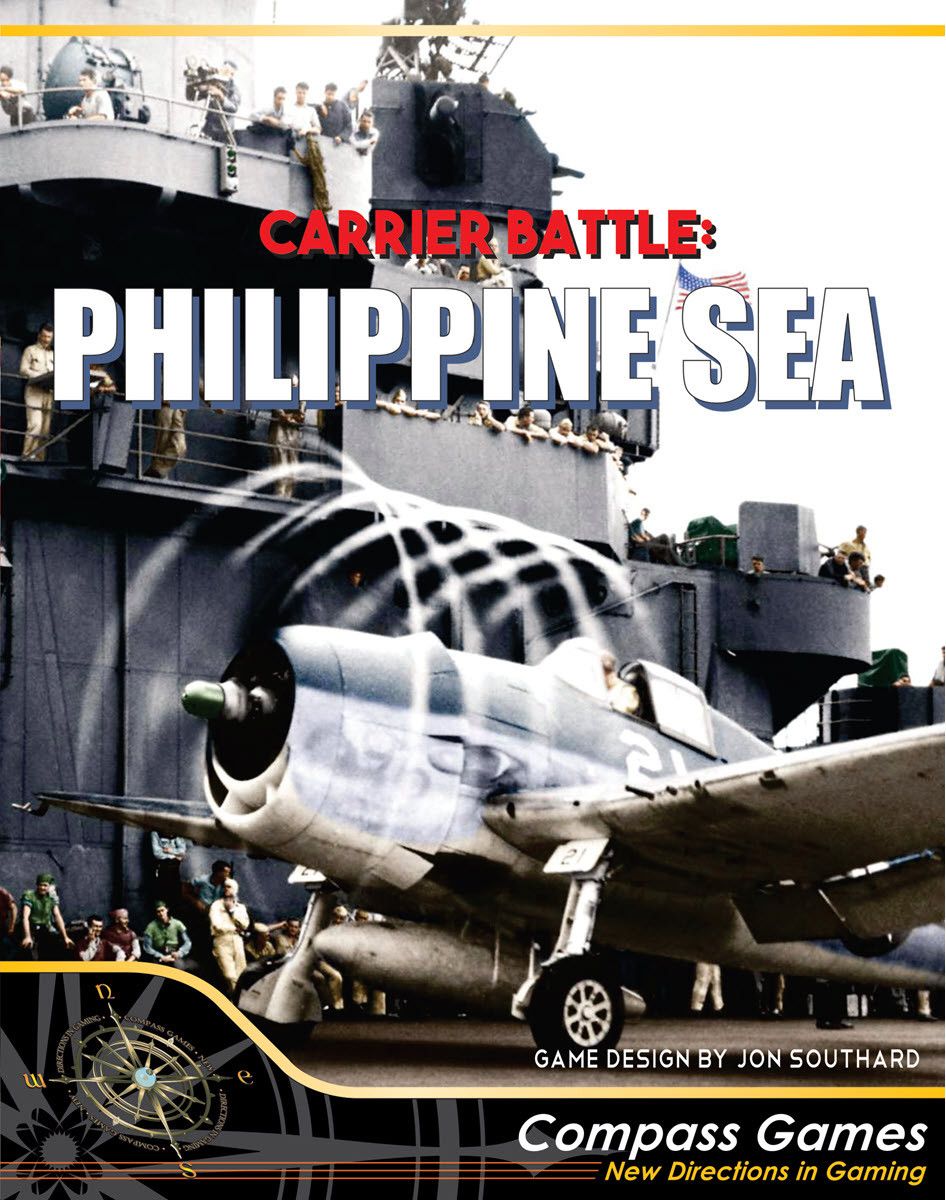
How to Play Carrier Battle: Philippine Sea
Compass Games · Board game · 2023What do you want to do now
Ask anything about Carrier Battle: Philippine Sea: rules, setup, components, complexity, price, or whether it fits your group.
Video: How to Play
Start here, then follow the written guide
Step by step
Game Objective
The objective of Carrier Battle: Philippine Sea is to simulate the Battle of the Philippine Sea, which occurred in June 1944, where the Japanese fleet attempted a decisive action against American forces. As a player, you control a US fleet and must protect the invasion fleet while facing Japanese air attacks. Victory is achieved by accumulating points according to the rules detailed in the End Game and Scoring section.
Setup
To set up the game, follow these steps:
- Game Board: Use the single game sheet with a hexagonal grid and displays for force control.
- Initial Counters: Distribute ship and aircraft counters according to the setup rules (refer to the manual for details on initial distribution).
- Cards and Tokens: Prepare the air mission cards, Butai (Japanese forces) displays, and other player aids (like the Game Turn Chart).
- Die: Use a 10-sided die (0 is considered 10).
- Each player receives all necessary pieces and aids to control their US fleet.
Game Flow
The game progresses in turns, each representing 80 minutes of real time. The flow is divided into phases and segments:
- Arrival Phase:
- Determine how many Japanese forces arrive this turn (7.1).
- Place them on the map (7.1).
- Distribute activation chits for Japanese forces and count the total in the cup.
- First Action Phase:
- Japanese Air Movement: Move all Japanese air raids (10.23).
- Japanese Force Activation: Draw activation chits and process each activated force (movement, attacks).
- If Guam is activated, conduct ground attacks (11.2).
- If rule 16.0 is used, process ground reinforcements (16.1).
- If the US submarine chit is drawn, resolve submarine actions (14.1).
- US Air Movement: Move air missions and expend fuel (4.4).
- Search Mission: Once per turn, conduct air searches (8.2-8.3).
- Air Operations: Launch, refuel, and land aircraft (6.2).
- Interception Air Combat: Resolve combats between interceptions and Japanese raids (4.5).
- US Air Attacks: Conduct attacks against Japanese forces (5.1).
- Final Action Phase: Check damage, adjust hit points, and finalize the turn (3.24).
Actions and How to Play
The player can perform the following actions:
- Air Missions:
- Attack Mission: Launch aircraft to attack detected Japanese forces (4.2).
- Interception Mission: Defend against Japanese raids (4.3).
- Movement:
- Move air missions on the map, respecting fuel limits (4.4).
- Move US surface forces (6.3).
- Combat:
- Resolve air combat (4.5) and air/naval attacks (5.1-5.6).
- Use CAP (Combat Air Patrol) to intercept raids (4.33).
- Fuel Management: Monitor air mission fuel (4.43).
End Game and Scoring
The game ends when one of the following triggers occurs:
- A Japanese force reaches intelligence level 4 (8.1).
- The player accumulates enough points to win (15.1).
Scoring is calculated based on:
- Destruction of Japanese ships and aircraft (12.0).
- Preservation of US forces (15.1).
- Mission performance (13.1).
Victory occurs if total points exceed the limit defined in the manual. Defeat is immediate if all US forces are eliminated.
Tips for Winning
- Use CAP efficiently: Maintain air patrols in your fleet's hex to intercept raids early (4.33).
- Manage fuel: Avoid missions with low fuel to prevent landing accidents (4.45).
- Prioritize detection: Increase the intelligence level of Japanese forces to improve attack accuracy (8.1).
Refer to the manual for details on this section.
More videos
More rules explanations from the community


Rules manual
Official PDF file
Frequently Asked Questions
Quick answers about the rules
What is the objective of Carrier Battle: Philippine Sea?
How do you set up Carrier Battle: Philippine Sea?
How do you play Carrier Battle: Philippine Sea?
How does Carrier Battle: Philippine Sea end, and how do you score?
What are some tips for winning Carrier Battle: Philippine Sea?
Other Games You'll Like
Based on mechanics and theme