Concept — Price & soundtrack
Repos Production, ADC Blackfire Entertainment, asmodee · Board game · 2013
4–12 · best 6
40 min
Weight 1.4/5
Buy · from US$ 26.56
7.5
rating
Ludopedia
6.7
rating
BGG
Our Verdict
RECOMMENDED
Perfect for parties and large groups who enjoy logic and association challenges. It's like a modern 'Pictionary' but without the mess of paper and pens.
Highlights
- Super intuitive association mechanics
- Supports large groups (up to 12 players)
- Stimulates lateral thinking
- Fast and fluid game dynamics
Keep in mind
- Language dependency for the cards
- Some icons can be ambiguous
Rules manual not indexed yet
Upload the PDF rulebook to ask questions about this game with AI.
About the game
What you do in a play session
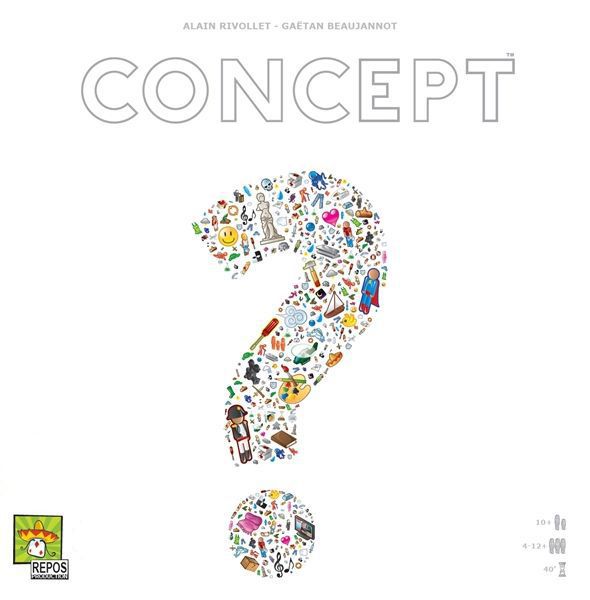
Ever wondered how to explain who Leonardo DiCaprio is without saying a single word, without charades, and without drawing? That's exactly what Concept does, and it does it brilliantly. Instead of speaking, you use a board filled with icons representing categories, colors, shapes, and concepts. The goal is straightforward: guess the secret word or phrase through the association of these images.
Here's how it works: two players (sitting side-by-side) form the 'clue-giving' team. They pick a concept and start placing colored cubes on the board's icons to guide the other players. If the word is 'milk', they might place the question mark marker (indicating the main concept) on the 'liquid' icon, then use cubes to point toward 'white' and 'food/drink'. The rest of the group then starts shouting guesses until someone hits the mark.
The game scales in complexity as the challenges get tougher. For more abstract ideas, the duo can use sub-concepts. Want to explain a famous actor? First, you indicate it's a person, then that they are in cinema, and then you start giving clues about specific movies they starred in, such as 'Titanic' or 'Inception'. It's a fascinating mental exercise that turns communication into a visual puzzle.
Scoring is dynamic: the first person to guess the word gets the most points, but the clue-giving team also earns points for their efficiency. In the end, the player with the most points wins. It's the perfect kind of game for when you want to gather a large crowd, as it supports up to 12 people, turning the room into a giant debate of deductions and laughter. It's intuitive, quick to learn, and sparks funny discussions about how different people associate ideas.
Here's how it works: two players (sitting side-by-side) form the 'clue-giving' team. They pick a concept and start placing colored cubes on the board's icons to guide the other players. If the word is 'milk', they might place the question mark marker (indicating the main concept) on the 'liquid' icon, then use cubes to point toward 'white' and 'food/drink'. The rest of the group then starts shouting guesses until someone hits the mark.
The game scales in complexity as the challenges get tougher. For more abstract ideas, the duo can use sub-concepts. Want to explain a famous actor? First, you indicate it's a person, then that they are in cinema, and then you start giving clues about specific movies they starred in, such as 'Titanic' or 'Inception'. It's a fascinating mental exercise that turns communication into a visual puzzle.
Scoring is dynamic: the first person to guess the word gets the most points, but the clue-giving team also earns points for their efficiency. In the end, the player with the most points wins. It's the perfect kind of game for when you want to gather a large crowd, as it supports up to 12 people, turning the room into a giant debate of deductions and laughter. It's intuitive, quick to learn, and sparks funny discussions about how different people associate ideas.
Gallery
Box and component photos
Tap any photo to open fullscreen. Photos submitted by the community or publisher.
Rules videos
Learn by watching before you open the box
In English
-
 Concept: Rules and Gameplay
-
 How To Play Concept - Roll For Crit
-
 Concept - Tutorial
-
 Concept - Part 2: how to play [JLTEI]
-
 How to Play - Concept - The Games Capital
-
 Concept - Part 1: game set up [JLTEI]
-
 Concept in the Classroom: An Instructor and Student Tutorial
-
 How to play Concept!
-
 Concept - Refresher on How to Play // Cosmic Tavern
-
 How to Play Concept [Rum and Board]
-
 Concept Rules & Play-Through
-
 How To Play
Best player count
BGG community vote
4
REC
5
REC
6
BEST
7
REC
8
BEST
9
REC
10
REC
11
REC
12
OK
Soundtrack
Ambience suggested by Melodice
Loading playlist...
Where to Buy
Prices monitored daily
Finding best prices...
Prices unavailable at this time.
Price history — last 6 months (lowest new offer)
Alert enabled!
Join the BoardGamesBot deals group
Get the best board game deals every day — without message spam.
Join the WhatsApp groupGame details
Mechanics, categories, families and credits
Mechanics
Categories
Families
Publisher
Repos Production, ADC Blackfire Entertainment, asmodee, Asterion Press, Galápagos Jogos, Gémklub, Hobby Japan, Kaissa Chess & Games, Korea Boardgames, Lautapelit.fi, Lifestyle Boardgames Ltd, Rebel Sp. z o.o., Rozum, Sombreros Production
Designer
Alain Rivollet, Gaëtan Beaujannot
Artist
Cédric Chevalier, Éric Azagury
Community
Data from BoardGameGeek
38,014owners
2,855wishlist
208want to play
Frequently Asked Questions
Quick answers before you buy
Is the game hard to learn?
Not at all! The rules are very simple, and most people grasp the logic within the first two minutes of play.
How many people can play?
From 4 to 12 players. It's ideal for those who want to involve a whole crowd in a single activity.
How long does a game last?
Around 40 minutes, but since it's a party game, you can adjust the duration based on the number of words used.
Is there a language barrier?
The word cards are often in English, so you might need a translated list or someone to translate them on the fly.
Is it suitable for children?
Yes, as long as they have a basic understanding of categories and associations. It's great for boosting kids' vocabulary.
Is the game complex?
No, the weight is low. The challenge isn't in the rules, but in the creativity of the clues and the speed of the guesses.
Other Games You'll Like
Based on mechanics and theme